AI and Data in Vertical Farming: The Maedcore + Tierra Case Study
Maedcore and Tierra optimise vertical farms with real-time data analysis: IoT sensors, dashboards and agricultural BI. A real success story.

Written by Eduardo Fuentevilla Blanco
Robotics Engineer at Maedcore · Robotics Engineer LinkedIn ↗
The Challenge: Managing the Complexity of an Urban Vertical Farm
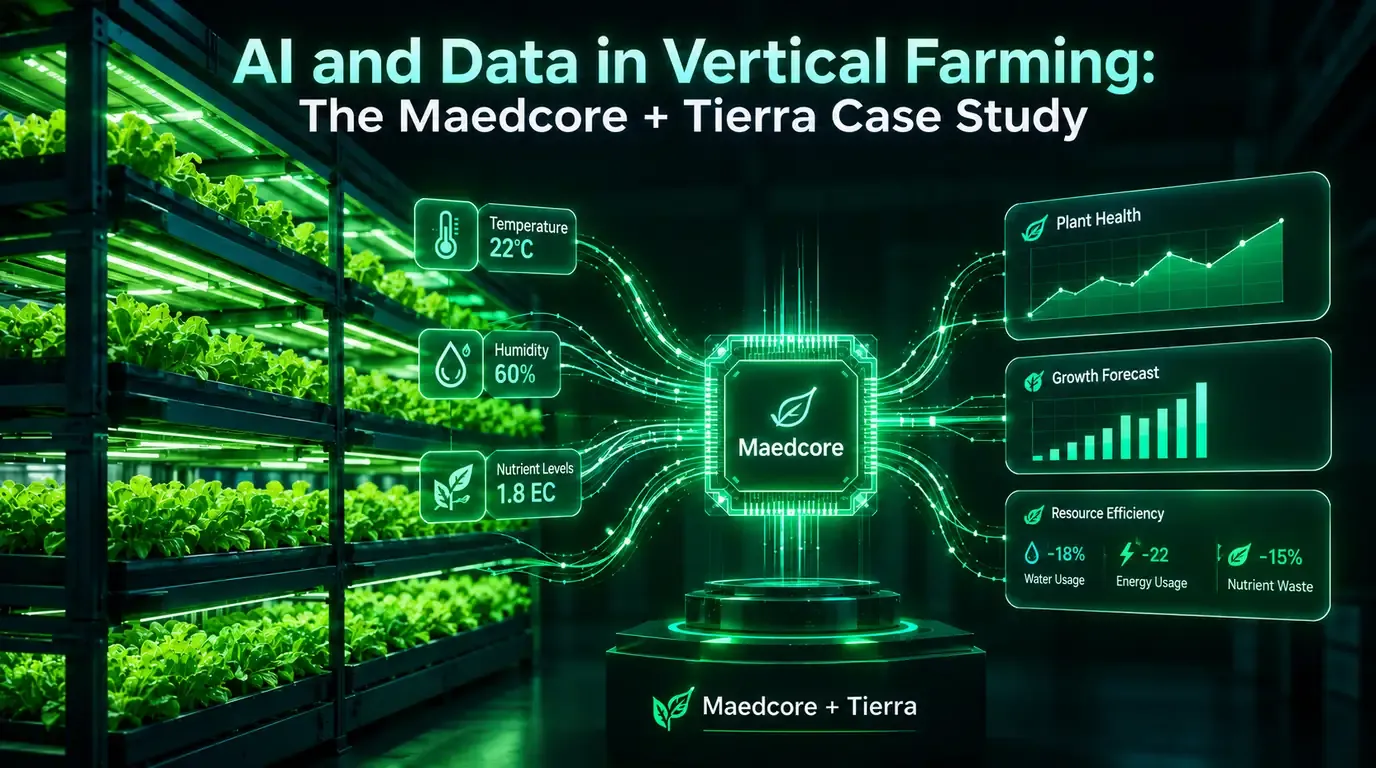
Vertical farming — growing food in stacked layers inside controlled buildings — promises to revolutionise urban food production. However, its efficiency depends on precise control of dozens of simultaneous variables: temperature, light, CO₂, humidity, water pH, nutrients and more. Without advanced technology, this complexity is unmanageable at scale.
Tierra, a leader in sustainable vertical farming, needed a technological solution that went beyond simple sensor control: a platform that connected the farm’s physical data with business intelligence.
The Solution: The Maedcore + Tierra OS Technology Stack
Tierra OS: Comprehensive Agricultural Business Management
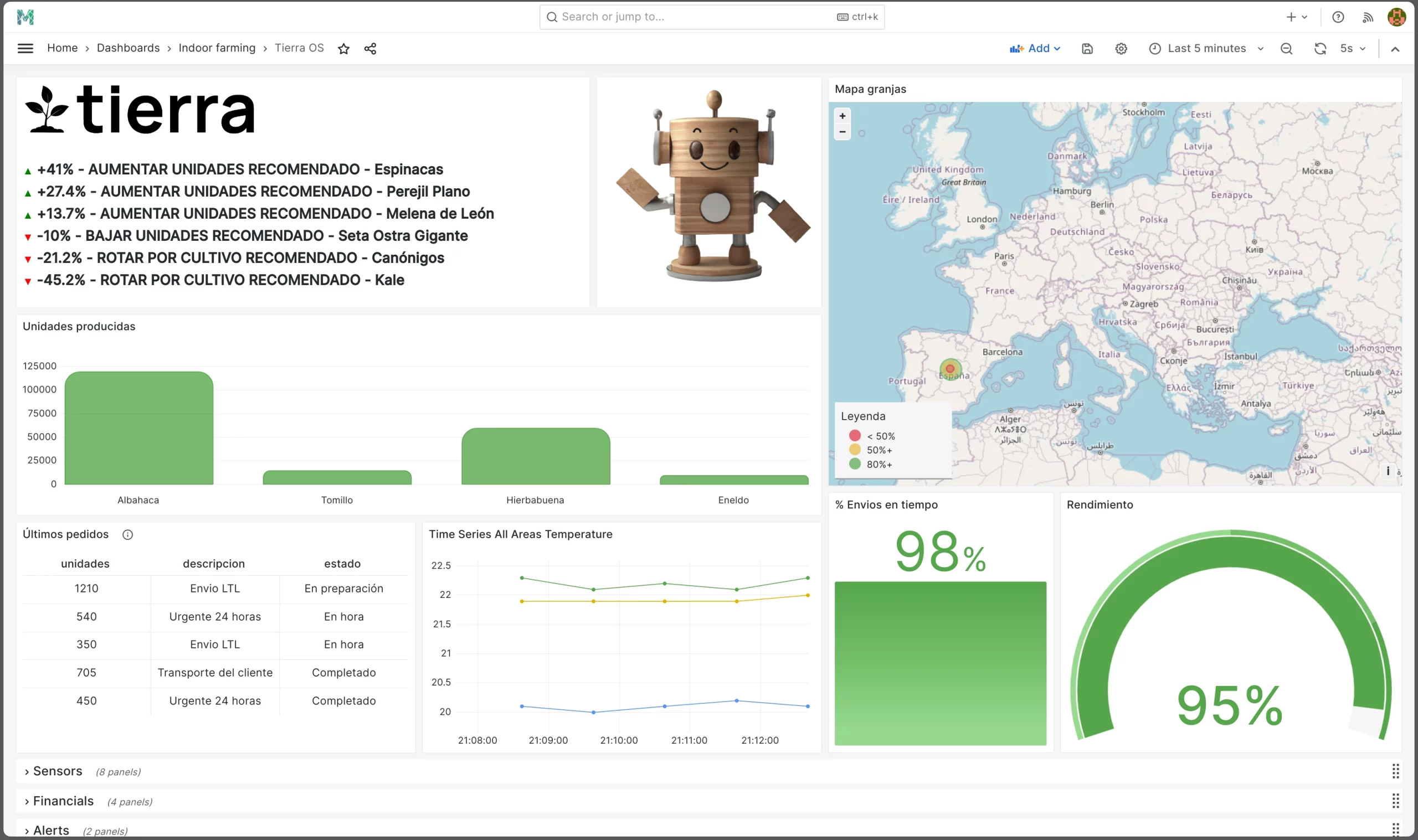
Tierra OS is Tierra’s agricultural operating system. It controls all production and business variables: raw material sourcing, market trend tracking, client-specific production customisation and order management. It is the organisational brain of the farm.
Maedcore Software: IoT Monitoring and Business Intelligence
Maedcore’s technology layer complements Tierra OS with two modules:
Module 1 — Real-Time Monitoring:
Continuously tracks and manages the critical physical conditions of each growing level:
- Ambient temperature and humidity
- Light intensity and spectrum
- Water pH and electrical conductivity
- CO₂ and O₂ levels
Automatic alerts notify deviations before they affect crops, reducing production losses.
Module 2 — Business Data Analysis:
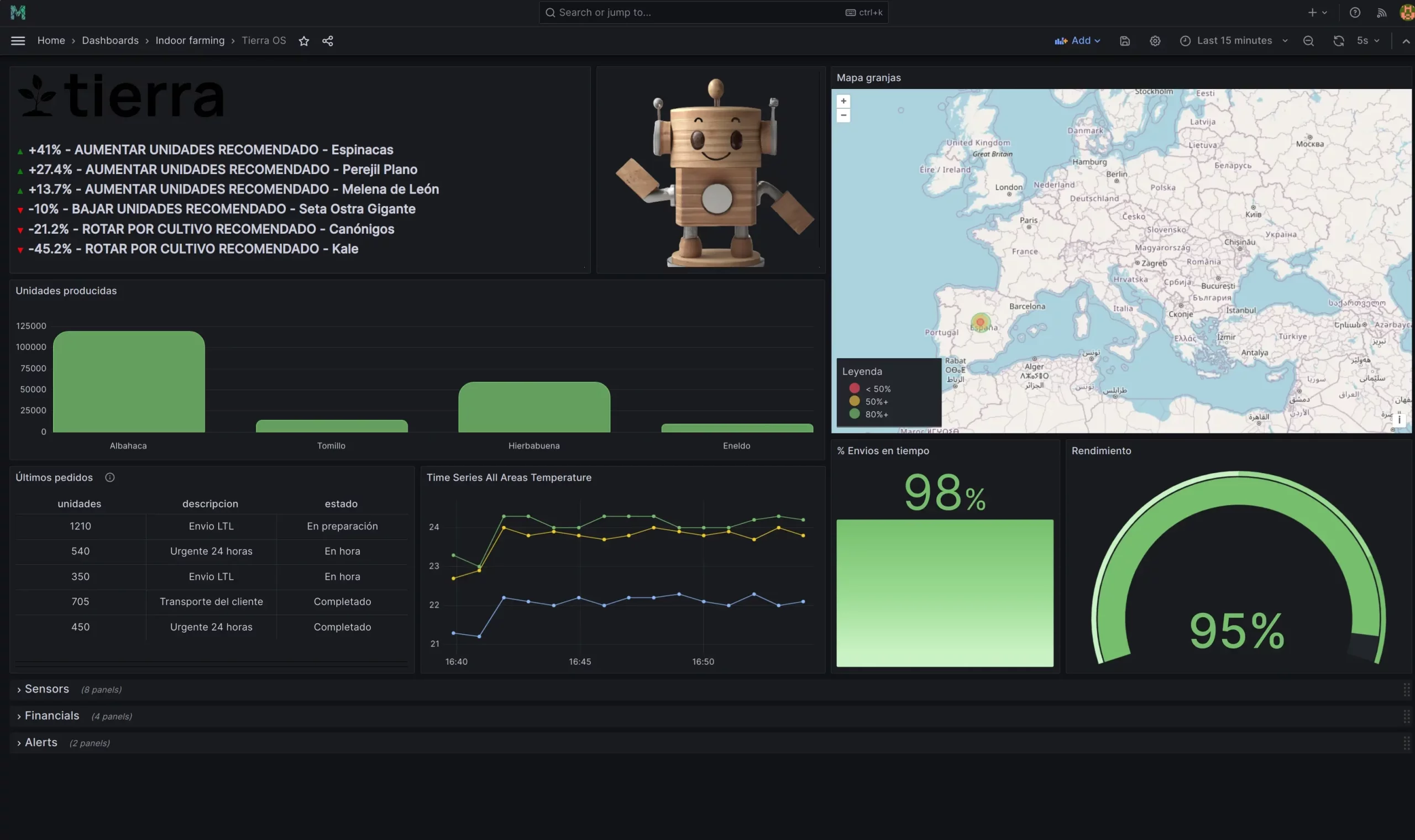
Beyond physical sensors, the platform aggregates and analyses business data:
- Sales and revenue by crop and period
- Customer base and demand patterns
- Quantities produced vs. targets
- Performance by variety and growing cycle
This makes it possible to identify which crops are most profitable, anticipate demand and adjust production weeks in advance.
Results: Measurable Benefits of Data in Vertical Farming
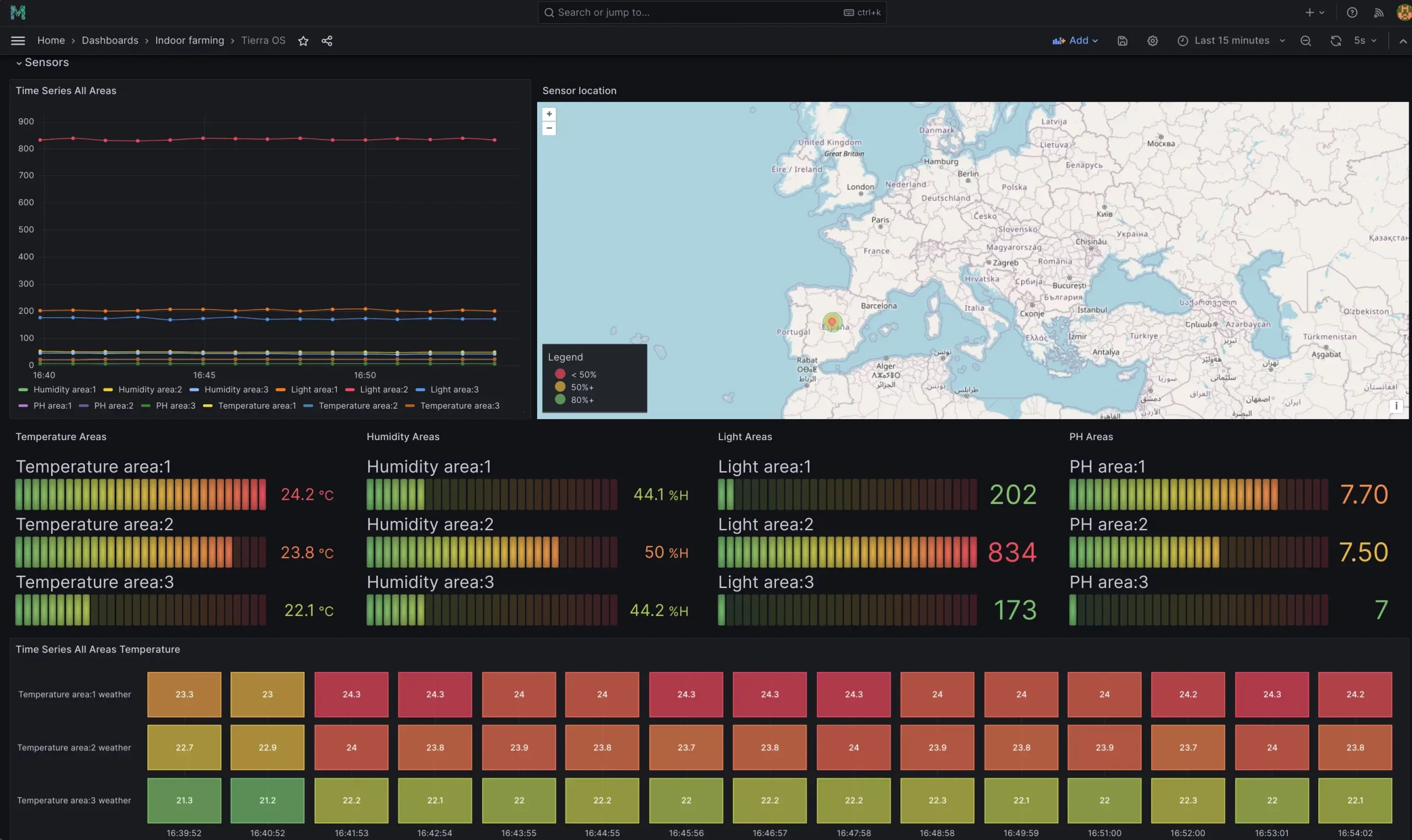
The deployment of this integrated solution delivers quantifiable benefits across three dimensions:
Operational Efficiency: Comprehensive control of growing conditions ensures a consistently optimal environment, eliminating deviations that previously required manual intervention. Farm technicians shift from reacting to problems to preventing them.
Production Optimisation: Analysing historical demand patterns allows adjustment of what and how much to grow, reducing food waste and maximising margins per harvest.
Strategic Decision-Making: Tierra’s management team has consolidated data in a single dashboard to make production, marketing and expansion decisions based on evidence, not intuition.
Inside the Data Pipeline: From Sensor to Insight
The value of a vertical farm’s data only emerges if it moves cleanly from the growing module to a decision. The architecture behind the Maedcore monitoring layer follows four stages:
- Acquisition. Sensor arrays on each growing level — temperature, humidity, PAR light, pH, electrical conductivity, CO₂ and O₂ — sample continuously. Each reading is tagged with its zone and timestamp so the data is queryable by location and time.
- Ingestion and storage. Readings stream over the farm’s network into a time-series store. Time-series structure matters here: crop conditions are only meaningful as trends, and storing them this way makes “show me pH drift in module 3 over the last 14 days” a cheap query rather than a batch job.
- Thresholds and alerts. Each variable has per-zone alert bands. When a reading crosses a band — pH drifting out of range, a temperature spike — the system flags it immediately, which is what shifts technicians from reacting to preventing.
- Aggregation and business intelligence. Physical readings are joined with business data (yield, sales, demand) in a single dashboard, so a grower can see not just that a module deviated, but what it cost in yield.
From Monitoring to Prediction
Threshold alerts catch problems as they appear. The next layer is anticipation. Once enough growing cycles are recorded, the historical series becomes training data: models learn the normal trajectory of a healthy crop and can flag a deviation — early plant stress, a drift toward sub-optimal conditions — before it is visible to the eye, and estimate the optimal harvest window from the conditions accumulated over the cycle. This is the same progression we apply in industry: start with reliable monitoring, then layer prediction on top of the history it generates. Prediction is not the starting point; it is what the data earns once the monitoring foundation exists.
Market Context: The AgriTech Opportunity
The global vertical farming market will reach $35 billion by 2028, driven by urbanisation, climate change and growing demand for fresh, locally grown food. The enabling technologies — agricultural IoT, artificial intelligence, data analytics and automation — will determine which operators manage to scale profitably.
The Maedcore–Tierra partnership is an example of how data technology turns a vertical farm into a scalable and competitive business.
Related reading
The same data-engineering discipline behind this analysis powers our industrial projects — see the radiation inspection software we built for Enusa, and explore our AI & software services.
About the Author
Robotics Engineer
For over a decade, I have been driven by a single mission: leveraging AI and robotics to build a world of automated production. I believe that by creating self-sufficient systems, we can empower people to refocus on what truly matters—their families and their passions. My expertise spans from winning prestigious European startup competitions to architecting complex, integrated hardware and software projects. I specialize in bridging the gap between today's industrial challenges and tomorrow's autonomous solutions.
Frequently Asked Questions
How is AI used in vertical farming?
What sensors are used to monitor crops in vertical farms?
What measurable results can AI deliver in vertical farming?
What is the Maedcore + Tierra vertical farming project?
Can small vertical farms afford AI monitoring systems?
Ready to transform your company?
Book a free 30-minute meeting with an engineer.