Predictive Maintenance with AI: How to Prevent Breakdowns Before They Happen
Reduce breakdowns and costs with AI-powered predictive maintenance. IoT sensors, machine learning and real-time data analysis for industry.

Written by Eduardo Fuentevilla Blanco
Robotics Engineer at Maedcore · Robotics Engineer LinkedIn ↗
What Is Predictive Maintenance?
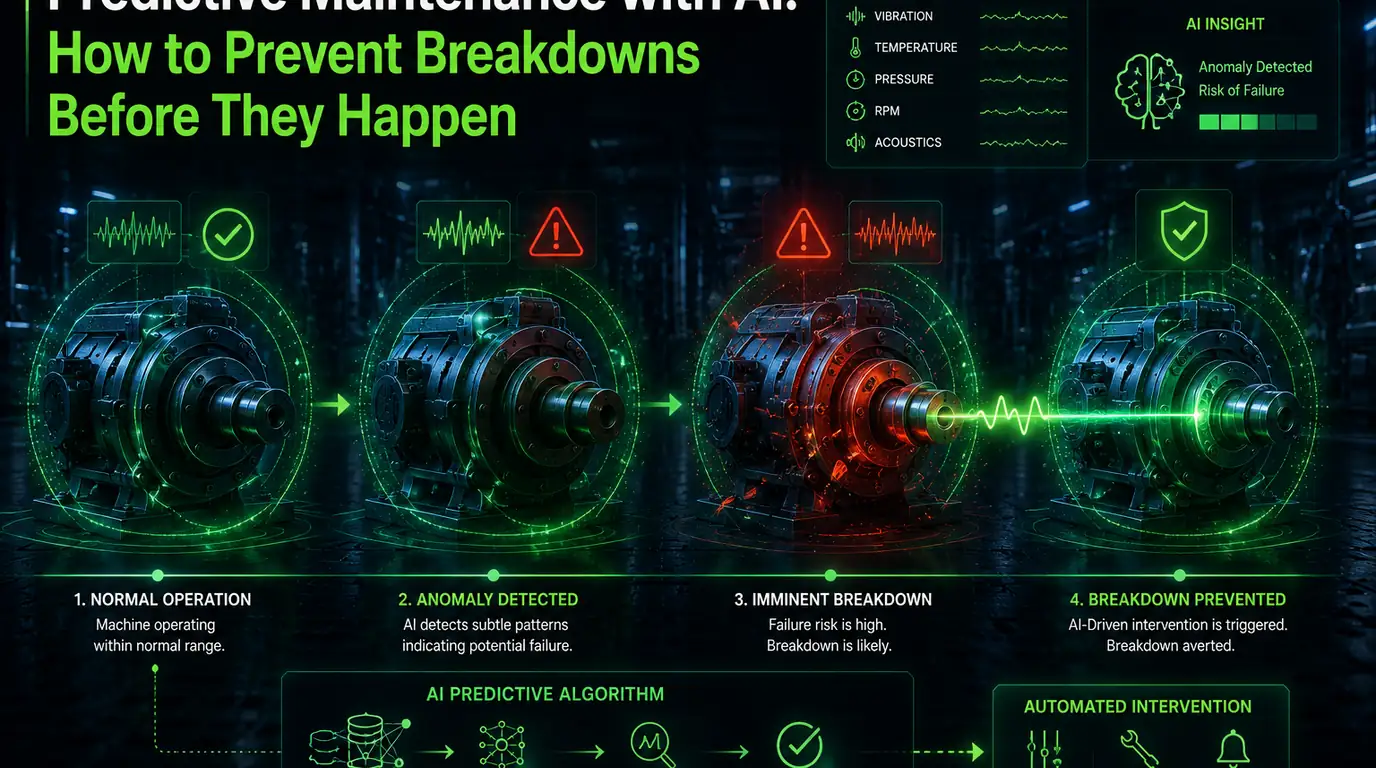
Predictive maintenance is an industrial asset management strategy that combines IoT sensors, machine learning and big data to monitor the condition of machines in real time. Unlike corrective maintenance (acting after a breakdown) or preventive maintenance (acting on a fixed schedule), predictive maintenance intervenes precisely when the data indicates it is necessary.
The most commonly monitored variables include:
- Vibrations and noise — early indicators of mechanical wear.
- Temperature — a sign of overload or lubrication failure.
- Energy consumption — anomalies reveal inefficiencies or imminent failures.
- Pressure and flow rate — critical in hydraulic and pneumatic systems.
How It Works: From Sensor to Decision
1. Data Capture with IoT Sensors
Sensors installed in machinery continuously send data to a centralised platform. Sampling frequency can range from milliseconds to minutes depending on the criticality of the equipment.
2. Processing with Machine Learning
Machine learning algorithms analyse time series data to detect anomalous patterns. Models such as LSTM neural networks or anomaly detection algorithms (Isolation Forest, Autoencoders) learn the normal behaviour of the equipment and raise alerts when deviations occur.
3. Real-Time Dashboard and Alerts
Results are displayed on control panels that allow technicians to see the status of all assets at a glance, receive alerts before a failure occurs and plan interventions during scheduled maintenance windows.
4. Continuous Model Improvement
Each intervention feeds back into the system: post-maintenance data refines the predictive model, increasing its accuracy over time.
Quantifiable Benefits for Industry
| Indicator | Reactive Maintenance | Predictive Maintenance |
|---|---|---|
| Unplanned downtime | High | Reduction of up to 50% |
| Repair costs | High | Reduction of up to 30% |
| Asset lifespan | Standard | Extended ~20% |
| Workplace safety | Variable | Improved (fewer critical breakdowns) |
Sectors with the Highest Adoption
Predictive maintenance with AI is transforming in particular:
- Manufacturing and automotive — assembly lines and industrial robotics.
- Energy — wind turbines, photovoltaic plants and electricity grids.
- Oil & Gas — pipelines, compressors and offshore platforms.
- Transport and logistics — vehicle fleets and conveyor belts.
- Food and beverage — production equipment and cold storage chambers.
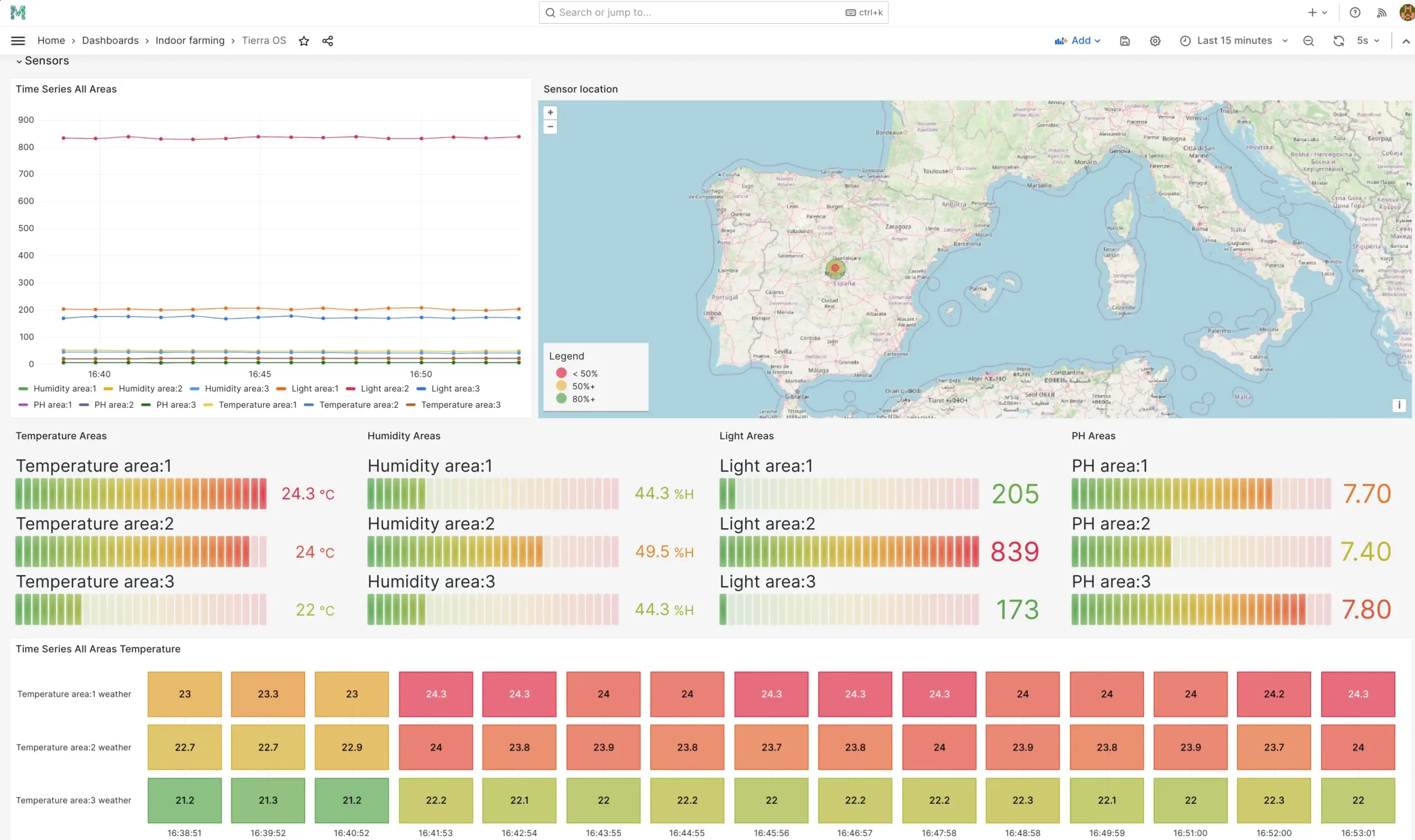
This is what the sensor-to-decision pipeline looks like in practice: a live dashboard from a real deployment of our Mapper platform, aggregating readings from every monitored zone into one view with per-variable alert thresholds.
Which Sensor Detects Which Failure
There is no single “predictive maintenance sensor.” Each failure mode announces itself through a different physical signal, so the sensor selection follows directly from the failure modes that matter for a given asset. This mapping is the starting point of any deployment:
| Failure mode | Primary signal | Sensor |
|---|---|---|
| Bearing wear, misalignment, imbalance | Vibration signature | Accelerometer (vibration) |
| Overload, lubrication failure, friction | Heat rise | Temperature probe / thermal camera |
| Electrical faults, motor degradation | Current/power draw anomalies | Energy / current meter |
| Leaks, blockages in hydraulics & pneumatics | Pressure or flow deviation | Pressure / flow sensor |
| Early-stage crack propagation | High-frequency stress waves | Acoustic emission sensor |
| Lubricant contamination / breakdown | Particle count, viscosity | Oil quality analyser |
Choosing the right signal is what separates a system that catches real failures from one that floods technicians with false alerts. The audit at the start of a project exists precisely to answer “what fails on this machine, and how would we see it coming?”
The P-F Curve: Why Early Detection Matters
The value of predictive maintenance is best understood through the P-F curve — the interval between the point where a failure becomes detectable (P) and the point where it results in functional failure (F).
Different signals appear at different points on this curve. Acoustic emission and oil analysis often detect a developing fault weeks or months out; vibration changes appear later; audible noise and heat are last-stage warnings, sometimes only days before failure. The earlier on the curve you detect, the more time you have to plan an intervention during a scheduled window instead of reacting to an emergency stop. This is why a mature system layers several signals rather than relying on one — each extends the warning horizon.
Implementation: Key Success Factors
A successful predictive maintenance deployment requires:
- Critical asset inventory — identify which machines justify the investment in sensors.
- Connectivity infrastructure — industrial WiFi, 5G or LoRaWAN depending on the environment.
- Historical data quality — the more past failure data available, the better the model training.
- Integration with the CMMS — connect alerts with the work order system.
- Technical team training — operators must trust the system’s recommendations.
Frequently Asked Questions
How long does it take to implement a predictive maintenance system? It depends on complexity, but a pilot on a production line can be operational within 8–12 weeks.
Is it necessary to replace all existing machinery? No. IoT sensors are installed on existing equipment without any need to modify it.
How does it compare with preventive maintenance in cost terms? We’ve published a full data-driven comparison: predictive vs. preventive maintenance — cost and ROI.
Related reading
- Predictive vs. Preventive vs. Corrective Maintenance — the cost and ROI comparison that decides which strategy fits which asset.
- Prescriptive Maintenance — the step past prediction: from sensor reading to an actual work order.
- Industrial Machinery Maintenance — why the constraint moved from the inspection visit to manual post-processing.
- Automated Visual Inspection — what accuracy is realistic, and the three gates a vision system has to clear first.
- Digital Work Orders — closing the loop: how the job gets assigned, executed and traced without paper.
- Maedcore — Mechatronics — what we build in this area.
About the Author
Robotics Engineer
For over a decade, I have been driven by a single mission: leveraging AI and robotics to build a world of automated production. I believe that by creating self-sufficient systems, we can empower people to refocus on what truly matters—their families and their passions. My expertise spans from winning prestigious European startup competitions to architecting complex, integrated hardware and software projects. I specialize in bridging the gap between today's industrial challenges and tomorrow's autonomous solutions.
Frequently Asked Questions
What is predictive maintenance with AI?
What sensors are used in AI predictive maintenance?
Do I need machine learning from day one?
How long does it take to implement an AI predictive maintenance system?
Which industries benefit most from predictive maintenance?
Ready to transform your company?
Book a free 30-minute meeting with an engineer.