Artificial Intelligence Applications in Business: The 6 Most Impactful in 2026
From chatbots to autonomous vehicles: the 6 most impactful AI applications for businesses in 2026. Real cases, sectors and how to implement them.

Why AI Is a Priority for Businesses in 2026
Artificial intelligence (AI) is no longer a technology of the future: it is the most powerful productivity and differentiation lever available today. From machine learning and natural language processing (NLP) to computer vision and generative models, the AI ecosystem offers concrete solutions for the most common challenges any organisation faces.
Below are the six applications with the greatest demonstrated impact.
1. Process Automation (RPA + AI)

Robotic process automation (RPA) powered by AI allows companies to delegate to software the repetitive tasks that previously required constant human intervention: invoice processing, order management, responding to frequent queries via chatbots, or updating inventory.
The most common results include:
- Reduction of operational errors by 70–90%.
- Acceleration of process cycles from hours to minutes.
- Freeing up human teams for higher-value strategic tasks.
Key technologies: RPA (UiPath, Automation Anywhere), NLP, language models (LLMs).
2. Data Analysis and Predictions
AI’s ability to analyse large volumes of data in real time and extract patterns is one of its greatest differentiators. Predictive analytics allows businesses to:
- Anticipate demand trends and adjust production or stock.
- Detect fraud in financial transactions before it consolidates.
- Predict customer churn and trigger proactive retention.
- Dynamically optimise prices based on market conditions.
In the financial sector, AI algorithms analyse market behaviour to identify risk signals with a speed and precision impossible for human analysts.
Key technologies: Scikit-learn, TensorFlow, time series models (LSTM, Prophet), AI-powered BI platforms (Power BI Copilot, Tableau AI).
3. Personalised Customer Service

Recommendation systems and conversational virtual assistants are the most visible AI applications for end consumers. Platforms such as Amazon and Netflix have shown that AI-based personalisation significantly increases conversion and customer loyalty.
In the B2B space, advanced chatbots and AI agents handle first-level support, qualify leads and answer complex queries 24/7, reducing the cost per contact and improving response times.
4. Medical Diagnosis and Healthcare

In medicine, AI is revolutionising the early diagnosis of diseases. Using deep learning and computer vision techniques, systems analyse medical images (X-rays, MRIs, dermatoscopies) with diagnostic accuracy comparable to or exceeding that of specialists in specific pathologies.
Other healthcare use cases include:
- Prediction of hospital readmissions.
- Genomic analysis for personalised medicine.
- Optimisation of emergency workflows.
- Accelerated drug discovery.
5. Manufacturing and Predictive Maintenance
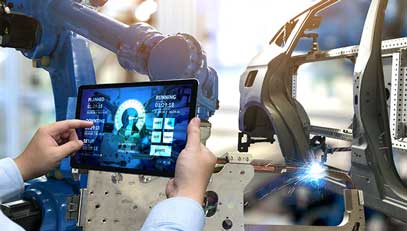
In the industrial environment, AI operates on two complementary fronts:
Production optimisation: Collaborative robots (cobots) with computer vision inspect quality inline, detecting defects invisible to the human eye and reducing rework.
Predictive maintenance: IoT sensors combined with machine learning models predict machinery failures before they occur, eliminating unplanned downtime. Companies that implement it reduce maintenance costs by 25–30%.
6. Autonomous Vehicles and Smart Mobility
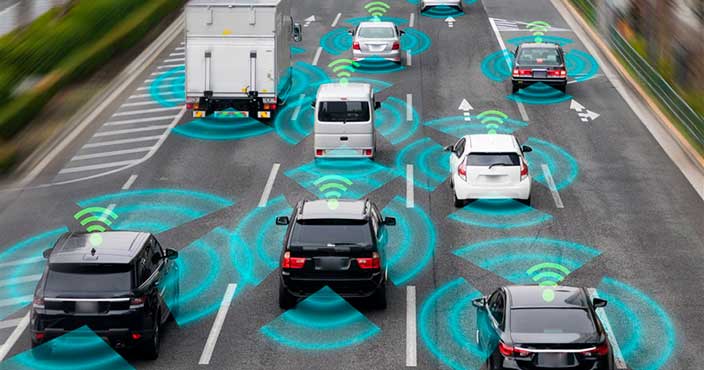
Autonomous vehicles are the most complex and visible AI application in public spaces. They combine LiDAR, radar, cameras and fusion sensors with real-time decision-making algorithms to navigate complex environments without human intervention.
Beyond self-driving cars, AI is transforming logistics with automated guided vehicles (AGVs) in warehouses, delivery drones and intelligent urban traffic management systems.
How to Get Started with AI in Your Business
There is no need to tackle all applications at once. A pragmatic three-step approach:
- Identify the highest-impact use case — where is there the most friction, cost or human error in your current processes?
- Validate with a scoped pilot — before scaling, test the solution in a specific department or process.
- Measure and scale — define clear KPIs from the outset and only scale what demonstrates ROI.
Ready to transform your company?
Book a free 30-minute meeting with an engineer.