AI Award: Best Solution for Low-Emission Zones
Maedcore wins €40,000 at the AI and Advanced Technologies Awards with its AI and IoT-powered parking management platform for Low-Emission Zones.

Written by Eduardo Fuentevilla Blanco
Robotics Engineer at Maedcore · Robotics Engineer LinkedIn ↗
The Award: Recognition for Innovation in Urban Mobility
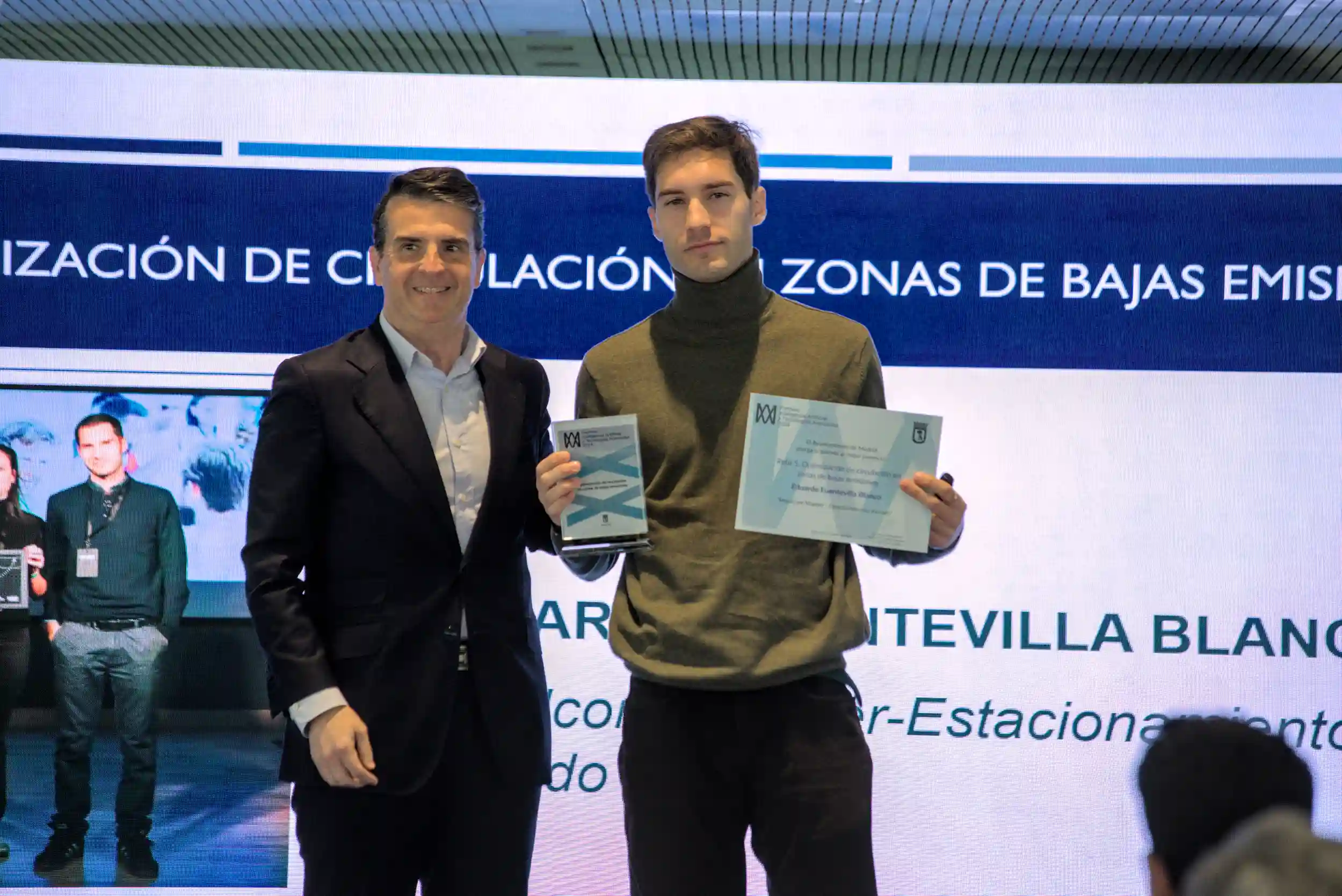
At the 3rd edition of the Artificial Intelligence and Advanced Technologies Awards, Maedcore won the prize for the best technological solution in the category of Traffic Optimisation in Low-Emission Zones (LEZ). The award, endowed with €40,000, recognises projects that use AI and advanced technologies to reduce the environmental impact of urban transport. The programme is backed by the Ayuntamiento de Madrid and Madrid Innovación, which support AI initiatives addressing the city’s mobility and sustainability challenges.
The Platform: How the Solution Works
Technology Architecture
The platform integrates three complementary technology layers:
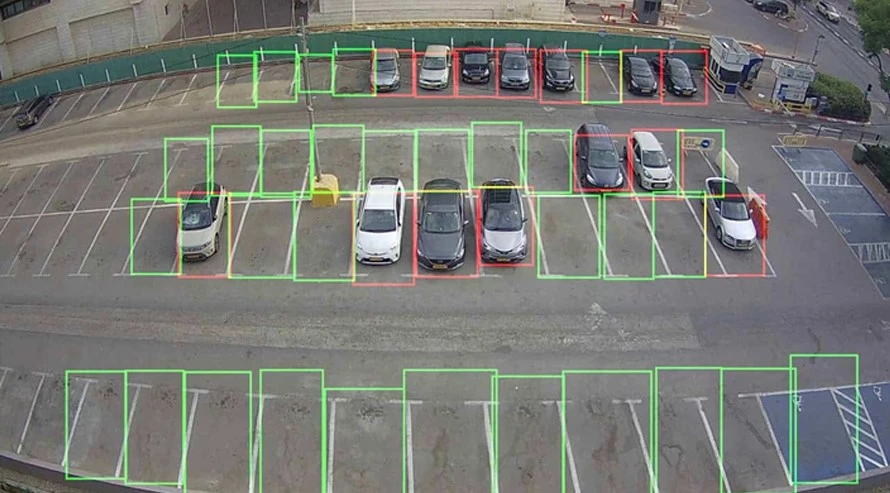
Capture layer — IoT Sensors and Computer Vision: A system of IP cameras installed in parking zones feeds a computer vision engine that detects in real time whether each space is occupied or free, the type of vehicle (electric, hybrid, combustion) and whether LEZ restrictions are being observed.
Intelligence layer — Machine Learning and Big Data: Occupancy data is processed by machine learning algorithms that predict future space availability based on historical data, time of day, day of the week and local events. This allows drivers to be guided not only towards currently free spaces, but towards spaces that will be free by the time they arrive.
Experience layer — App and Integration API:
Drivers access information through a dedicated mobile application or via integration with third-party navigation apps. The platform has an open API compatible with Waze, Google Maps and Easypark, maximising reach without friction for the end user.
Inside the Computer Vision Pipeline
Turning a camera feed into a reliable “free / occupied / which vehicle type” signal is the hard part of the capture layer. The pipeline runs in stages:
- Space definition. Each parking bay is mapped once as a region of interest in the camera frame, so the model reasons about defined spaces rather than raw pixels.
- Detection. A computer-vision model locates vehicles in each frame and classifies the type — combustion, hybrid, or electric — using visible cues such as plate badging and vehicle characteristics.
- Occupancy logic. Detections are matched to the mapped bays to decide occupancy, with temporal smoothing across consecutive frames so a pedestrian crossing or a brief occlusion does not flip a space’s state.
- Edge-first processing. Running inference close to the camera keeps only the resulting state (occupied/free/type) flowing to the cloud rather than raw video — which reduces bandwidth and avoids storing footage of public space.
The same perception pattern — define regions, detect, classify, smooth over time — is what we reuse in industrial inspection and quality-control vision systems.
How Compliant Routing Works
LEZ rules are not static: they vary by time of day, vehicle emissions standard, and zone. The routing engine treats the city as a network graph and overlays the current restrictions onto it, so that edges forbidden to a given vehicle at a given time are excluded before the search runs. A shortest-path search (in the A*/Dijkstra family) then finds the fastest compliant route, and re-evaluates automatically when the regulation database changes. The result is that compliance becomes a property of the route itself rather than something a driver has to check manually.
Benefits: Impact on Mobility, the Environment and Logistics
For Private Drivers
- Reduced parking search time — the average search time in dense cities can exceed 20 minutes. The platform dramatically reduces this.
- Lower CO₂ emissions — less time circulating means less fuel consumed and less pollution.
- Incentive system — the use of electric and hybrid vehicles is encouraged through benefits and advantages within the platform.
For Logistics and Freight Transport
The solution includes a dedicated module for the dynamic management of loading and unloading zones. The system intelligently assigns time windows and spaces, minimising the impact of delivery traffic in LEZs and facilitating mobility for transport operators.
For Local Authorities and Institutions
The business model is scalable and subscription-based for municipal authorities and logistics companies. Local councils gain:
- Real-time data on the use of their LEZs.
- Tools to verify compliance with restrictions.
- Measurable environmental impact indicators for sustainability reports.
Traffic and Environmental Improvement: Impact Data
Deployment of the platform in urban pilots has demonstrated:
- Reduction in parking search time of up to 60%.
- Decrease in vehicles circulating in LEZs looking for spaces of up to 25%.
- Increase in the use of loading/unloading zones within assigned time windows of 40%.
The Vision: Cleaner, More Efficient Cities
“This recognition drives us to continue developing intelligent solutions that contribute to cleaner and more efficient cities.” — Eduardo Fuentevilla Blanco, CEO of Maedcore
With plans to expand to various European cities, Maedcore is positioning this platform as a key technological infrastructure for the transition towards sustainable urban mobility. Integration with public transport systems, autonomous vehicles and city digital twins is the next horizon.
Related reading
This platform applies the same data-and-AI engineering behind our other industrial projects — see the radiation inspection software for Enusa for real-time data visualisation in a regulated environment, and our guide to predictive vs. preventive maintenance for AI-driven decision systems. Explore the full AI & software services.
About the Author
Robotics Engineer
For over a decade, I have been driven by a single mission: leveraging AI and robotics to build a world of automated production. I believe that by creating self-sufficient systems, we can empower people to refocus on what truly matters—their families and their passions. My expertise spans from winning prestigious European startup competitions to architecting complex, integrated hardware and software projects. I specialize in bridging the gap between today's industrial challenges and tomorrow's autonomous solutions.
Frequently Asked Questions
What are low-emission zones and how does AI help manage them?
What award did Maedcore win for its LEZ AI solution?
How can AI optimize vehicle routing for LEZ compliance?
Which cities in Spain have low-emission zones?
Ready to transform your company?
Book a free 30-minute meeting with an engineer.