25-Channel Embedded Electronics: Real-Time Sensor-Driven Display System
Maedcore engineers a 25-channel display control system with ultrasonic proximity and capacitive touch sensors, deterministic timing, and real-time response.

Written by Eduardo Fuentevilla Blanco
Robotics Engineer at Maedcore · Robotics Engineer LinkedIn ↗
25-Channel Embedded Electronics: Real-Time Sensor-Driven Display Control
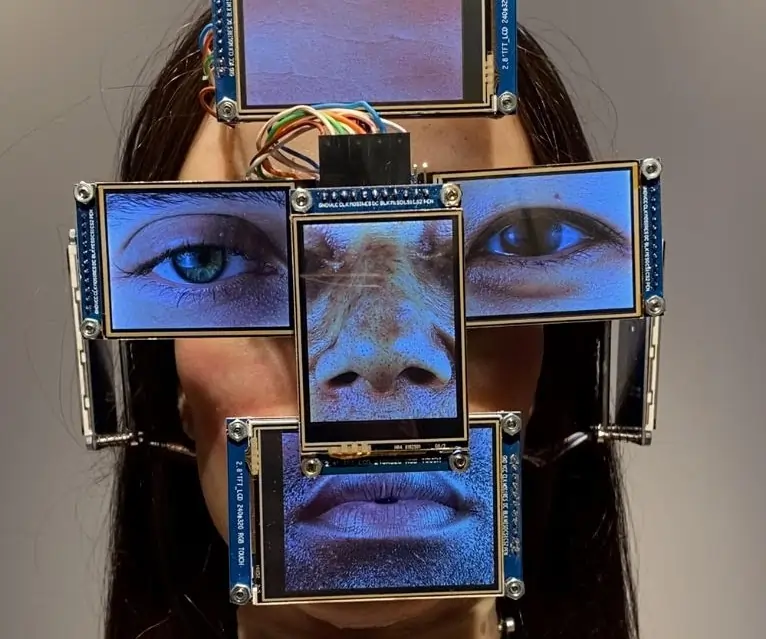
Executive summary: Maedcore designed and manufactured the complete embedded electronics infrastructure for a 25-channel interactive display system: synchronised video playback across 25 independent screens with no visible inter-screen latency, a dual-sensor input layer (HC-SR04 ultrasonic proximity + capacitive touch), and a real-time control loop that routes sensor events to playback state changes across the entire display array. The core engineering challenge was coordinating 25 independent media players under a single deterministic control loop while maintaining sub-frame response to user interaction. Deployed for Filip Ćustić’s Pi(x)el installation at Espacio SOLO Madrid — the same distributed display control architecture applies directly to industrial multi-zone HMI systems, real-time process monitoring displays, and coordinated sensor-display networks in manufacturing environments.
The Engineering Challenge
Controlling a single display in real time is straightforward. Coordinating 25 independent displays — each with its own media player, its own playback state, and its own response to sensor input — while maintaining visual synchronisation and sub-frame latency introduces three compounding engineering problems:
Distributed state consistency. Each of the 25 screens runs an independent media player process. When a sensor event fires, all 25 must respond to the same state change simultaneously. A naive broadcast approach introduces visible desynchronisation; a proper distributed state controller is required.
Sensor-to-display latency. The interaction contract requires that touch and proximity events produce an immediately perceptible change in the display array. Latency above ~50 ms is noticeable to users and breaks the interaction illusion. The control loop must be deterministic, not event-driven through a high-level OS scheduler.
Continuous uptime. The system runs for multi-hour daily sessions over weeks of exhibition. The control architecture must handle media player failures, sensor drop-outs, and network instability without requiring manual intervention.
System Architecture
Control Layer — Master Orchestrator
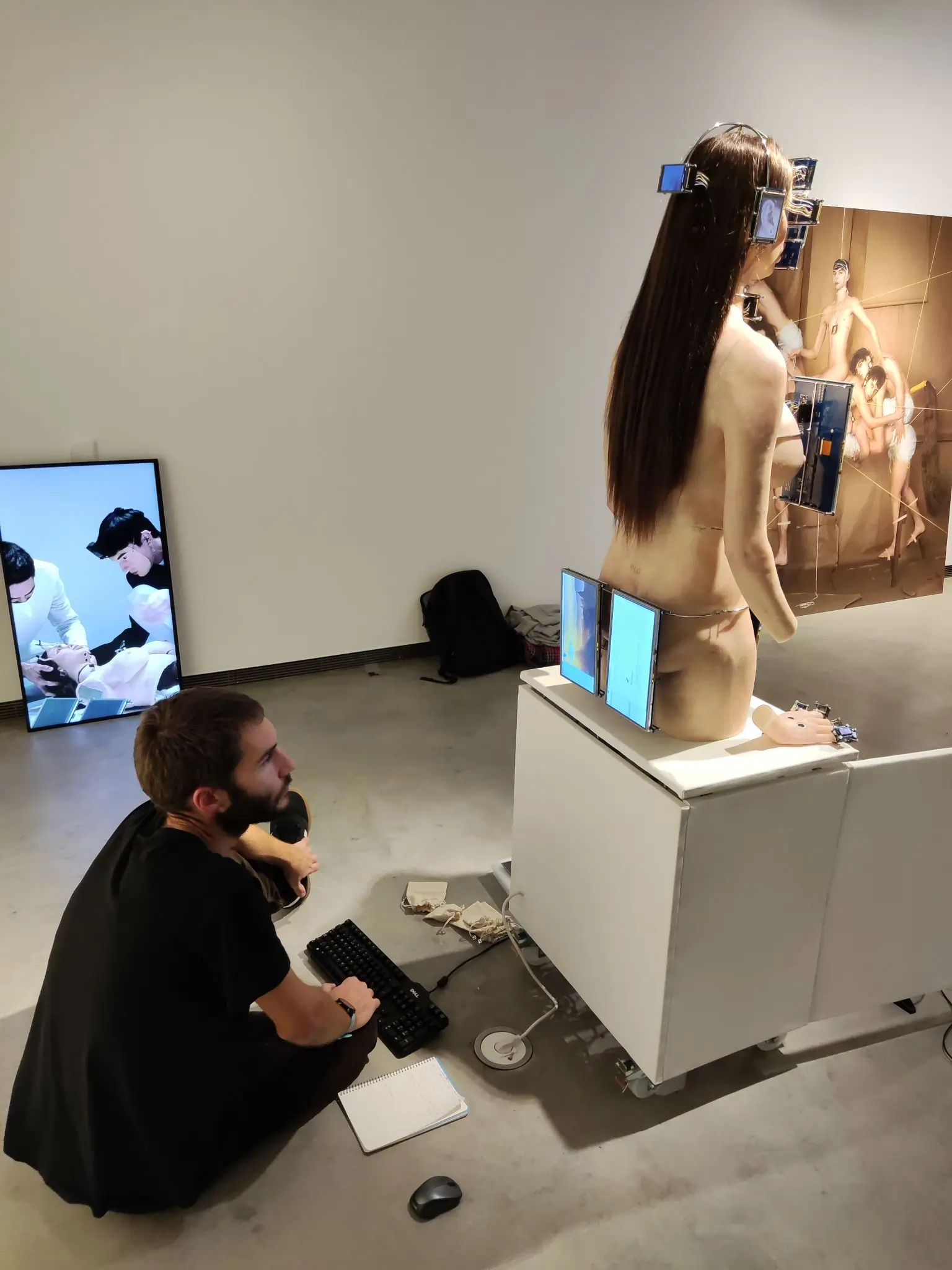
Maedcore designed a master orchestrator that manages all 25 displays as a unified array:
- State machine model — the system defines a finite set of display states (idle, proximity-active, touch-active, transition). All 25 screens share the same current state; the orchestrator is the single source of truth.
- Synchronised command broadcast — state change commands are broadcast to all 25 players simultaneously via a low-latency local network protocol, not HTTP or WebSocket. This eliminates the per-connection latency that would cause visible desynchronisation.
- Watchdog monitoring — each media player heartbeats to the orchestrator. If a player stops responding, the orchestrator restarts it and resynchronises its playback position to the rest of the array within one video segment.
Sensor Layer — Dual-Input System
The interaction layer uses two complementary sensor types:
HC-SR04 ultrasonic proximity sensors detect the presence and distance of viewers approaching the installation. Distance thresholds are configurable — the system can trigger different display states at different proximity distances (e.g., transition at 2 metres, full activation at 0.5 metres). Multiple sensors cover the full width of the installation, ensuring no approach direction is missed.
Capacitive touch sensors on each screen surface detect intentional touch input. Touch events are mapped to per-screen playback commands, allowing a viewer to interact with individual screens within the globally coordinated array — a two-level interaction model: global (proximity) and local (touch).
Display Layer — 25 Coordinated Media Players
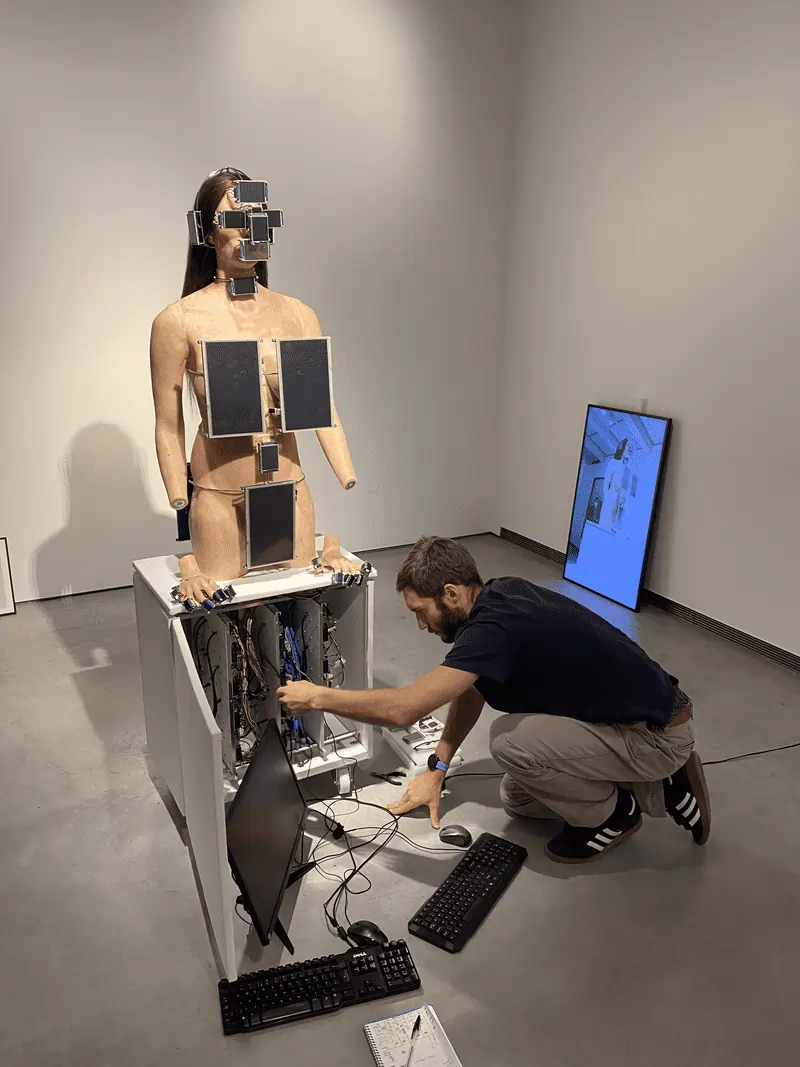
Each of the 25 screens runs a dedicated media player process configured to respond to orchestrator commands. The player selection and configuration was optimised for:
- Low command-to-render latency — players that buffer video in hardware memory respond to playback commands in under one frame cycle.
- Gapless looping — video segments loop without black frames, maintaining continuous visual output between state transitions.
- State-specific playlists — each display state maps to a different playlist for each screen, ensuring the full 25-screen composition changes coherently across states.
Physical Infrastructure Engineering
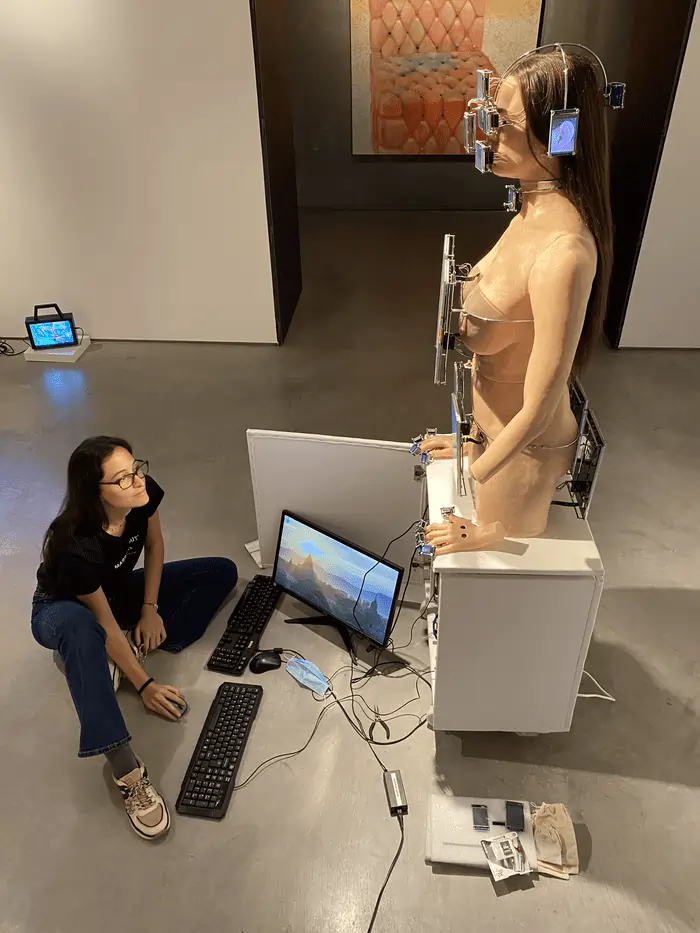
The physical installation required mechanical and electrical engineering alongside the software work:
Connection structure design. The framework supporting 25 screens must be structurally rigid (no vibration artifacts on screen), electrically safe (power distribution to 25 screens via managed power strips), and modular (the installation travels to different venues). Maedcore designed a cabling and connection system that allows full assembly and disassembly without tools in under four hours.
Cable concealment. All control, power, and sensor cables are routed inside the structural framework. No external cabling is visible from the viewer-facing side — a requirement from the commissioning artist that directly constrained the electrical routing architecture.
Thermal management. 25 screens in a closed structural frame generate significant heat. Maedcore specified passive ventilation gaps and active airflow paths to keep all media players within their operating temperature range during multi-hour sessions.
Performance Results
| Metric | Result |
|---|---|
| Number of synchronised displays | 25 independent screens |
| Sensor-to-display-state latency | < 50 ms from sensor event to visible state change |
| Playback synchronisation accuracy | < 1 frame inter-screen timing offset |
| System uptime per session | Multi-hour continuous operation |
| Failure recovery time | < 10 seconds for any single media player failure |
| Assembly / disassembly time | < 4 hours for full installation or strike |
Technology Applications
The distributed display control architecture Maedcore built for this project addresses a pattern that appears repeatedly in industrial and enterprise technology contexts:
Multi-zone industrial HMI systems. A coordinated control layer managing multiple independent displays — each showing different data streams but responding to shared system state — is the architecture for process control rooms, manufacturing dashboards, and logistics operations centres.
Sensor-triggered display networks. The proximity-sensor-to-display-state control loop is the foundation for retail environments, wayfinding systems, and any context where physical presence should trigger a specific information display.
Real-time process monitoring. The deterministic control loop and watchdog monitoring architecture are directly applicable to industrial monitoring systems where display failure must be detected and recovered automatically without operator intervention.
Distributed media systems. The synchronised broadcast approach for coordinating 25 independent media players scales to digital signage networks, multi-screen event production, and coordinated information display in transportation hubs.
Technologies Used
Project developed with: Embedded Electronics — Distributed Display Control — HC-SR04 Ultrasonic Sensors — Capacitive Touch Sensors — Real-Time Control Systems — Mechatronics — Multi-Channel Media Orchestration
Building a Multi-Display, Sensor-Driven, or Real-Time Control System?
Maedcore engineered every layer of this 25-channel embedded system — from sensor hardware to control software to physical infrastructure. The same capability applies to industrial HMI networks, process monitoring systems, and any application requiring coordinated real-time control of distributed hardware. Request a technical consultation.
Talk to the Engineering Team | View Mechatronics Services | See All Success Stories
Further Reading
Related reading: machinery safety for equipment manufacturers and the most impactful AI applications for business in 2026.
About the Author
Eduardo Fuentevilla Blanco
Robotics Engineer
For over a decade, I have been driven by a single mission: leveraging AI and robotics to build a world of automated production. I believe that by creating self-sufficient systems, we can empower people to refocus on what truly matters—their families and their passions. My expertise spans from winning prestigious European startup competitions to architecting complex, integrated hardware and software projects. I specialize in bridging the gap between today's industrial challenges and tomorrow's autonomous solutions.
Ready to transform your company?
Book a free 30-minute meeting with an engineer.