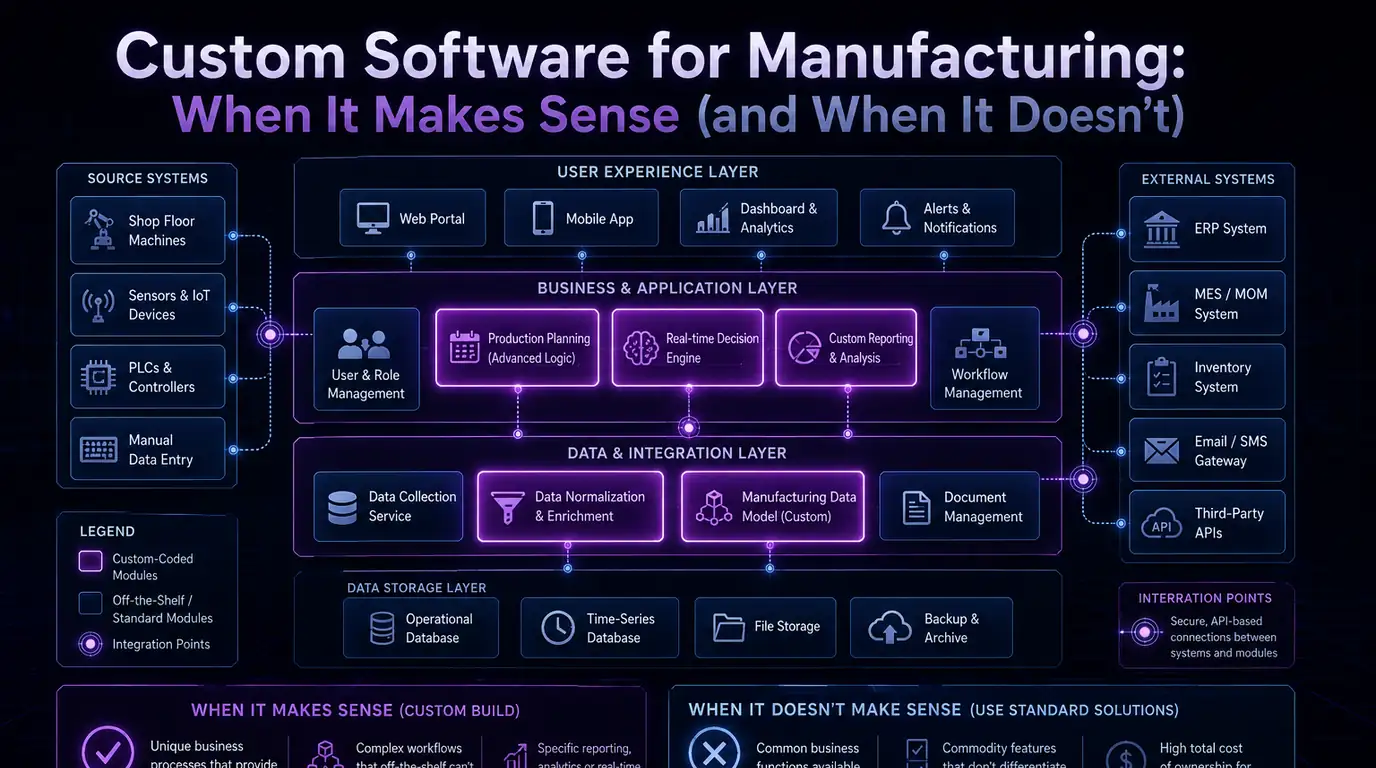
Custom Software for Manufacturing: When It Makes Sense (and When It Doesn't)
Custom software or standard platform? A five-filter decision framework with real costs, TCO calculation and concrete industrial case studies.

Written by Eduardo Fuentevilla Blanco
Robotics Engineer at Maedcore · Robotics Engineer LinkedIn ↗
Key Takeaways
- ► 73% of ERP projects in discrete manufacturing fail to meet their objectives, with average cost overruns of 215% (Panorama Consulting, 2026).
- ► SaaS spend grows 21.9% year-on-year per employee; any TCO model that locks in today's licence price systematically understates the true cost of the standard option (Zylo, 2025).
- ► Each integration with existing machinery or systems adds €3,000–€15,000 to the project, whether the base is standard or custom — and that cost rarely appears in the initial OTS proposal.
- ► 71% of internal custom development projects are eventually abandoned; the risk is organisational, not technical, and is mitigated by an MVP-first methodology, a named technical owner and a specialist industrial partner.
- ► The five-filter framework (PUS, ICI, LTT, CDT, BCT) lets a plant manager determine whether a case calls for OTS, hybrid or custom software before speaking to any vendor.
- ► The hybrid model — standard ERP for back-office plus custom software for differentiating workflows — is the most common practical outcome in mature industrial plants.
The build-vs-buy decision for industrial software is rarely made in a boardroom — it surfaces when an inspection line generates data no SaaS can read, or when accumulated licence costs exceed what a custom build would have cost. In discrete manufacturing, 73% of ERP projects fail to meet their objectives and average cost overruns reach 215%; the question is not whether the standard solution will fall short, but when. This article is a decision framework for plant managers and engineers who need to answer that question with their own numbers, not vendor promises.
Why Standard Platforms Fail on the Shop Floor (and When They Don’t)
Standard platforms work well for processes that are identical across every company — payroll, basic inventory, CRM. They break down when the workflow itself is the differentiating asset, or when the machine population doesn’t speak the protocols the SaaS expects.
The Three Hard Limits of Off-the-Shelf Software in Industrial Environments
Limit 1 — Plant Connectivity. Equipment more than ten years old rarely supports OPC-UA natively. The fix exists — hardware gateways such as Softing edgeConnector, Kepware or Cogent DataHub translate Modbus RTU, PROFIBUS or EtherNet/IP to OPC-UA in real time — but it carries a price: between €2,000 and €8,000 per gateway unit, plus €3,000 to €15,000 per connected system. That cost exists whether the base is standard or custom — but in the standard case, nobody budgets it in the initial proposal.
Limit 2 — Configurability vs. Customisation. SaaS platforms advertise “configurability” — the ability to change parameters within the vendor’s design. Real customisation — modifying the underlying logic — is a different and expensive project. Many companies that chose off-the-shelf software end up spending two to three times more on customisations, integrations and workarounds than a custom build would have cost, according to Bits Orchestra (2026).
Limit 3 — Inescapable Price Escalation. Average SaaS spend per employee reached $4,830 per year in 2025, a 21.9% year-on-year increase. Any TCO model that locks in today’s licence price for the next five years systematically understates the true cost of the standard option.
When Off-the-Shelf Does Win
For back-office functions — accounting, HR, general document management — standard software is the right choice in most cases. Faster deployment (weeks rather than months), vendor support and a lower upfront cost are genuine advantages. In practice, most mature industrial plants end up using both: each where it fits.
A Note on Failure-Rate Figures: Two Sources, Two Numbers
Gartner (2024), cited by Cudio, puts ERP project failure in the 55–75% range (all industries, broad definition). Panorama Consulting (2025–2026), cited by Godlan, gives 68% globally and 73% specifically for discrete manufacturing. The difference reflects different scope and methodology, not contradiction: Gartner uses a broader definition of “failure”, while Panorama focuses on projects with formal budgets and deadlines. Both sources point in the same direction.
What It Really Costs: Licences, Integrations and the Hidden Price of Workarounds
The most common mistake is comparing the development cost of custom software against the licence price of a standard platform, ignoring integration costs, annual price escalation and operator time lost to workarounds.
Real Cost Ranges in the European Industrial Market (2026)
Custom software development in Spain ranges from €5,000 to over €100,000. A full MES system — real-time production control, traceability, IoT integration, dashboards and predictive maintenance — cost €95,000 in a documented market case. Annual maintenance typically falls between 15% and 20% of the development cost (engineering judgement, consistent with market practice).
Comparison Table: Off-the-Shelf vs. Custom vs. Hybrid
Explicit assumptions: 30 plant users, OTS platform at €60/user/month, custom project at €100,000, 17% annual maintenance, no price escalation in the conservative scenario. These figures are illustrative; your plant’s actual variables will shift the result.
| Item | Off-the-Shelf (OTS) | Custom (Outsourced) | Hybrid (OTS + Custom Layer) |
|---|---|---|---|
| Development / implementation cost | €15,000 | €100,000 | €50,000–€70,000 |
| Year 1 licence | €21,600 | €0 | €10,800 |
| Year 1 Total | €36,600 | €100,000 | €65,000 |
| Cumulative licence Years 2–5 | €86,400 | €0 | €43,200 |
| Cumulative maintenance Years 2–5 | €20,000 (support) | €68,000 (17%/yr) | €40,000 |
| Integrations (average estimate) | €25,000 | €20,000 | €22,000 |
| 5-Year TCO | €168,000 | €188,000 | €170,000 |
| Break-even point | — | ~Year 4–4.5 | ~Year 3 |
| Lock-in risk | High | Low (owned code) | Medium |
| Time to first value | 2–12 weeks | 16–24 weeks (MVP) | 4–10 weeks |
Bits Orchestra (2026) puts TCO parity at month 18–24 for outsourced development; IIIION (2025) puts it at month 33 for a 250-user company. That is not a contradiction: the larger the user count, the lower the relative per-seat SaaS cost, which delays the break-even point. Break-even is a function of per-seat price, user count and development complexity.
The Kit Digital Distortion (Spain-Specific)
Custom software is not eligible for the Kit Digital voucher, the Spanish programme that distributed over €3.8 billion in digitalisation grants to SMEs between 2022 and 2025. The result is a structural distortion: the subsidy systematically steers SMEs towards standard solutions, even when custom software is the technically correct choice. The voucher covers Year 1 of the licence; the cost continues through Years 2 to 5 and beyond. Treating Kit Digital as a decision criterion — rather than a cash-flow tool — is a frequent mistake for Spanish operations. For international buyers, the equivalent risk is any grant or framework contract that subsidises Year 1 SaaS costs without accounting for the full licence trajectory.
The Five-Filter Decision Framework
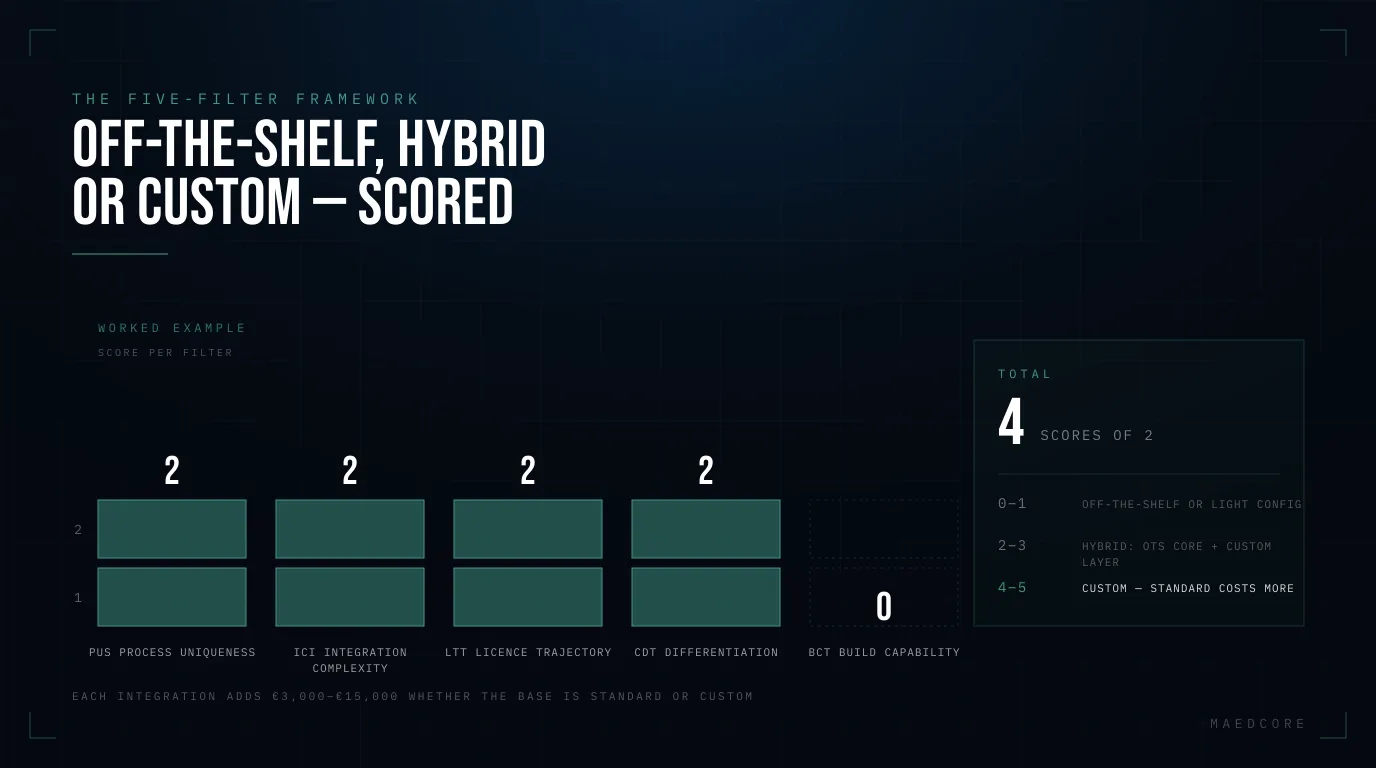
Before speaking to any vendor, a plant manager can answer five questions that determine whether a given case calls for OTS, hybrid or custom software. This framework does not exist in the available English-language literature at this level of industrial specificity; it is offered as a structured starting point, not as absolute truth.
Filter 1 — Process Uniqueness Score (PUS)
Question: Does the target workflow exist as a standard module in three or more commercial platforms?
- Score 0: Yes, it is a commodity function → OTS viable
- Score 1: Partial match, requires more than 20% configuration → hybrid candidate
- Score 2: No commercial match, or the match requires a custom connector for your equipment → custom development
Concrete industrial test: Can the platform ingest data from your specific PLC or SCADA — OPC-UA, Modbus, PROFIBUS — without a paid add-on? If the answer is no, score 2.
Filter 2 — Integration Complexity Index (ICI)
Question: How many existing systems must the new software connect to, and how old is the equipment?
| Systems to integrate | Equipment age | ICI Score |
|---|---|---|
| 1–2, modern (post-2015, native OPC-UA) | — | Low (0) |
| 3–5, mixed vintage | Some legacy | Medium (1) |
| 5+, or any equipment pre-2010 | Legacy protocols | High (2) |
Each integration adds between €3,000 and €15,000 to the project cost, regardless of whether the base is standard or custom. With a high ICI, the integration cost of an OTS platform frequently exceeds the cost difference versus going fully custom. Integrating modern industrial software with legacy infrastructure creates communication gaps that limit efficiency and visibility — and those gaps cost real money.
Mandatory prior action: Map every machine by: (a) the protocol it speaks, (b) the data it can expose, (c) whether a gateway is needed. Without that audit, any budget is an estimate without foundation. Globental (2026) confirms this is the most common cause of budget overrun in industrial software projects.
Filter 3 — Licence Trajectory Test (LTT)
Question: What is the 5-year licence cost of the standard option, modelling 10–15% annual escalation?
SaaS spend grows at 21.9% year-on-year per employee. Use this minimum calculation:
OTS Cost Year N = Current_seat_price × users × 12 × (1 + escalation)^(N-1)With €60/user/month, 30 users and 12% annual escalation:
- Year 1: €21,600 | Year 3: €27,095 | Year 5: €33,969
- 5-year cumulative: €130,000 (licence only, excluding implementation and integrations)
If that cumulative figure exceeds the custom development cost plus 5-year maintenance, score 2.
Filter 4 — Competitive Differentiation Test (CDT)
Question: Is the workflow being automated a source of competitive advantage, or is it a back-office function shared with every other company in the sector?
- Commodity function (payroll, basic inventory, invoicing): OTS wins.
- Proprietary differentiator (in-house inspection logic, process-specific defect classification, monitoring of singular equipment): Custom required. Forcing that workflow into a generic tool means compromising precisely what makes you competitive.
Filter 5 — Build Capability Test (BCT)
Question: Will development be internal or with a specialist partner?
This distinction is the most overlooked in the available literature. A 2025 survey of more than 2,000 IT decision-makers — cited by TK Turners (2025) — found that 71% of internal development projects are eventually abandoned and 46% cost nearly double the original budget.
- Internal development: Require an MVP-first methodology, a named technical owner and defined kill-switch milestones before committing budget.
- Development with a specialist partner: Significantly lower abandonment risk. Require the partner to demonstrate prior integrations with industrial protocols (OPC-UA, Modbus) and verifiable references in your sector.
Scoring Table and Decision Rule
| Filter | Score 0 | Score 1 | Score 2 |
|---|---|---|---|
| PUS — Process uniqueness | OTS viable | Hybrid | Custom |
| ICI — Integration complexity | OTS viable | Hybrid | Custom |
| LTT — Licence trajectory | OTS cheaper at 5 years | Break-even <4 years | Custom cheaper at 5 years |
| CDT — Competitive differentiation | OTS | — | Custom |
| BCT — Build capability | Internal risk flag | — | Partner recommended |
Decision rule:
- 0–1 scores of 2 → OTS or light configuration
- 2–3 scores of 2 → Hybrid (OTS core + custom integration layer)
- 4–5 scores of 2 → Custom development — the standard option will cost more and deliver less
A Real 2/2 Scoring Example on PUS and CDT
In the radiation inspection software project for Enusa Industrias, no commercial platform could handle the combination of multi-stage inspection logic, nuclear-process-specific defect taxonomy and real-time integration with plant sensors. PUS = 2 (no commercial match), CDT = 2 (the inspection logic is the differentiating asset). The framework would have pointed to custom development before the first meeting with any standard vendor. Similarly, in the automated welding head with inspection display project, the equipment interface required proprietary protocol translation that no SaaS platform contemplated: ICI = 2 from day one.
The Mistakes We See Most Often (and How to Avoid Them)
Mistake 1 — Estimating without a connectivity audit. Legacy machinery sometimes only allows indirect reads, which completely changes scope and cost. Globental (2026) confirms this as the most common cause of budget overrun. Fix: map the protocol of every machine before speaking to any vendor.
Mistake 2 — Confusing “configurable” with “customisable”. Configurability changes parameters within the vendor’s design; customisation changes the underlying logic. Ask the vendor to show, in a live demo, how your specific inspection workflow logic would be modified — not how a form field is relabelled.
Mistake 3 — Ignoring price escalation in the TCO model. With a 21.9% year-on-year increase in SaaS spend per employee, any model that locks in today’s price for five years systematically understates the standard option’s cost. Always model a 10–15% annual escalation scenario.
Mistake 4 — Internal development without a named technical owner. 71% of internal development projects are eventually abandoned. The most common cause: operations knows the project but IT builds it, with no single technical owner who has both authority and accountability.
Mistake 5 — Treating a Year 1 subsidy as a decision criterion. Any grant that covers Year 1 of a standard licence does not change the conclusion if custom software is the technically correct choice for your process — it only changes Year 1 cash flow.
Mistake 6 — No vendor exit strategy. Before signing, require: (a) data export in open formats, (b) custody of configuration data, (c) a portability clause in the event of vendor closure or significant price change.
Related reading
- What Custom Software Development Really Looks Like — phases, risks and the metrics that tell you a build is on track.
- Industrial Process Automation — how to pick the first process to automate — and which ones to leave manual.
- Maedcore — Digital Solutions — what we build in this area.
Frequently Asked Questions
How long does it take for custom industrial software to break even against a standard platform?
It depends on user count and per-seat price. For 30 users on a platform at €60/user/month, the break-even point falls around Year 4–4.5. Bits Orchestra (2026) puts parity at month 18–24 for outsourced development; IIIION (2025) puts it at month 33 for 250 users with volume discounts. Always model with 10–15% annual SaaS price escalation.
What does it really cost to integrate legacy machinery with new industrial software?
Each integration with an existing system adds between €3,000 and €15,000 to the project, depending on documentation quality. For equipment pre-2010 without native OPC-UA support, add the cost of a hardware gateway (€2,000–€8,000 per unit). This cost exists in both OTS and custom projects — the difference is that in OTS projects it rarely appears in the initial proposal, and it is the most frequent cause of budget overrun.
When does the hybrid model (OTS + custom layer) make the most sense?
The hybrid model is the most common practical solution in mature industrial plants: standard ERP for finance and logistics, plus custom software for the production or inspection workflows specific to the process. It makes sense when the five-filter framework returns 2–3 “custom” scores — enough to justify proprietary development in the differentiating layers, without abandoning the entire existing standard infrastructure.
What is the biggest risk in custom software development for a manufacturing plant?
The biggest risk is not technical: it is organisational. 71% of internal development projects are eventually abandoned, primarily due to the absence of a technical owner with real authority and an MVP-first methodology. With outsourced development to a specialist industrial partner, the abandonment risk is significantly lower — but it requires verifying prior experience with industrial protocols (OPC-UA, Modbus) and references in your sector.
How should a plant manager evaluate a vendor’s claim that their platform is “fully configurable”?
Ask the vendor to demonstrate, in a live session, how your specific inspection or production workflow logic would be modified — not how a label or form field is changed. If the answer involves a professional services engagement or a change request to the vendor’s development team, that is customisation, not configuration, and it carries a different cost and timeline profile.
Sources
- Godlan — ERP Implementation Failure Statistics: 2026 Research — Godlan, citing Panorama Consulting Group 2026 ERP Report
- Cudio — ERP Implementation Failure — Cudio, citing Gartner 2024 and Panorama Consulting 2025
- Zylo — 2025 SaaS Management Index — Zylo, 2025
- Bits Orchestra — Custom Manufacturing Software: Is It Worth Building in 2026? — Bits Orchestra, 2026
- Globental — Software a medida para industria: guía 2026 — Globental, 2026
- iFactory — OPC-UA + AI: Enabling Seamless Machine-to-MES Connectivity in Auto Plants — iFactory, 2026
- Arteco Consulting — Cuánto Cuesta Desarrollar Software a Medida en 2026 — Arteco Consulting, 2026
- 10Code / desarrollosoftware.es — Cuánto Cuesta Desarrollar una App en 2025 — 10Code, 2025
- Efiprox — Cuánto cuesta desarrollar un software a medida en 2026 — Efiprox, 2026
- 10Code — Digitalización de PYMEs en España 2026 — 10Code, 2026
- 10Code — Mercado del Software y TIC en España 2026 — 10Code, 2026
- Transmitter Shop — OPC UA Integration with SCADA & MES Using Smart Transmitters — Transmitter Shop, 2026
- IIIION — Build vs Buy: Custom Software Guide 2025 — IIIION, 2025
- TK Turners — Custom vs Off-the-Shelf Software (citing Exclaimer 2025) — TK Turners, 2025
About the Author
Robotics Engineer
For over a decade, I have been driven by a single mission: leveraging AI and robotics to build a world of automated production. I believe that by creating self-sufficient systems, we can empower people to refocus on what truly matters—their families and their passions. My expertise spans from winning prestigious European startup competitions to architecting complex, integrated hardware and software projects. I specialize in bridging the gap between today's industrial challenges and tomorrow's autonomous solutions.
Frequently Asked Questions
How long does it take for custom industrial software to break even against a standard platform?
What does it really cost to integrate legacy machinery with new industrial software?
When does the hybrid model (OTS + custom layer) make the most sense?
What is the biggest risk in custom software development for a manufacturing plant?
How should a plant manager evaluate a vendor's claim that their platform is 'fully configurable'?
Ready to transform your company?
Book a free 30-minute meeting with an engineer.