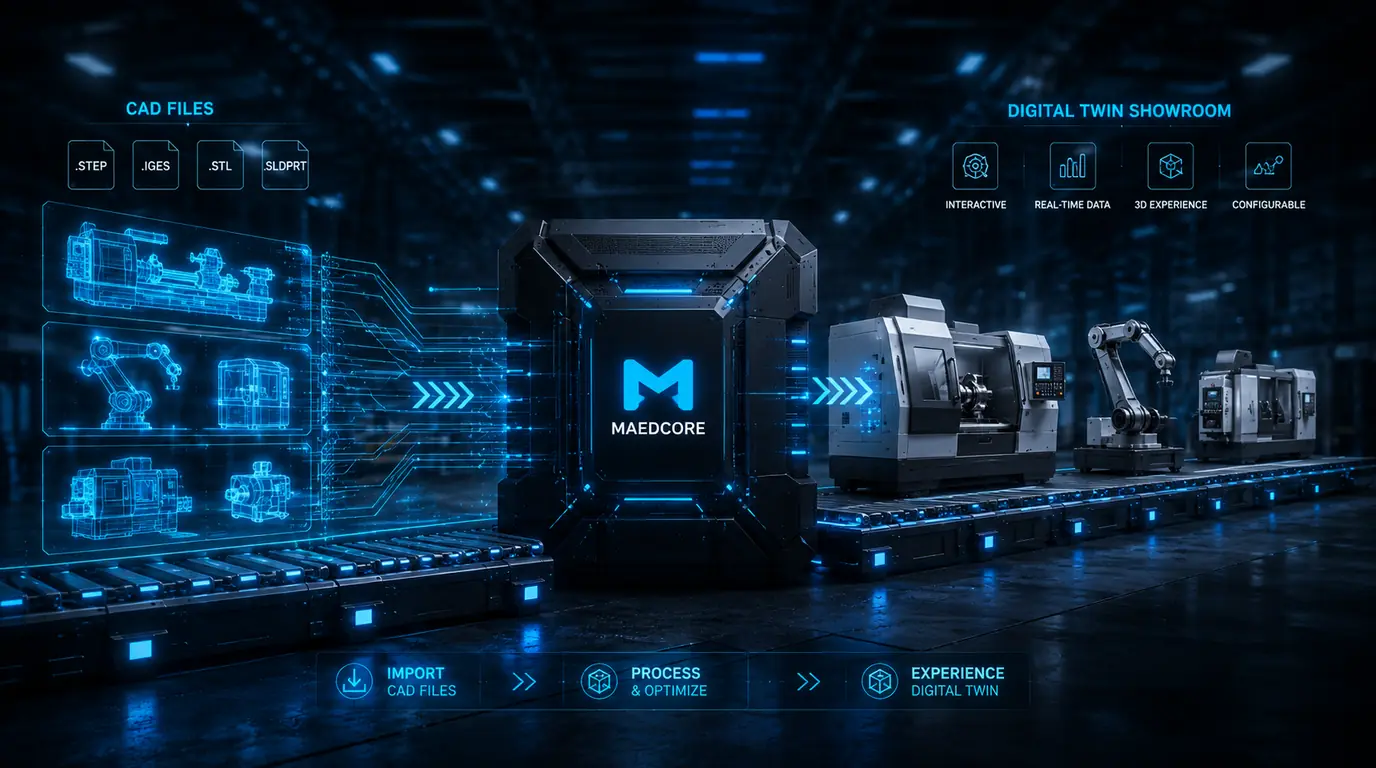
Digital Twin Showrooms for Industrial Machinery Manufacturers
What a digital twin showroom is, when to build one, and which type fits your machinery. Real costs, a Maturity Matrix, and the technical pipeline for

Written by Eduardo Fuentevilla Blanco
Robotics Engineer at Maedcore · Robotics Engineer LinkedIn ↗
Key Takeaways
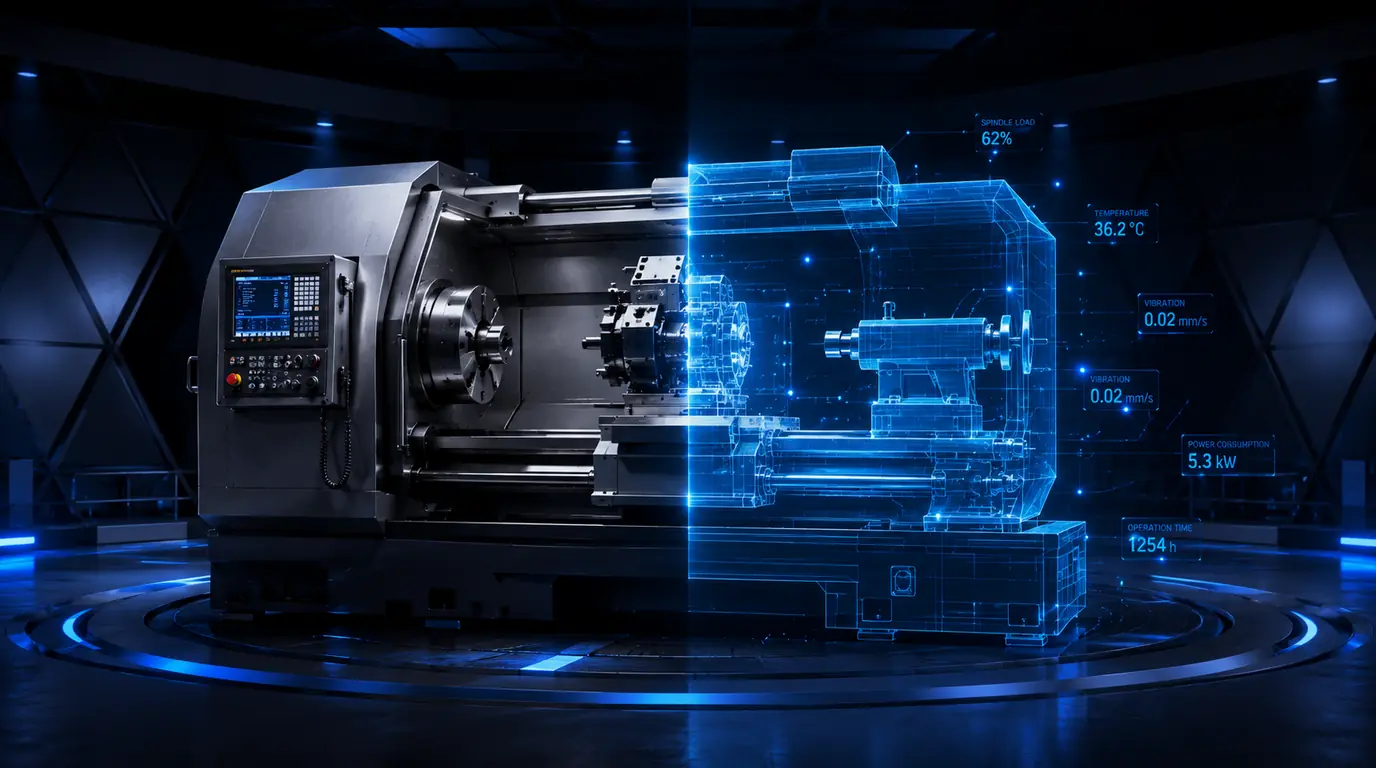
- ► A digital twin showroom for industrial equipment is a real-time, 1:1-scale 3D environment in a game engine — not a 360° tour or a static model — accessible 24/7 from any browser.
- ► The digital twin market in manufacturing will grow from USD 8.12 billion (2025) to USD 139.57 billion by 2035; DMG MORI's operational metrics (40% faster ramp-up, –30% costs) apply to the operational twin, not the sales showroom.
- ► The six-criterion Maturity Matrix (machine footprint, demo cost, sales cycle, buyer geography, CAD maturity, revision frequency) determines whether a manufacturer needs a full showroom, a single-machine twin, or simply a 360° tour.
- ► The most critical technical step is a CAD data audit and consolidation before the project starts: it typically takes 2–6 weeks and is the most common cause of schedule overruns.
- ► An experiential twin at €40,000–€60,000 breaks even in under 12 months against two annual trade shows costing €80,000–€120,000 combined — and continues generating visits every day thereafter.
- ► Delivery infrastructure is world-class in Spain (95.2% fibre coverage vs. 64% EU average), but a shortage of 30,000–50,000 digital specialists makes an external specialist partner the most realistic choice from day one.
A digital twin showroom for industrial equipment is a real-time, 1:1-scale 3D environment of a machine or production line — accessible from any browser — that combines the technical credibility of an operational digital twin with the selling power of a physical showroom. The global digital twin market in manufacturing stood at USD 8.12 billion in 2025 and is projected to reach USD 139.57 billion by 2035, according to Evolvance Market Research. For an industrial manufacturer spending more than €50,000 per event at physical trade shows, the question is no longer whether to build one — it is when, and which type.
What a digital twin showroom actually is (and why it is not a virtual tour)
A digital twin showroom is not a 360° photo gallery or an interactive PDF. It is a real-time environment in which a buyer moves freely around the machine, activates mechanisms, checks specifications, and requests a demonstration — without travelling. Choosing the wrong type can mean a 3× cost overrun or a tool the sales team abandons within weeks.
The market breaks into three categories that almost no article distinguishes clearly:
| Type | What it is | Live data | Estimated cost | Best for |
|---|---|---|---|---|
| 360° tour / Matterport | Photographic scan, fixed viewpoint navigation | No | €3,000–€10,000 | Existing showroom, limited budget |
| Experiential twin | 3D environment in a game engine (Unreal/Unity/Omniverse), free movement | No | €20,000–€80,000 | Trade-show replacement, B2B sales |
| Full operational twin | Exact NC/PLC replica + navigable environment (DMG MORI model) | Yes | €80,000–€300,000+ | Machine-tool OEMs, complex capital equipment |
The key distinction is stated clearly by Eclipse Automation: a digital twin is “an interactive 3D model at a 1:1 scale, down to the last bolt” — not a static model. A 360° tour is, by comparison, a slideshow of fixed viewpoints.
DMG MORI deliberately blurs the boundary between the last two categories: their showroom is a marketing asset (navigable, available 24/7) built on the credibility of an operational twin (exact NC/PLC replica). This hybridisation is precisely the innovation that no generalist article has yet named.
The DMG MORI precedent and the real cost of the status quo
DMG MORI was the first machine-tool manufacturer to publish and name a Digital Twin Showroom — a virtual replica of its Iga production centre, accessible 24/7 from anywhere in the world. The origin was not a planned strategy: it was an emergency response to the closure of trade shows during the pandemic. Before 2020, the company occupied 10,000 m² with 80 live machines at each open house. The solution, developed with the agency Jangled Nerves and documented in the project record, was available worldwide, 24/7, and rendered in real time inside a game engine.
The performance figures published by DMG MORI for its machine-level twin are: a 40% increase in production ramp-up speed, cost reductions of up to 30%, and the complete elimination of collisions. It is important to note that these are operational metrics, not sales metrics. Conflating the two categories is one of the most common errors in ROI analyses of this technology.
Exhibiting at Hannover Messe or BIEMH with heavy machinery starts at €15,000 in stand costs alone — before transport or rigging — and generates presence for four days a year. The largest single cost is not floor space: it is transporting bulky machinery, as the Hannover Messe guide by Adam Expo Stand makes clear. In the pharmaceutical manufacturing segment — comparable in sales complexity — Martech3D documents a 4× annual ROI, £0.5 million in attributed new sales, and a 50% reduction in event costs. These are vendor-reported figures, not independently audited, but they are the only named, sector-specific data available in the public literature.
What it costs to build an industrial experiential twin
The range published by Utsubo for experiential twins in a retail context is USD 20,000–200,000. Adjusted upward for the greater geometric complexity of industrial machinery, a reasonable working estimate is:
- Single-machine twin (browser-based, no live data): €15,000–€40,000, 6–12 weeks
- Virtual showroom of 3–5 machines (navigable environment): €40,000–€100,000, 3–5 months
- Full operational twin (DMG MORI model): €150,000–€400,000+, 6–18 months
- Annual maintenance: 15–25% of build cost
These figures are engineering estimates based on the Utsubo range adjusted for industrial complexity — not independently verified vendor pricing.
The break-even calculation is straightforward: if a company attends two trade shows a year at a total cost of €80,000–€120,000, an experiential twin at €40,000–€60,000 pays for itself in under 12 months — and continues generating visits every day of the following year.
When does it make sense to build one? The Maturity Matrix for Industrial Manufacturers
Not every industrial manufacturer needs a full digital twin showroom. This matrix does not exist in any published article on the subject: it is constructed from the DMG MORI precedent, the available cost data, and engineering principles governing CAD data fidelity.
Step 1: Score your product (6 criteria, 1–3 points each)
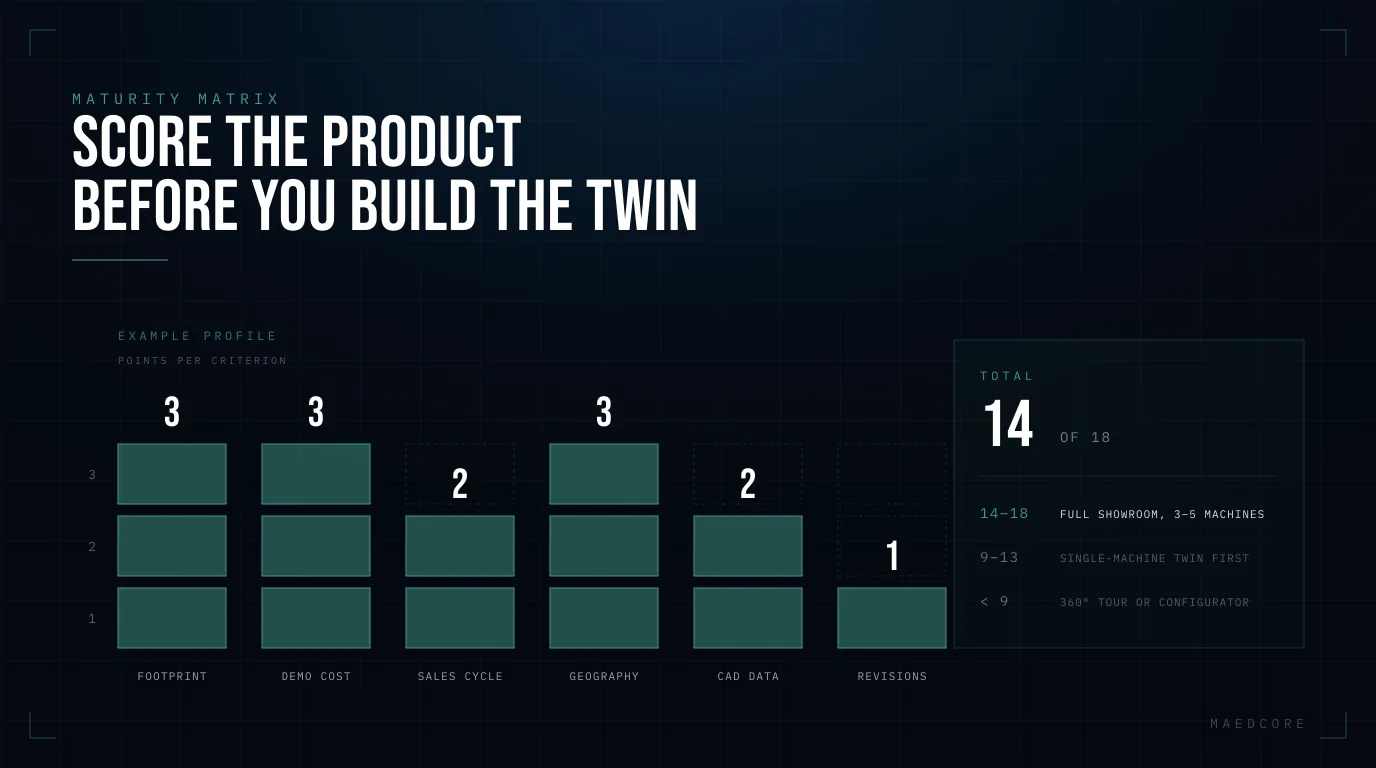
| Criterion | 1 point — Low fit | 2 points — Medium fit | 3 points — High fit |
|---|---|---|---|
| Machine footprint | < 1 m² | 1–10 m² | > 10 m² (CNC, press, conveyor line) |
| Physical demo cost per event | < €5,000 | €5,000–€50,000 | > €50,000 (transport + rigging) |
| Sales cycle length | < 1 month | 1–6 months | > 6 months |
| Buyer geography | Local only | Domestic | International / export |
| CAD data maturity | No 3D CAD | 3D CAD exists but fragmented | Full parametric CAD, single source of truth |
| Product revision frequency | > 4 times/year | 1–4 times/year | < 1 time/year |
Interpretation (maximum 18 points):
- 14–18 points: Strong candidate for a full showroom of 3–5 machines or more.
- 9–13 points: Start with a single-machine experiential twin; scale once you have validated the ROI.
- < 9 points: A 360° tour or a product configurator is sufficient.
Critical assumption: Product revision frequency deliberately penalises manufacturers with short development cycles, because a twin that becomes obsolete within weeks is a credibility liability in long-cycle B2B sales.
Step 2: Define the data pipeline (the engineering prerequisite)
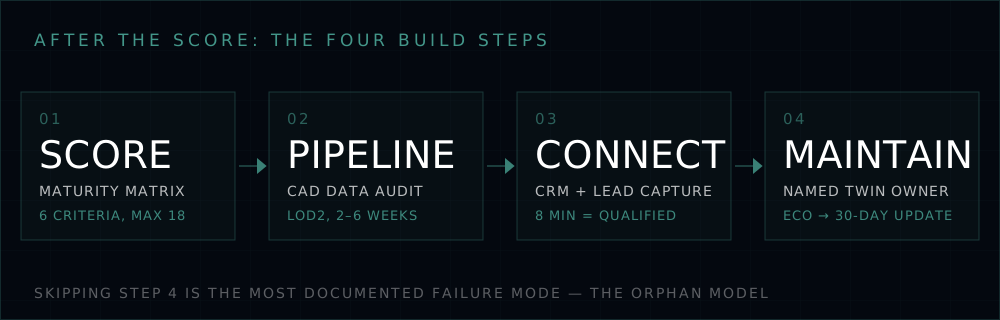
The most frequently skipped step in projects that fail is a CAD data audit before any 3D build begins. In our experience, industrial manufacturers typically have CAD data scattered across multiple versions, formats, and teams; a consolidation phase of 2–6 weeks is standard before any conversion pipeline can start.
The standard technical flow is:
- Native CAD (SolidWorks, CATIA, NX) → export to STEP/IGES
- Conversion and optimisation: STEP → USD (NVIDIA Omniverse) or glTF (native for web). Pixyz (PTC) reduces polygon count by more than 90% while preserving visual fidelity.
- LOD decision: A sales showroom requires LOD2 — exterior geometry and visible moving parts, without internal wiring. Building to LOD4 for a showroom is 3–5× more expensive and slower to render.
- Virtual environment: Placing the machine inside a contextualised virtual factory floor multiplies perceptual impact. This component is what separates a showroom from a plain model viewer.
- Interactivity layer: Hotspots with technical specifications, key mechanism animations, embedded video, links to a product configurator.
NVIDIA Omniverse, built on USD and real-time ray tracing, is the reference infrastructure for high-fidelity industrial twins: the Blueprint announced in November 2024 enables simulations 1,200× faster with direct support from Siemens, Ansys, and Altair. For lighter showrooms, Unreal Engine (royalty-free for internal B2B tools) and Unity Pro (~€185/month/seat) are viable alternatives with WebGL export for browser delivery without installation.
In a 3D industrial animation project we built for a rolling-mill manufacturer — documented in the Maedcore Industrial 3D Animation case study — the data pipeline was the single most time-consuming bottleneck: consolidating CAD files from two separate plants took three weeks before any visualisation work could begin. It is a pattern that repeats.
Step 3: Connect the showroom to the sales process
A virtual showroom with no CRM connection, no lead capture, and no session analytics is a brochure, not a sales tool. The minimum viable integration points are:
- Lead capture at high-intent moments: for example, a “Request a demonstration” prompt after the buyer activates the cutting-head animation.
- Session data to CRM: time spent per section, features explored. A buyer who spends more than 8 minutes in the twin is, in our experience, a qualified lead for a direct commercial conversation.
- Embedded in the sales sequence: the showroom link belongs in prospecting emails, in the LinkedIn profiles of the commercial team, and in meeting-preparation materials.
Step 4: Maintenance protocol (preventing the most common failure)
The “orphan model” is the most documented failure mode: the manufacturer invests in a 3D model but establishes no update process, and the model becomes obsolete quickly. In a B2B showroom, an inaccurate model is a serious credibility risk. The solution is structural:
- Assign a twin owner (product manager or applications engineer).
- Set a revision trigger: any Engineering Change Order affecting exterior geometry initiates an update within a maximum of 30 days.
- Conduct a full annual audit against the physical machine.
The international context: world-class infrastructure, scarce specialist talent
For manufacturers targeting export markets from Spain, a relevant paradox applies. Spain’s fibre-optic coverage reaches 95.2% of the population — well above the European average of 64% — according to the European Commission’s Digital Decade 2025 Country Report. The infrastructure to deliver a digital twin showroom is world-class. However, Spain faces a shortage of between 30,000 and 50,000 digital specialists, with only 4.4% of the active workforce employed in ICT, against an EU average of 4.8% (Acelera Pyme).
For a manufacturer in the Madrid–Guadalajara industrial corridor or the Bilbao industrial belt, the practical conclusion is clear: delivery capacity exists, internal talent does not — planning with an external specialist partner from day one is the most realistic decision. The España Digital 2026 programme, mobilising USD 77 billion in technology modernisation, and the Kit Digital scheme — which has distributed more than €1.9 billion to over 460,000 companies — create a co-financing context that lowers the entry barrier for industrial SMEs.
The six most common failure modes
The literature on digital twin showrooms is strikingly optimistic. Failures follow predictable patterns:
- The orphan model: The twin is built but connected to no update process. Fix: establish a maintenance protocol from day one.
- Wrong LOD: Building to LOD4 for a sales showroom is 3–5× more expensive and slower to render.
- No sales integration: A showroom without CRM and analytics is an interactive brochure.
- Campaign asset, not channel asset: Under-investment in maintenance produces a twin that visibly ages.
- CAD audit skipped: Fragmented CAD data is the most frequent bottleneck; without prior consolidation the project timeline becomes unpredictable.
- Commercial team adoption ignored: Training and workflow integration matter as much as the technical build.
Related reading
- OmniViewer in Action: Inside Maedcore’s VR Showroom for Industrial Machinery
- From CAD File to Virtual Showroom: How to Turn Your Product Catalogue into a Digital Twin
- Virtual Showroom vs. Industrial Trade Show Booth: A Real Cost and ROI Comparison
Sources
- DMG MORI Digital Twin Showroom — DMG MORI, 2021–ongoing
- DMG MORI Digital Twin Software (Store) — DMG MORI, ongoing
- DMG MORI Digital Showroom (agency case study) — Jangled Nerves, no date
- Digital Twin in Manufacturing Market — Evolvance Market Research, 2026
- How digital twin technology is revolutionizing the industrial manufacturing sector — Eclipse Automation, April 2026
- NVIDIA Announces Omniverse Real-Time Physics Digital Twins — NVIDIA (press release), November 2024
- Digital Twin Experiences for Brands & Showrooms (2026) — Utsubo, June 2026
- How the Virtual Showrooms Generate ROI — Martech3D, no date
- Spain 2025 Digital Decade Country Report — European Commission, 2025
- Is your sector digitally prepared for 2025? — Acelera Pyme (Red.es / Government of Spain), 2024
- Spain Digital Transformation Market Growth Report 2031 — Mordor Intelligence, January 2026
- BIEMH 2026 – International Machine Tool Exhibition — Bilbao Exhibition Centre, March 2026
- Hannover Messe 2026 Exhibition Stand Design Guide — Adam Expo Stand, June 2026
- Industrial 3D Animation: Rolling Mill Case Study — Maedcore, ongoing
About the Author
Robotics Engineer
For over a decade, I have been driven by a single mission: leveraging AI and robotics to build a world of automated production. I believe that by creating self-sufficient systems, we can empower people to refocus on what truly matters—their families and their passions. My expertise spans from winning prestigious European startup competitions to architecting complex, integrated hardware and software projects. I specialize in bridging the gap between today's industrial challenges and tomorrow's autonomous solutions.
Frequently Asked Questions
How much does it cost to build a digital twin showroom for industrial machinery?
What is the difference between a digital twin showroom and a 360° virtual tour?
What CAD data do I need to build a digital twin showroom for my machine?
How do you integrate a digital twin showroom into a B2B sales process?
Does a digital twin showroom make financial sense for an industrial SME?
Ready to transform your company?
Book a free 30-minute meeting with an engineer.