Virtual Showroom vs. Industrial Trade Show Booth: A Real Cost and ROI Comparison
Rigorous cost comparison of virtual showrooms vs industrial trade show booths: real figures, ROI by sector, and a worked break-even model for

Written by Eduardo Fuentevilla Blanco
Robotics Engineer at Maedcore · Robotics Engineer LinkedIn ↗
Key Takeaways
- ► Exhibiting at a top-tier industrial trade show costs €40,000–€100,000 per event all-in; floor space accounts for only 33% of the total budget according to EXHIBITOR Magazine.
- ► The $20.98 ROI per $1 invested cited by CEIR is a cross-sector aggregate; in manufacturing, trade show conversion rates are just 0.7% — the second lowest channel in the sector.
- ► A Spanish manufacturer attending 2 shows per year that adopts a virtual-first model can save €31,000 in Year 1 and €97,000 cumulatively over two years, with the virtual showroom breaking even within its first year of operation.
- ► Trade show attendance remains 12.9% below 2019 levels per the CEIR Q4 2024 Index, while exhibitor numbers have nearly fully recovered — meaning exhibitors are paying more per square metre to reach a smaller audience.
- ► IFEMA Madrid's concession model allows external contractors without mandatory venue labour, making it structurally 30–50% cheaper to build a stand there than at Hannover Messe for the same specification.
- ► The Multiphoton Optics case shows a 98.5% reduction in exhibition carbon footprint by introducing VR — from 96.1 to 1.4 tonnes of CO₂ per round trip — with logistics savings covering two additional engineering salaries.
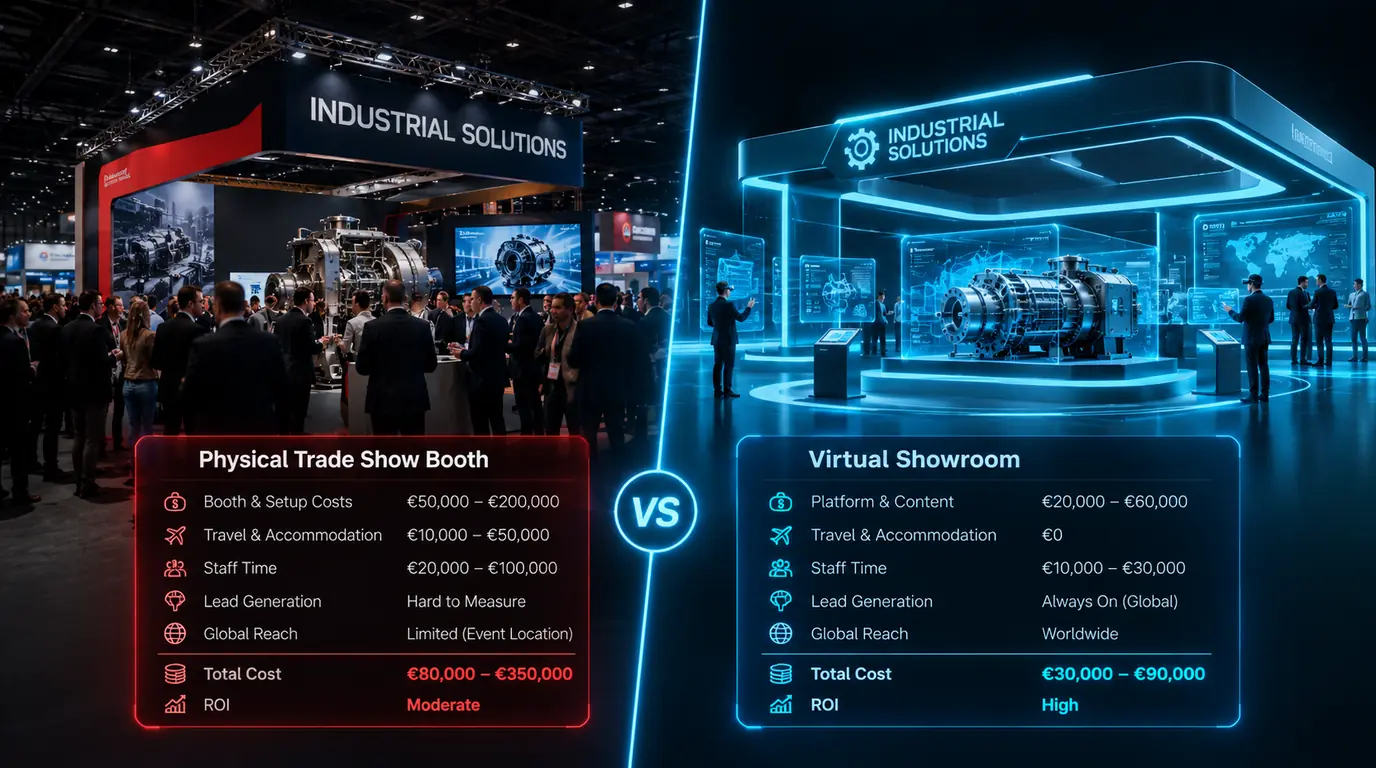
Exhibiting at a top-tier industrial trade show in Europe costs between €40,000 and €100,000 per event once every line item is counted — yet most budgets only account for floor space and the stand build. A mid-range industrial virtual showroom can be built for €25,000–€60,000 and pays for itself against two physical shows per year by the end of Year 2. But the $20.98 return per $1 invested that CEIR publishes is a cross-sector aggregate; in manufacturing specifically, trade show conversion rates sit at just 0.7%. This comparison breaks down the real numbers, surfaces where sources contradict each other, and offers a five-scenario decision model with a fully worked break-even calculation for industrial manufacturers.
How Much Does Exhibiting at an Industrial Trade Show Actually Cost?
Floor space is only one-third of the total bill — the rest arrives as unexpected invoices.
According to EXHIBITOR Magazine data compiled by Metro Exhibits, the average exhibition budget breaks down as follows: floor space (33%), stand build and graphics (18%), travel and subsistence (18%), venue services — power, cleaning, material handling (12%), freight and logistics (9%), promotion (8%), and miscellaneous (2%). At IFEMA Madrid, floor space is contracted at €100–€300/m² and stand construction ranges from €400 to €1,200/m². For a 30 m² stand, that alone comes to €15,000–€45,000 before a single freight invoice arrives.
Drayage — the charge for moving materials from the loading dock to your stand — can cost between $1.50 and $4.00 per pound according to EXHIBITOR Magazine. For a manufacturer shipping a 500 kg machine, that translates to an additional €3,000–€8,000. There is also an amortisation cost that annual budgets routinely ignore: the average stand structure lasts five years, but graphics last only one.
The Structural Cost Advantage of IFEMA Over Frankfurt or Hannover
This point is absent from virtually every English-language article on the subject: IFEMA Madrid operates under a concession model that allows approved external contractors to manage the entire stand build without any obligation to use in-house venue labour. This systematically reduces construction costs compared to German venues such as Hannover Messe, where venue regulations and mandatory union labour can push costs 30–50% higher for an identical specification. In practice, a 20 m² stand in Spain can cost €4,000–€8,000 in design and build, while the same stand in Hannover can exceed €16,000–€24,000.
The European Trade Show Market: Context Before Comparing
Spain is the world’s sixth-largest trade fair market — which is why physical presence remains a strategic investment for many manufacturers, not a discretionary line item.
According to AFE data using Oxford Economics methodology for 2024, the Spanish trade fair sector generates a total economic impact of €13.6 billion, contributes €6.9 billion to GDP, and supports 124,400 jobs. In 2025, 472 trade shows were held with 6.8 million visitors and 64,236 exhibiting companies. IFEMA Madrid accounts for a disproportionate share: according to a PwC report on 2024 data, it generated €5.779 billion in economic impact for the city and represented 3.2% of Madrid’s GDP. In 2024, IFEMA billed €230.2 million — 30% more than 2023 and a historic high.
However, the CEIR Q4 2024 Index reveals a paradox that recovery-narrative articles rarely mention: the overall index reached 95.6 — its highest level since the pandemic — but attendance remains the most lagging component, still 12.9% below 2019 levels, while the exhibitor metric has nearly recovered to pre-pandemic levels (just 0.1% below). Across Europe, net contracted exhibition space has declined at -1.4% per year since 2019 — the worst regional performance globally. The practical reading: European exhibitors are paying more per square metre to reach a smaller audience than they accessed before the pandemic.
What Does a Trade Show Actually Return? ROI, Lead Quality and the Aggregate Data Trap
The $20.98 return per $1 invested that CEIR publishes is real — but it is a cross-sector aggregate that does not apply directly to industrial manufacturing, where trade show conversion rates are 0.7%.
CEIR research for 2024 documents that it takes 3.5 sales calls to close a trade show lead (versus significantly more for digital leads), that the average cost per lead is $112, and that 81% of attendees have purchasing authority, with 46% in the final stage of their buying process. These are solid figures — but they come from an index that includes high-velocity sectors such as consumer technology, retail and food.
Manufacturing Lead Generation data (February 2026) places trade shows as the second lowest-converting channel in manufacturing, at 0.7%. This does not invalidate the CEIR ROI figure — it contextualises it. Industrial trade shows serve relationship-building and access to high-value buyers, but that value is difficult to capture in a direct-conversion model when sales cycles run 6–18 months. The question an industrial marketing director should be asking is not “is the trade show worth attending?” but rather “what portion of our exhibition budget generates measurable pipeline, and what portion builds relationship assets that won’t appear in the CRM for another 18 months?”
How Much Does an Industrial Virtual Showroom Cost?
Published ranges (€15k–€500k) are too wide to make decisions from: what matters is the level of 3D fidelity and how tightly the platform integrates with your sales process.
The most detailed available benchmark comes from the retail and furniture sector: Dagger Interactive (2025) documents £15,000–£25,000 for virtual environment creation and 3D product modelling, £3,000–£6,000 per year in hosting and platform fees, and £2,000–£4,000 per year in content updates. These figures almost certainly underestimate industrial complexity, where 3D models must capture engineering tolerances, machine kinematics and technical configuration options.
Based on engineering judgment from comparable projects: an industrial virtual showroom with medium-to-high fidelity 3D models, an interactive configurator and basic CRM integration should be budgeted at €25,000–€60,000 in initial development, with €5,000–€15,000 per year in maintenance. SaaS platforms can be deployed in 2–6 weeks at €150–€5,000/month, but offer less customisation and lower technical fidelity for complex machinery.
Three cost items that comparison articles systematically omit: CRM and lead-scoring integration (an additional €3,000–€8,000), training the sales team to act on visitor behaviour data, and content governance. The most expensive mistake we have seen is treating the virtual showroom as a one-off project: an outdated environment — with discontinued products or incorrect pricing — actively damages credibility. Custom development timelines run 12–20 weeks from briefing to launch.
The Comparison You Won’t Find Anywhere Else: Five Participation Models and Their Real Costs
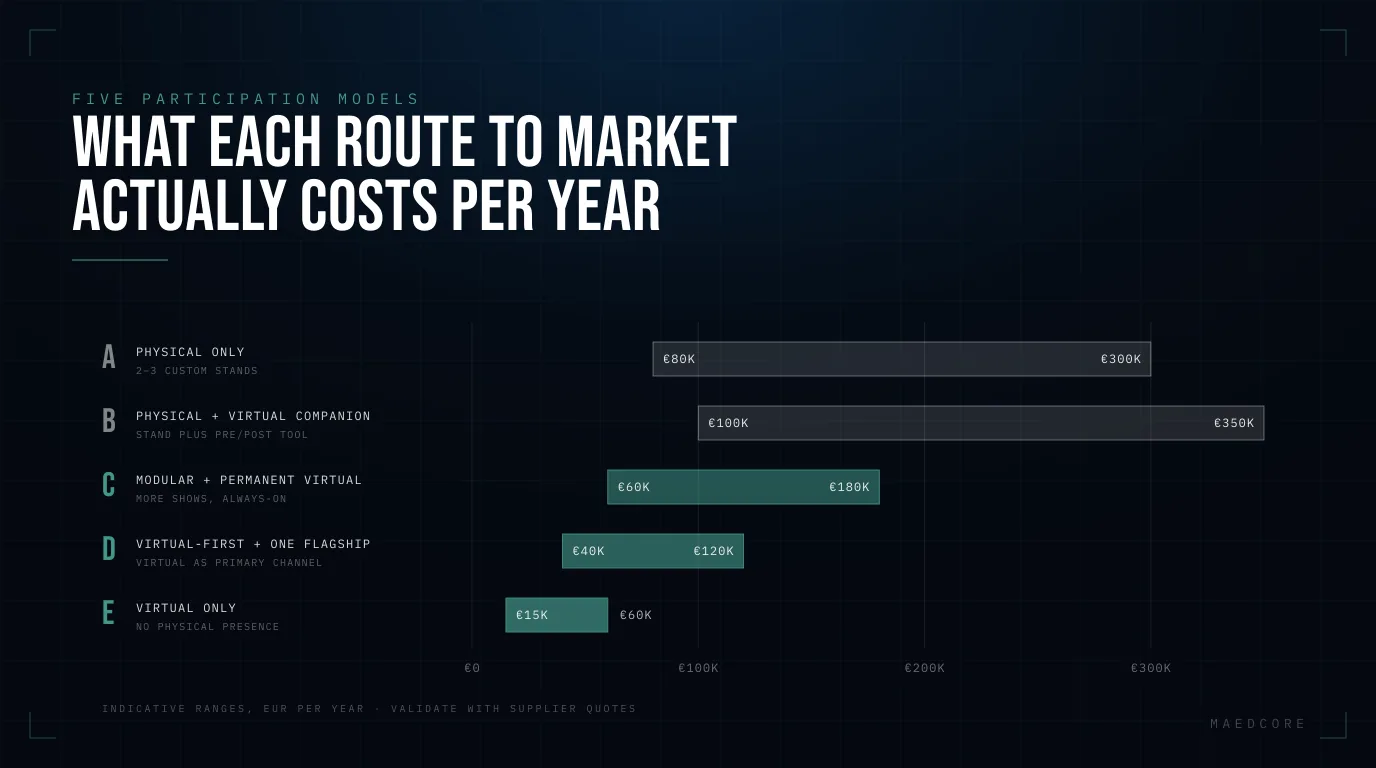
This is the analysis no published article provides: a structured cost comparison across five models, with a fully worked break-even calculation using explicit assumptions for the typical Spanish industrial manufacturer.
The Five Participation Models
| Model | Description | Indicative cost range (EUR/year) | Best suited for |
|---|---|---|---|
| A. Physical only | Custom stand at 2–3 major shows (e.g. IFEMA + Hannover Messe) | €80,000–€300,000/year | Established brands, high-touch selling, machinery requiring live demo |
| B. Physical + virtual companion | Physical stand + virtual showroom as a pre/post-show tool | €100,000–€350,000 (Year 1); €85,000–€310,000 (Year 2+) | Companies wanting to extend reach beyond the 3-day window |
| C. Modular physical + permanent virtual | Modular stand at more shows + always-on virtual showroom | €60,000–€180,000/year | Mid-size industrials, multiple product lines, export focus |
| D. Virtual-first + selective physical | Virtual showroom as primary channel; physical presence at 1 flagship show only | €40,000–€120,000/year | Scale-ups, heavy but shippable products, international buyers |
| E. Virtual only | No physical presence; virtual showroom + digital outreach | €15,000–€60,000/year | Early stage, niche products, geographically dispersed buyers |
The Four Decision Variables
The optimal model does not depend on available budget — it depends on four operational variables.
Variable 1: Product demo requirement
- Physical demo essential (machinery >500 kg, hazardous, requires live operation): +3 for physical
- 3D/VR demo sufficient (software, components, systems): +3 for virtual
- Hybrid demo feasible (scale model + VR for the full system): 0
Variable 2: Annual show frequency
- 1 show/year: virtual showroom amortisation likely in Year 1; +3 for virtual
- 2–3 shows/year: break-even in Year 2–3; +1 for virtual
- 4+ shows/year: physical asset amortisation improves; 0
Variable 3: Geographic reach objective
- Domestic market only: physical presence at IFEMA sufficient; +2 for physical
- EU export markets: virtual showroom eliminates travel barriers for international buyers; +2 for virtual
- Global: virtual essential; +3 for virtual
Variable 4: Product transport cost
- <€5,000 per show (portable, lightweight): physical cost manageable; +1 for physical
- €5,000–€20,000 per show (mid-weight machinery): break-even analysis required; 0
-
€20,000 per show (heavy/bulky industrial equipment): compelling ROI for virtual; +3 for virtual
The Worked Break-Even Calculation
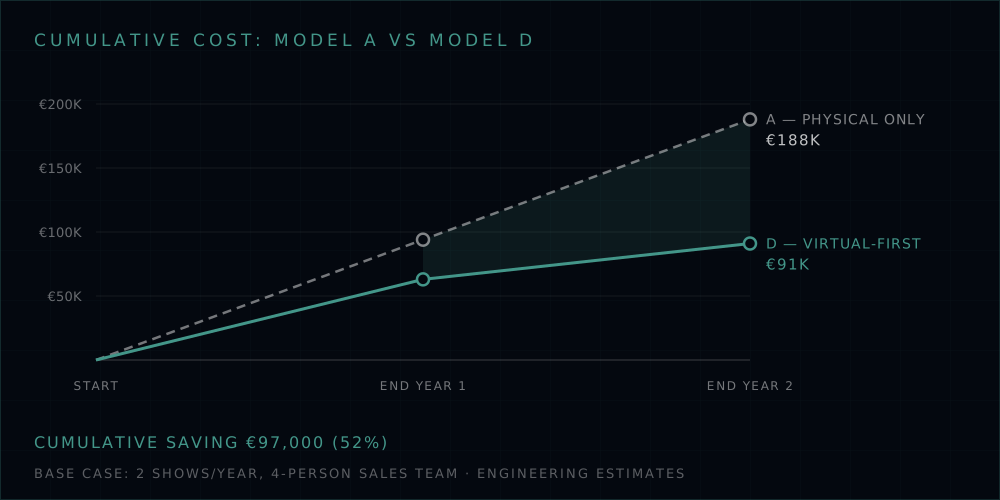
Base case: Spanish industrial machinery manufacturer, 2 shows/year (IFEMA + 1 German show), 4-person sales team
| Cost item | Model A — Physical only | Model D — Virtual-first + selective physical |
|---|---|---|
| IFEMA stand (30 m², custom) | €25,000 | €12,000 (modular) |
| German show stand (20 m², custom) | €35,000 | €0 (virtual only) |
| Freight and logistics (2 shows) | €18,000 | €4,000 (1 show) |
| Travel and accommodation (4 people, 2 shows) | €16,000 | €4,000 (1 show) |
| Virtual showroom build (Year 1) | €0 | €35,000 |
| Virtual showroom maintenance (annual) | €0 | €8,000 |
| Total Year 1 | €94,000 | €63,000 |
| Total Year 2 | €94,000 | €28,000 |
| Cumulative 2-year total | €188,000 | €91,000 |
Explicit assumptions: IFEMA floor space at €200/m²; stand build at €600/m² (mid-range); German show at €800/m² build; 4 people × 3 nights × €200/night + €400 flight; virtual showroom at mid-range industrial build cost. All figures are engineering estimates — validate with real supplier quotes before making decisions.
Year 1 savings: €31,000 (33%). By the end of Year 2, cumulative savings exceed €97,000 (52%). The virtual showroom development cost (€35,000) breaks even within the first year of operation.
What the Calculation Does Not Capture
This cost model has limitations worth naming explicitly. It does not quantify the difference in lead quality: face-to-face interactions generate higher short-term intent leads, while the virtual showroom compensates with volume and geographic reach. It does not include the opportunity cost of reduced attendance: with attendance still 12.9% below 2019, a manufacturer investing €94,000 in physical presence is accessing a smaller audience than they paid for before the pandemic. And it does not model the virtual showroom’s value as a permanent asset: unlike a stand that generates leads for 3 days, a virtual showroom operates 365 days a year. Companies that combine virtual appointments with physical stands report 32% more qualified leads compared to physical-only strategies.
The most extreme documented case is Multiphoton Optics, a manufacturer that previously exhibited at 7–10 global events per year with heavy equipment: by introducing VR, they reduced their exhibition carbon footprint by 98.5% — from 96.1 tonnes of CO₂ per round trip to 1.4 tonnes, with logistics savings fully covering the annual salaries of two additional engineers.
Common Failure Modes on Both Sides
Experience on industrial visualisation projects reveals recurring error patterns on both sides of this decision.
On the physical stand: budgeting only for floor space and structure, then receiving drayage, power and penalty invoices that push the total 40–60% over budget; failing to capture leads digitally (only 54% of exhibitors use lead-capture apps, meaning nearly half still rely on business cards); and refreshing graphics less frequently than their one-year average lifespan demands.
On the virtual showroom: low-resolution 3D models that destroy credibility for precision industrial equipment; no CRM integration, generating traffic but no pipeline; and treating the project as a one-time deliverable rather than a living asset.
In a 3D industrial animation project we built for a rolling mill line manufacturer, the visual asset simultaneously served as a sales tool for international buyers who could not visit the plant and as a technical demonstration for the client’s engineering team — two use cases a conventional physical stand cannot cover at the same time. The project is documented in Industrial 3D Animation: Selling Twin Factories with Maedcore.
Frequently Asked Questions: Virtual Showroom vs. Industrial Trade Show Booth
How much does a trade show booth at a major industrial exhibition cost?
The all-in cost ranges from €15,000 to €60,000 per edition for a 20–50 m² stand, combining floor rental (€100–€300/m²), stand build (€400–€1,200/m²), logistics and staffing. The most frequently omitted items are drayage, annual graphics refresh and venue services, which according to EXHIBITOR Magazine collectively account for around 35% of the total budget.
How quickly does a virtual showroom pay back against physical trade show participation?
With two top-tier physical shows per year, a mid-range industrial virtual showroom (€35,000 development cost) generates net savings from Year 1 if it replaces at least one physical participation. The worked calculation in this article shows €31,000 in Year 1 savings and €97,000 cumulative over two years compared to the physical-only model, using conservative and explicit assumptions.
Do virtual showroom leads have the same quality as trade show leads?
Available sources show a genuine tension: face-to-face interactions generate higher immediate-intent leads (81% of attendees have purchasing authority, according to CEIR), while virtual showrooms generate greater volume and geographic reach. The key distinction is that a virtual showroom operates 365 days a year and captures international buyers who cannot travel — complementing rather than replacing the trade show.
Which industrial manufacturers should prioritise a virtual showroom over trade shows?
Manufacturers with the highest potential ROI from a virtual-first model are those with heavy machinery (logistics >€20,000 per show), export targets in EU or global markets, and 2–3 annual show participations. Manufacturers whose value proposition requires a live operational demo and who sell exclusively in their domestic market have fewer arguments for reducing physical presence.
How much does it cost to maintain an industrial virtual showroom each year?
Annual maintenance includes hosting and platform fees (€3,000–€6,000) and content updates (€5,000–€15,000 for environments with complex 3D models), for a total range of €8,000–€21,000 per year. This recurring cost should be compared against the annual graphics refresh on a physical stand and the staffing and logistics costs of each show participation.
Can you combine a physical trade show presence with a virtual showroom without doubling the budget?
Yes — and it is the model with the strongest documented ROI. Companies that combine virtual appointments with physical stands report 32% more qualified leads compared to physical-only strategies, according to Iconic Displays data. The key is using the virtual showroom as a pre-qualification tool before the show and as a post-event follow-up channel, allowing you to reduce the physical stand footprint without losing reach.
Related reading
- OmniViewer in Action: Inside Maedcore’s VR Showroom for Industrial Machinery
- VR Showroom for Industrial Machinery Sales: How to Close More Deals Without Moving the Equipment
- Virtual Sales Demos for Industrial Machinery: How to Close Deals Without a Factory Visit
- How to Calculate the ROI of a Virtual Demo for Industrial Machinery Sales
- Digital Twin Showrooms for Industrial Machinery Manufacturers
- From CAD File to Virtual Showroom: How to Turn Your Product Catalogue into a Digital Twin
Sources
- Trade Show Costs: A Complete Breakdown for Exhibitors — Buzz Impressions, 2026 (citing CEIR 2024 and EXHIBITOR Magazine)
- CEIR Releases Q4 2024 Index Results — CEIR / IAEE, March 2025
- UFI Global Exhibition Industry Statistics 2025 — UFI and Oxford Economics, May 2025
- AFE approves accounts and annual report — Spanish trade fair sector 2026 — AFE / Oxford Economics, 2026
- IFEMA MADRID billed 230.2m euros in 2024 — Travel Daily News / IFEMA, 2025
- IFEMA Madrid economic impact — Madrid es Noticia / PwC report, May 2025
- IFEMA Madrid 2026 Trade Fair Calendar: Complete Guide for Exhibitors — Adam Expo Stand, 2026
- How much does it cost to design a trade show stand in Spain — Connecting Project, March 2026
- What Does it Cost to Exhibit at a Trade Show? — Metro Exhibits, 2025 (citing EXHIBITOR Magazine)
- 47 Trade Show Statistics Shaping 2025 and Beyond — Cvent, June 2025
- Virtual Showrooms vs Physical Stores: Cost Analysis — Dagger Interactive, 2025
- How VR Can Significantly Reduce a Company’s Carbon Footprint — VRgineers / Multiphoton Optics case study, 2019
- 85+ Manufacturing Lead Generation Statistics — Manufacturing Lead Generation, February 2026
- Virtual Showroom Guide 2026 for Trade Show Exhibitors — Iconic Displays, December 2025
- Trade Show Statistics 2026: 50+ Data Points — Trade Show PRO, February 2026
- Industrial 3D Animation: Selling Twin Factories with Maedcore — Maedcore, case study
About the Author
Robotics Engineer
For over a decade, I have been driven by a single mission: leveraging AI and robotics to build a world of automated production. I believe that by creating self-sufficient systems, we can empower people to refocus on what truly matters—their families and their passions. My expertise spans from winning prestigious European startup competitions to architecting complex, integrated hardware and software projects. I specialize in bridging the gap between today's industrial challenges and tomorrow's autonomous solutions.
Frequently Asked Questions
How much does a trade show booth at a major industrial exhibition cost?
How quickly does a virtual showroom pay back against physical trade show participation?
Do virtual showroom leads have the same quality as trade show leads?
Which industrial manufacturers should prioritise a virtual showroom over trade shows?
How much does it cost to maintain an industrial virtual showroom each year?
Can you combine a physical trade show presence with a virtual showroom without doubling the budget?
Ready to transform your company?
Book a free 30-minute meeting with an engineer.