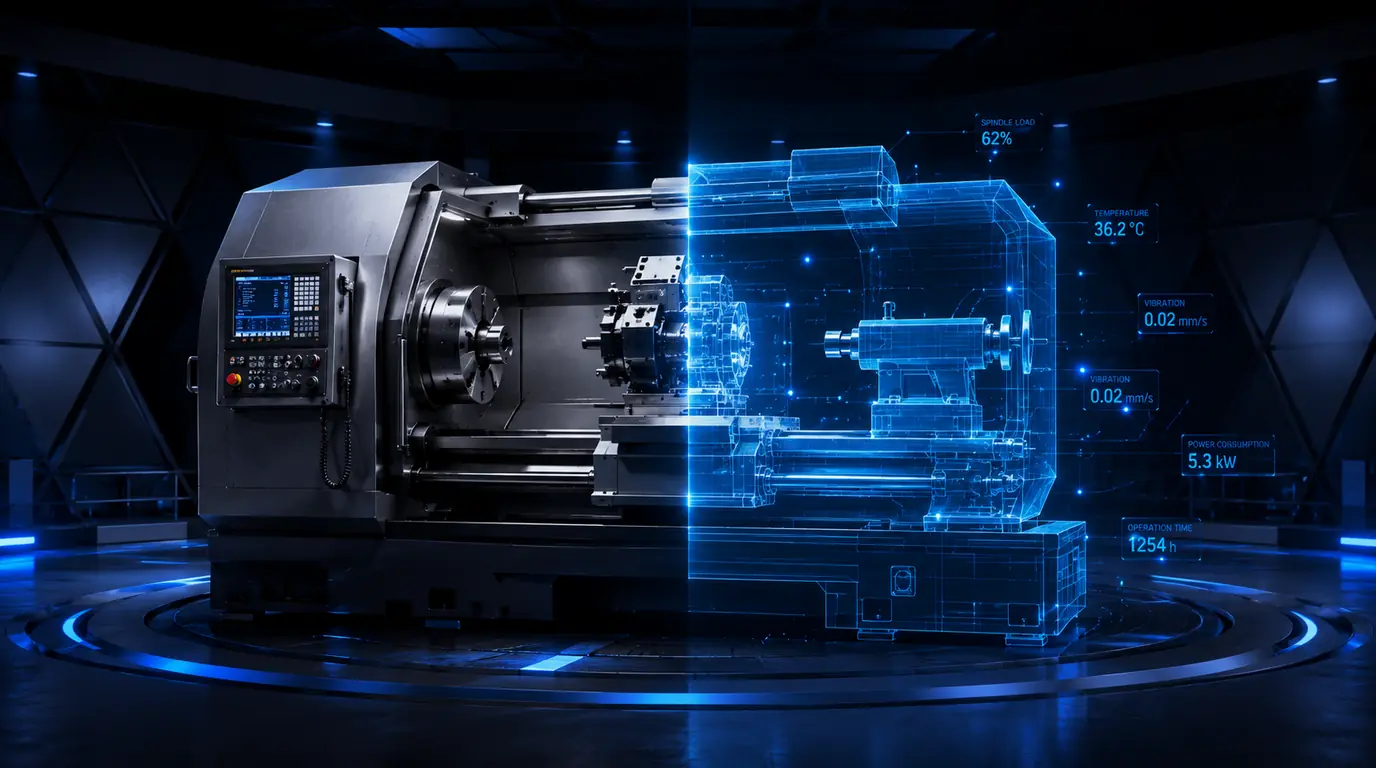
VR Showroom for Industrial Machinery Sales: How to Close More Deals Without Moving the Equipment
Exhibiting heavy machinery at a trade show costs €40,000–€100,000 per event. Learn how a VR showroom lets your team run full-scale demos anywhere.

Written by Eduardo Fuentevilla Blanco
Robotics Engineer at Maedcore · Robotics Engineer LinkedIn ↗
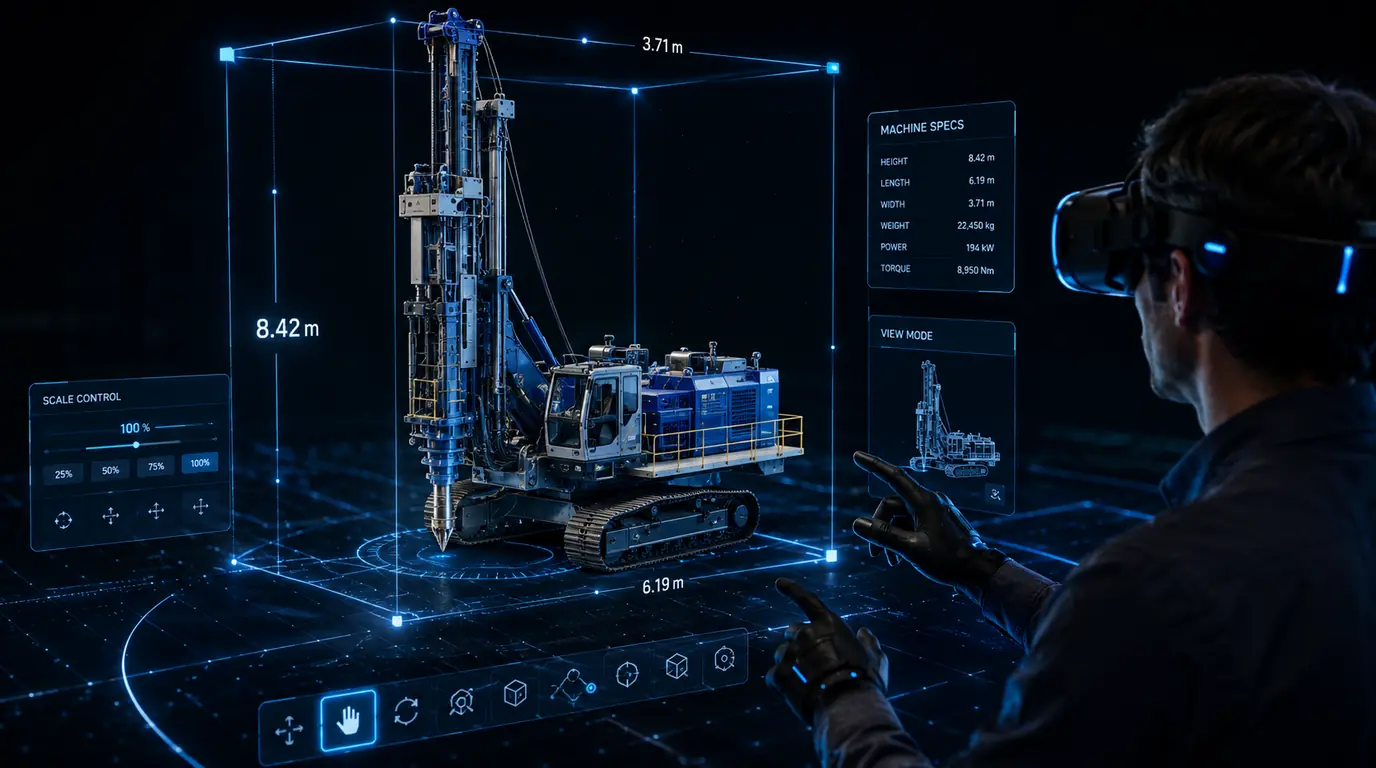
Key Takeaways
- ► Exhibiting heavy machinery at a trade show costs €40,000–€100,000 per event; a programme of 3–5 shows per year can exceed €300,000 in annual spend.
- ► The break-even point for a Tier 2 VR showroom (€52,000 in Year 1) is reached by closing just 3 additional deals annually at an average ticket of €120,000.
- ► Only 3.3% of Spanish factories have full digitalisation, creating a real competitive advantage window for early adopters of immersive sales tools in that market.
- ► The longest and most underestimated phase of any VR showroom project is 3D asset optimisation from engineering CAD — it can consume 40–60% of the total project timeline.
- ► In relationship-driven industrial markets, the co-piloted demo format (sales rep + buyer on a video call) consistently outperforms self-service models.
- ► EK Interactive documented a 150% increase in conversions after implementing a virtual showroom; ChargePoint Technology cut trade show costs by 50% without reducing lead generation.
Exhibiting heavy machinery at a European trade show costs between €40,000 and €100,000 per event and, at best, reaches around 500 qualified visitors. An industrial VR showroom eliminates that logistics cost and lets a sales team run true-to-scale demos for buyers anywhere in the world — with average session times of 14 minutes and conversion uplifts of up to 150% in documented cases. This guide breaks down real costs, the current market context, and a step-by-step decision framework so any technical sales director can evaluate whether — and at what level — the investment makes sense right now.
The Real Cost of Taking a Machine to a Trade Show: Why the Traditional Model Is Breaking Down
Exhibiting heavy machinery at a trade show costs €40,000–€100,000 per event; with three to four shows a year, the annual programme can exceed €300,000 — and reach is still limited.
Let’s break down the line items honestly. According to data from Buzz Impressions and ExOptions — both drawing on CEIR and EXHIBITOR Magazine research — the cost profile for a machinery manufacturer exhibiting a piece weighing more than five tonnes looks like this:
| Cost Item | Typical Range |
|---|---|
| Space rental (20 m²) | €8,000–€15,000/show |
| Stand design and build | €10,000–€30,000/show |
| Heavy transport and rigging (>5 t) | €15,000–€40,000/show |
| Travel and accommodation (4 people, 3 days) | €4,000–€8,000/show |
| Pre- and post-show marketing | €3,000–€8,000/show |
| Total per show | €40,000–€100,000 |
| Shows per year (typical programme) | 3–5 |
| Estimated annual spend | €120,000–€500,000 |
Note: the transport and rigging range for machinery >5 t is an engineering estimate consistent with market data; no primary source verifies it directly for the European market.
Industrial trade shows are not dead: more than 6.5 million people visited Spanish exhibition venues in 2023, with 40–60% holding purchase decision authority (Sequio, 2025). The problem is not that trade shows don’t work; it is that their opportunity cost has changed.
Cost per Lead: Where the Sources Disagree
There is an important discrepancy here that deserves attention. Trade Show Labs puts the average cost per lead generated at a trade show at $112. Sopro puts it at $840 for in-person events — the most expensive channel of all those analysed.
The reconciliation is technical: the $112 figure reflects a raw lead (a badge scanned, a contact captured). The $840 figure reflects a qualified lead with verified purchasing authority. For industrial machinery — where a “lead” without real budget and mandate is worthless — the $840 benchmark is the operationally honest one. CEIR data compiled by PureXhibits confirms that closing a trade show lead costs $811 versus $1,039–$1,356 for a field visit; the difference exists, but the absolute cost remains high.
Adding to this, trade shows absorb around 40% of the total B2B marketing budget, and 68% of exhibitors anticipate internal cost pressure as one of their main challenges in the coming years. The question is not whether trade shows have value, but whether that value justifies the cost when alternatives exist that extend reach without adding logistics.
The Industrial Machinery Market: Digitalisation at Two Speeds
Only 3.3% of factories have full digitalisation, yet the industrial sector accounts for 52% of total manufacturing output — that gap defines exactly where the competitive advantage window lies for early movers in immersive sales tools.
Spain occupies an intermediate position in the European digitalisation index: it stands out in connectivity and digital skills, but shows a notable lag in deep OT/IT integration, especially among manufacturing SMEs, according to Ecosistema Startup citing Eurostat 2025 data.
Global headlines can be misleading. The fact that 48% of manufacturers worldwide are investing in 3D visualisation tools in 2025 sounds promising, but that figure comes from a KBMax/Epicor study with a strong Anglo-Saxon market bias. The reality in Southern Europe and other relationship-driven industrial markets is more conservative: the VIII Smart Industry Report 2025 notes that more than 70% of the companies analysed identify a shortage of digital and industrial talent as one of their main transformation barriers.
The reading is twofold: the market is less saturated with VR showroom solutions than Germany or North America — a real advantage for early adopters — but the tool must be designed to be guided by a human, not as a self-service portal, because industrial buying culture in relationship-driven markets remains deeply personal.
What an Industrial VR Showroom Is — and How It Differs from a 3D Catalogue
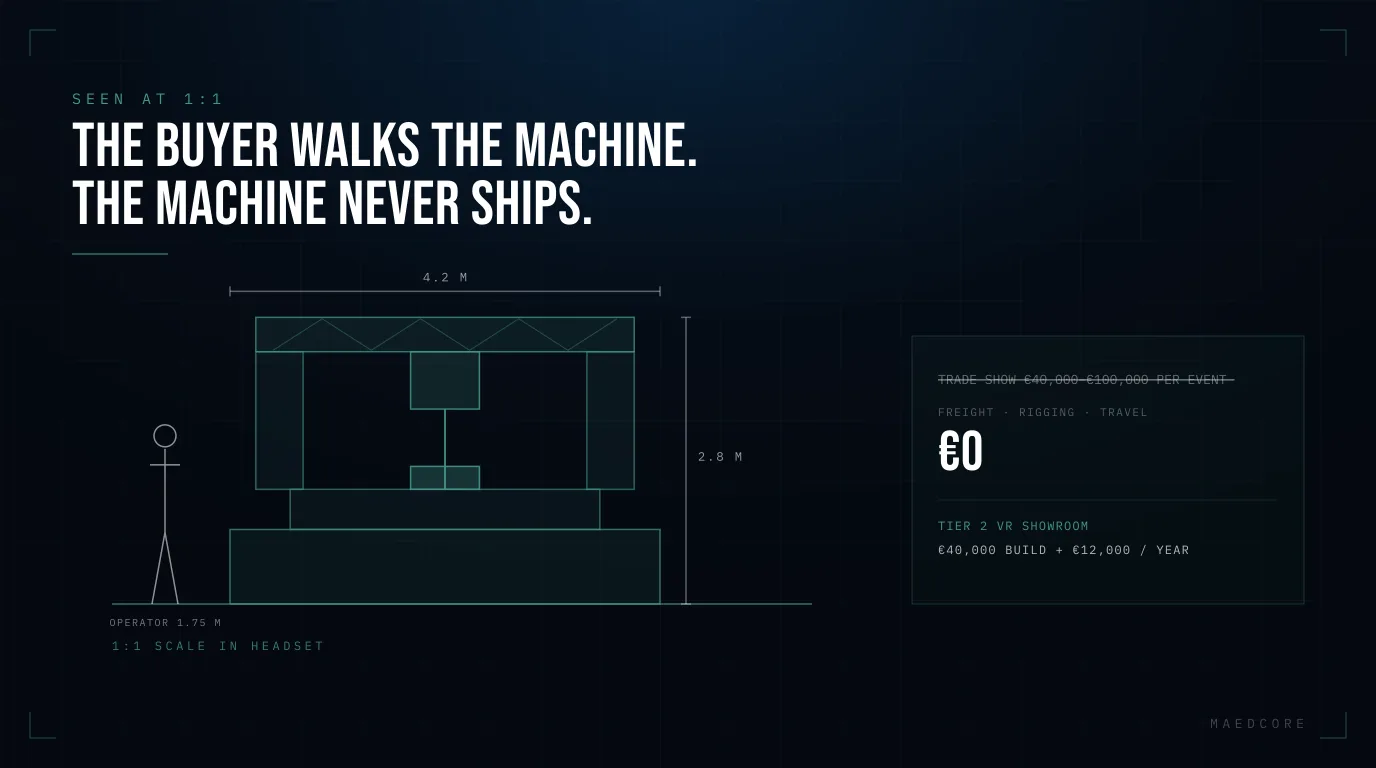
An industrial VR showroom is not an interactive PDF or a product video: it is a navigable environment where the buyer can inspect the machine at true scale, open panels, watch operating cycles and ask questions — all without leaving their office.
Terminological confusion is common, so it is worth distinguishing three layers clearly, following the taxonomy used by Frame Sixty and ScienceSoft:
- Web3D viewer: a browser-based navigable 3D model, no headset or installation required. The buyer rotates, zooms and explores the machine from their computer. The lowest entry point in cost and friction.
- Guided VR demo (co-piloted): a live session where the sales rep walks the buyer through the 3D or VR environment while they talk on a video call. Can run via WebXR in a browser or with a headset on the seller’s side. This is the most suitable format for relationship-driven industrial sales cultures.
- Always-open immersive showroom: a fully self-navigable environment, available 24/7, CRM-integrated, with session analytics. Designed for multi-product distributors or manufacturers with high volumes of inbound demo requests.
Engagement data supports the investment: sessions in digital sales rooms with a 3D component last an average of 14 minutes, and engagement time rises 28% compared with non-immersive formats, according to Market Growth Reports. And in B2B sales cycles of three to nine months, where the average number of buying interactions per significant deal jumped from 17 in 2019 to 27 in 2021 (Cirrus Insight / Forrester), every memorable touchpoint counts.
Tools in this space — Omni Viewer, built by Maedcore, among them — are designed specifically for the co-piloted demo model: the sales rep opens the session, navigates the buyer through the machine in 3D and answers technical questions in real time, with neither party needing to install anything or travel anywhere.
The market is moving the same way: the global virtual showroom segment was valued at $4.55 billion in 2023 and is projected to reach $18.31 billion by 2030, according to Market Growth Reports.
Decision Framework: Should Your Company Invest in a VR Showroom Right Now?
This section develops the one analysis that does not exist anywhere else: a structured framework, with real numbers and explicit assumptions, for a technical sales director at an OEM to evaluate whether the investment makes sense — and at what level.
Step 1 — Trade Show Cost Audit (Trigger Calculation)
Before evaluating any alternative, calculate your real annual trade show spend. If the result exceeds €80,000 and your average deal size exceeds €50,000, move to Step 2. If not, a VR showroom is probably not your priority investment right now.
Use the table in the first section as your template. For a company with three shows a year at €50,000 each, annual spend is €150,000 — the figure we will use in the break-even calculation below.
Step 2 — 3D Asset Audit
The most valuable asset you already own is your CAD files. The longest phase of any VR showroom project is not platform development: it is 3D model preparation. Engineering CAD files (SolidWorks, CATIA, NX) are designed for structural analysis, not real-time rendering; they contain millions of polygons where a VR environment needs fewer than 100,000 per object. That reduction — polygon reduction and texture baking — is where time and money go if it is not planned from the start.
| Question | Yes | No |
|---|---|---|
| Do you have parametric CAD files for your key machines? | → Eligible for Tier A directly | → Add €15,000–€40,000 for 3D modelling from scratch |
| Are your machines configurable (variants, options)? | → You will need a configurator | → A static model is sufficient |
| Do you sell to export markets outside your home country? | → Multiply the projected ROI | → Local-only use case |
| Does your buyer need to see the machine in the context of their own plant? | → Full VR justified | → Web3D viewer may be sufficient |
Step 3 — Tier Selection Matrix
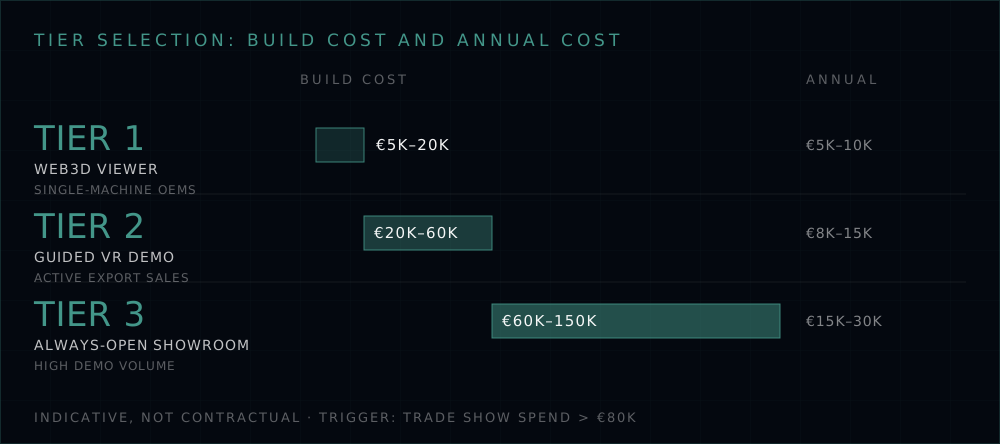
| Tier | Description | Build Cost | Annual Cost | Best For |
|---|---|---|---|---|
| Tier 1 — Web3D Viewer | Browser-based 3D model, no headset | €5,000–€20,000 | €5,000–€10,000 | Single-machine OEMs, SMEs, first step |
| Tier 2 — Guided VR Demo | Co-piloted session, WebXR or headset | €20,000–€60,000 | €8,000–€15,000 | Multi-product OEMs, active export sales |
| Tier 3 — Always-Open Showroom | Fully self-navigable, CRM-integrated | €60,000–€150,000 | €15,000–€30,000 | Distributors, multi-brand, high demo volume |
Cost ranges based on market data from ScienceSoft, DesignersX and VISARD; treat as indicative, not contractual.
Step 4 — Break-Even Calculation (With Explicit Assumptions)
This calculation is illustrative. Assumptions are marked as such; replace them with your own numbers.
Assumptions:
- Annual trade show spend: €150,000 (3 shows × €50,000)
- Tier 2 VR showroom investment: €40,000 build + €12,000/year = €52,000 in Year 1
- Current reach: ~500 qualified visitors per year across three shows
- Projected reach with VR: 200 guided demo sessions per year (conservative estimate for a sales team of 3–4 people)
- Current demo-to-proposal conversion rate: 34% (industrial machinery industry benchmark, per Atwix 2025)
- Post-VR demo-to-proposal conversion rate: 51% (applying a 50% uplift over the benchmark, based on the EK Interactive case — 150% documented increase per MARTECH3D — halved to remain conservative for industrial machinery)
- Average deal value: €120,000
Result:
- Conversion rate difference: 51% − 34% = 17 additional percentage points
- Over 200 demos: 34 additional potential proposals
- Applying industry close rate (24–35%, using 28%): ~9–10 additional deals closed
- Incremental value: 9 × €120,000 = €1,080,000 in potential additional revenue
- Real break-even point: if the VR showroom closes 3 additional deals per year that would not otherwise have closed, the Year 1 investment is covered.
This calculation does not include trade show cost savings (if you reduce the number of events), nor the value of demos in export markets where shipping the machine was previously logistically impractical. Both factors improve the projected ROI.
Step 5 — Go/No-Go Verdict
| Profile | Verdict |
|---|---|
| Trade show spend >€80k + CAD files available + export markets | GO — Tier 2 or Tier 3 |
| Trade show spend €40k–€80k + domestic market only | GO — Tier 1, with upgrade path |
| Trade show spend <€40k + no export ambition | NO — Invest in digital catalogue first |
The Most Common Failure Modes: What Goes Wrong in Practice
Most articles about VR showrooms are promotional. This section covers the most frequent failures observed in real projects, so you can avoid them.
1. Poor 3D asset quality. This is the single most common cause of abandoned projects. Without the optimisation pass described in Step 2, the result is a slow environment with visual artefacts that convinces no technical buyer.
2. No integration into the sales process. A VR showroom that lives outside the CRM is a marketing toy, not a sales tool. More than 80% of enterprise-level digital sales rooms are integrated with CRM, session analytics and lead capture workflows, according to Market Growth Reports. Define the handoff flow before you build, not after.
3. Hardware friction on the buyer’s side. Asking a buyer to install software or use a headset they don’t own kills adoption. The fix is to prioritise browser-based delivery (WebXR or WebGL) and reserve the headset experience for in-person events or buyers already in an advanced stage.
4. Stale content. A showroom built on the 2024 model becomes a liability when the 2026 version ships. Maintenance costs are typically 15–20% of the build cost annually, according to DesignersX. Budget for content updates from Day 1.
5. Ignoring relationship-driven buying culture. Industrial buyers — especially in sectors like food processing machinery, machine tools, or aerospace manufacturing — expect a human counterpart, not a self-service portal. The VR showroom works best as a co-piloted experience: sales rep and buyer on a video call, with the seller navigating the environment and answering questions in real time. Projects that have attempted a pure self-service model in relationship-driven markets have seen very low adoption rates.
6. No pilot before full commitment. Without clear ROI visibility, implementation tends to be delayed indefinitely. The fix is to run a 90-day pilot with two or three machines and ten to fifteen guided demos before committing to a full catalogue.
Realistic Implementation Timelines
Time estimates are as important as cost estimates. Based on experience in industrial 3D visualisation projects — including work such as the industrial 3D animation for twin-factory sales and the multi-world VR platform on Meta Quest — typical timelines are:
- Tier 1 (Web3D viewer, existing CAD): 4–8 weeks from CAD file delivery to production deployment.
- Tier 2 (Guided VR demo): 8–16 weeks, including 3D asset optimisation, platform configuration and sales team training.
- Tier 3 (Full immersive showroom): 4–9 months for a custom build with CRM integration and full QA.
The longest phase is always 3D asset preparation, not platform development. If your CAD files are not optimised for real-time rendering, that step can consume 40–60% of the total project timeline.
Frequently Asked Questions
How much does a VR showroom for industrial machinery cost?
It depends on the complexity tier. A basic Web3D viewer built from existing CAD files can be ready for €5,000–€20,000 in build cost plus €5,000–€10,000 per year in maintenance. A mid-level co-piloted VR demo costs €20,000–€60,000 to build. A fully self-navigable immersive showroom with CRM integration can cost €60,000–€150,000, according to ScienceSoft and DesignersX. Annual maintenance is typically 15–20% of the build cost.
Will industrial buyers actually engage with VR demos?
Yes, if the format is right. Industrial buyers in relationship-driven markets will not readily adopt a self-service portal, but they do engage well with co-piloted demos where a sales rep guides them through the 3D environment during a video call. MEON UK documented a 32% increase in leads at live events after implementing their 3D showroom, according to MARTECH3D. Designing the experience as a guided session — not self-service — is the differentiating factor in relationship-driven markets.
Can I use my existing CAD files directly in a VR showroom?
You can use them as a starting point, but not directly in production. Engineering CAD files (SolidWorks, CATIA, NX) contain millions of polygons designed for structural analysis, not real-time rendering. They require an optimisation process — polygon reduction and texture baking — that costs €3,000–€15,000 per machine depending on complexity, and is the phase most frequently underestimated in initial budgets.
Does a VR showroom completely replace trade show presence?
No, and it should not be framed that way. Trade shows generate serendipity, networking and brand visibility that a digital showroom does not replicate. The most effective model is to use the VR showroom to eliminate lower-performing shows, reduce the number of physical machines transported, and extend reach to buyers who would never have travelled to an exhibition. ChargePoint Technology, for example, saved 50% in trade show costs while maintaining or increasing lead generation, according to MARTECH3D.
How many additional deals do I need to close for the VR showroom to pay for itself?
Using the assumptions in this article’s decision framework — Tier 2 at €52,000 in Year 1, average deal value of €120,000, close rate of 28% — the break-even point is reached by closing just three additional deals per year that would not otherwise have progressed. That is a conservative threshold for any active technical sales team selling complex industrial equipment.
Related reading
- OmniViewer in Action: Inside Maedcore’s VR Showroom for Industrial Machinery
- Virtual Showroom vs. Industrial Trade Show Booth: A Real Cost and ROI Comparison
Sources
- Trade Show Costs: A Complete Breakdown for Exhibitors — Buzz Impressions / CEIR & EXHIBITOR Magazine, 2026
- Trade Show Budgeting: The Real Cost of Exhibiting — ExOptions / CEIR & EXHIBITOR Magazine, 2026
- Trade Show Statistics 2025: Industry Data, Trends & ROI Insights — Wave Connect, 2025
- Trade Show Statistics 2026 — PureXhibits / CEIR, 2026
- 150+ Trade Show Statistics for 2026 — Trade Show Labs, 2026
- B2B Cost Per Lead Benchmarks by Channel and Industry — Sopro, 2025
- Ferias industriales en España 2026 — Sequio, 2025
- Industria 4.0 España: solo 3,3% de fábricas digitalizadas — Ecosistema Startup / Eurostat 2025, 2026
- VIII Informe Smart Industry 4.0 — Claves 2025 — LYL Ingeniería / Smart Industry, 2025
- Virtual Reality in B2B Sales — KBMax/Epicor, 2025
- Digital Sales Room Software Market Size & Forecast — Market Growth Reports, 2026
- Global B2B Sales Statistics & Buying Behavior — Cirrus Insight / Forrester & Demand Gen Report, 2026
- B2B eCommerce Conversion Rate Benchmarks 2025 — Atwix, 2026
- How the Virtual Showrooms Generate ROI — MARTECH3D, 2024
- What Is a Virtual Showroom? AR Try-On, WebAR, and Full VR Explained — Frame Sixty, 2025
- Virtual Reality (VR) Showroom: A Tech Guide — ScienceSoft, 2024
- Virtual Showroom Development: Costs and Implementation Guide — DesignersX, 2024
- Industrial 3D Visualization Platform VISARD — VISARD, 2024
- Industrial 3D Animation: Twin-Factory Sales with Maedcore — Maedcore
- VR Systems Engineering: Multi-World Platform on Meta Quest and Field Deployment — Maedcore
About the Author
Robotics Engineer
For over a decade, I have been driven by a single mission: leveraging AI and robotics to build a world of automated production. I believe that by creating self-sufficient systems, we can empower people to refocus on what truly matters—their families and their passions. My expertise spans from winning prestigious European startup competitions to architecting complex, integrated hardware and software projects. I specialize in bridging the gap between today's industrial challenges and tomorrow's autonomous solutions.
Frequently Asked Questions
How much does a VR showroom for industrial machinery cost?
Will industrial buyers actually engage with VR demos?
Can I use my existing CAD files directly in a VR showroom?
Does a VR showroom completely replace trade show presence?
How many additional deals do I need to close for the VR showroom to pay for itself?
Ready to transform your company?
Book a free 30-minute meeting with an engineer.