Industrial Process Digitalisation: What Works, What Doesn't, and Where to Start (With Real Numbers)
A three-layer framework for sequencing industrial process digitalisation in manufacturing SMEs: real costs, failure rates, and ROI with explicit

Written by Eduardo Fuentevilla Blanco
Robotics Engineer at Maedcore · Robotics Engineer LinkedIn ↗
Key Takeaways
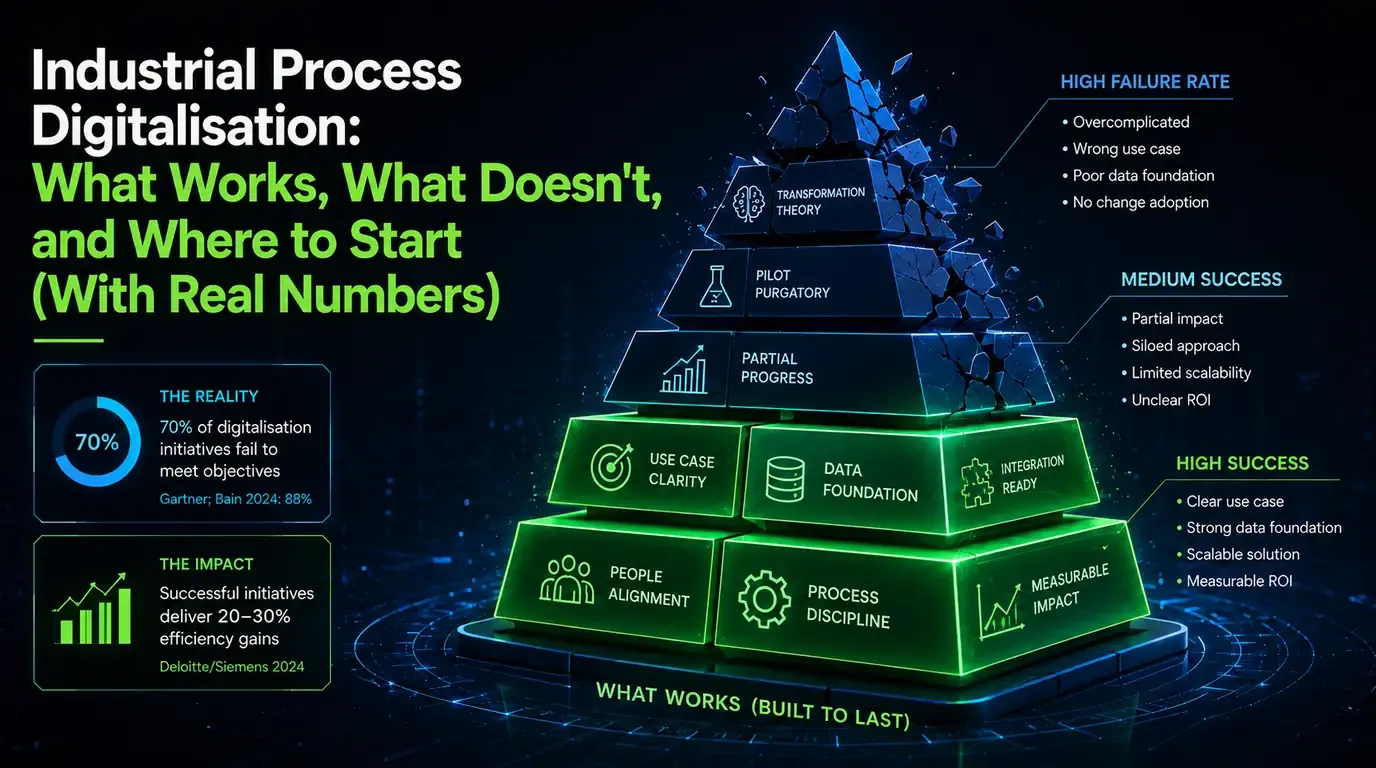
- ► Between 70% (Gartner) and 88% (Bain 2024) of industrial digitalisation projects fail to meet their objectives — the most common cause is not the technology chosen but the order in which it is applied.
- ► Layer 0 — a physical process stability audit — is the prerequisite no vendor includes in their proposal and the single factor that most determines whether the rest of the project succeeds.
- ► Realistic three-layer cost for an 80-employee manufacturing SME is approximately €195,000 gross in Year 1; with a 35% ERDF subsidy, the net falls to ~€127,000 and combined payback sits at ~14 months.
- ► IIoT sensor costs have fallen 60% since 2020, making retrofit instrumentation viable for plants that could not justify the investment three years ago.
- ► A misconfigured OT system causes a safety incident, not just a service outage: the ISA/IEC 62443 zone architecture must be designed before the first sensor connects to the network.
- ► The right AR pilot starts with 5–10 users and one workflow, with a 50/50 hardware-to-content budget split — spending €15,000 on headsets and €2,000 on content produces warehouse equipment within 60 days.
Between 70% and 88% of industrial digital transformation projects fail to meet their original objectives — and the most common cause is not the technology chosen, but the order in which it is applied. For a plant or operations manager at a mid-sized manufacturer, that means the statistical probability of failure exceeds the probability of success before a single contract is signed. This article proposes a three-layer framework with pass/fail criteria, realistic costs for an industrial SME, and an ROI calculation with fully declared assumptions — so you can build a business case that holds up under scrutiny.
The Real Gap: Where Manufacturing Stands on Digitalisation
Only 62% of Spanish manufacturing companies have reached a basic level of digitalisation — below the European average of 68.3% — and just 6% operate at a high level, according to the VIII Smart Industry Report 2025. Yet 72% declare they will increase their commitment to Industry 4.0 technologies in the coming years. The gap between stated intention and actual execution is the sector’s most expensive problem.
Spain invests the equivalent of 11.7% of industrial gross value added in intangible assets, compared with a European average of 20%, according to Funcas 2025. More than 70% of companies identify the lack of specialist profiles as the primary barrier to transformation — a skills shortage that technology alone cannot solve.
For manufacturers in the Madrid industrial corridor specifically, the funding landscape matters. The region concentrates 11.1% of national industrial turnover — third behind Catalonia (21.9%) and Andalusia (12.2%) — according to the INE. Some 65% of Madrid’s ERDF digitalisation grants are concentrated in the Henares Corridor (25%) and the Southern Metropolitan area (40%), with subsidy intensity of up to 35% for small enterprises, according to Madrid Actual. The budget grew from €8 million in 2023 to €10 million in 2025 — but the 2024 call exhausted its funds in April. The project must be structured before the call opens, not after reading the resolution.
Why 70–88% of Industrial Digitalisation Projects Fail
The failure rate ranges from 70% (Gartner, via MeltingSpot) to 88% (Bain & Company 2024), depending on how “failure” is defined. A BCG study of more than 850 companies found that only 35% meet their value targets; Integrate.io puts the cost of failed transformations at 12% of annual revenue.
The failure modes that recur across all studies:
1. Dirty data. 64% of organisations cite data quality as their primary integrity challenge, according to Precisely 2025. Deploying AI analytics on poorly calibrated sensor data produces wrong answers that look authoritative.
2. Automating an unstable physical process. A process with uncontrolled variability generates anomalous signals that no algorithm can distinguish from real failures: false alerts, operator distrust, and system abandonment within weeks.
3. Treating OT/IT integration as an IT project. Yokogawa identifies OT/IT collaboration failures as the second leading cause of project failure. A misconfigured IT system causes a service outage; a misconfigured OT system causes a safety incident.
4. Underestimating the cybersecurity attack surface. Manufacturing has been the most ransomware-targeted sector for four consecutive years, accounting for 30% of ransomware activity over the past twelve months, according to the Dragos OT Cybersecurity Year in Review 2025.
Projects that survive share three characteristics: they start with a stable physical process, they define success metrics before buying technology, and they limit initial scope to three to five critical assets with a known downtime cost per hour.
The Three-Layer Framework: How to Sequence Industrial Process Digitalisation
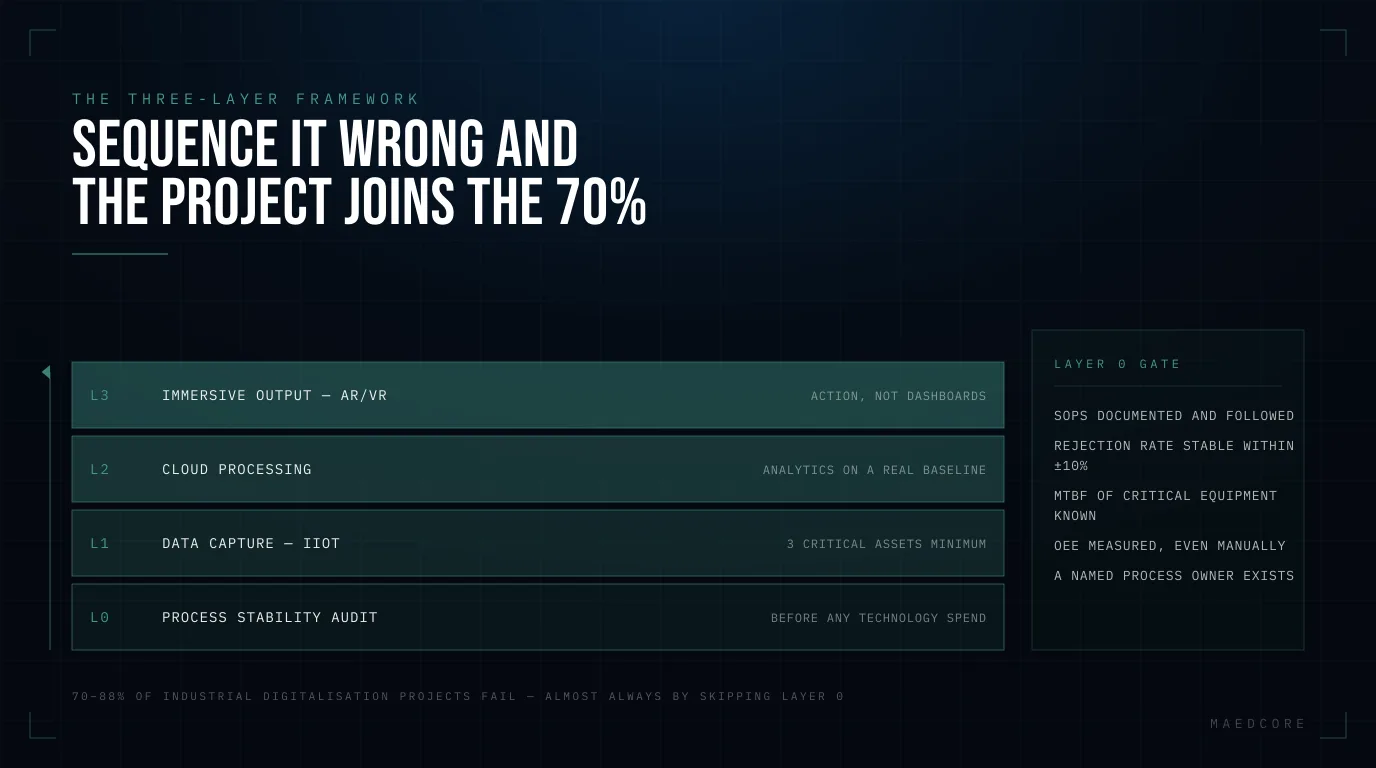
Industrial digitalisation is a chain of dependencies: without clean data there is no useful analytics, and without useful analytics there is no immersive interface that adds value. What follows is the framework we use internally to assess a project’s maturity before recommending any technology investment.
Layer 0 — Process Stability Audit (Before Any Technology)
You cannot digitalise what is not defined. This layer generates no new data — it only verifies that the physical process is stable enough for the data it produces to be interpretable.
| Pass Criterion | Passes | Fails → Required Action |
|---|---|---|
| Are SOPs documented and followed? | Yes | Document first; zero technology spend |
| Is the rejection rate stable (±10% week-on-week)? | Yes | Resolve physical root cause first |
| Is the MTBF of critical equipment known? | Yes | Establish a manual baseline |
| Is OEE measured, even manually? | Yes | Install manual recording first |
| Is there a named process owner? | Yes | Assign accountability before investing |
Realistic duration: 4–8 weeks. Software vendors never include this phase in their proposals because it generates no revenue for them. It is, however, the phase that determines whether the rest of the project will succeed.
Layer 1 — Data Capture (IIoT / Instrumentation)
Layer 1 converts the physical process into digital signals. Its output is not data — it is data of known, documented quality.
| Pass Criterion | Passes | Fails → Required Action |
|---|---|---|
| ≥3 critical assets identified with known downtime cost per hour | Yes | Prioritise by downtime cost |
| OPC-UA or Modbus connectivity confirmed on target machines | Yes | Install retrofit edge gateway |
| Cybersecurity zone architecture defined (ISA/IEC 62443) | Yes | Design OT/IT DMZ first |
| Data quality KPI defined (% completeness, latency SLA) | Yes | Define before go-live |
Real-world hardware: Edge gateways such as the Siemens SIMATIC IOT2050 or Advantech WISE-5000 (€500–2,000/unit); retrofit vibration sensors such as the SKF Enlight Collect IMx-1 or ifm VSE150 (€200–800/sensor). OPC-UA is the non-negotiable standard for OT/IT interoperability. Sensor costs have fallen 60% since 2020, according to Wiss, making retrofit instrumentation viable for plants that could not justify the investment three years ago.
Realistic cost for an industrial SME (20–50 monitored assets):
- Retrofit IIoT sensors + edge gateways: €15,000–45,000
- Integration and commissioning: €10,000–25,000
- Platform/connectivity Year 1: €8,000–18,000
- Layer 1 total Year 1: €33,000–88,000
Realistic duration: 10–16 weeks for installation and data pipeline, plus 12–16 additional weeks of stabilisation before any model can be trained. Vendors promise “immediate insights”; the reality is that models need clean history.
Layer 2 — Cloud Processing and Analytics
Data without decisions is just storage cost. Layer 2 converts Layer 1 signals into actionable recommendations — but only if Layer 1 has produced at least 90 days of clean data.
| Pass Criterion | Passes | Fails → Required Action |
|---|---|---|
| ≥90 days of clean Layer 1 data collected | Yes | Wait; do not advance |
| At least one KPI has improved thanks to a Layer 1 insight | Yes | Validate value before scaling |
| IT/OT security review completed | Yes | Complete before exposing data to cloud |
| Internal “data champion” trained | Yes | Train before buying platform |
Realistic cost:
- Cloud platform (MES overlay, analytics, dashboards): €20,000–60,000/year SaaS
- Integration services (MES/ERP connectors): €15,000–40,000 one-off
- Predictive maintenance model training: €10,000–30,000
- Layer 2 total Year 1: €45,000–130,000
Well-implemented predictive maintenance reduces maintenance costs by 18–25% and unplanned downtime by 30–50%, according to McKinsey and Deloitte/Siemens 2024. Proactive repairs cost four to five times less than emergency repairs on the same asset. 95% of adopters report positive ROI, with 27% achieving full payback within 12 months, according to IoT Analytics.
Layer 3 — Immersive Output and Action (AR/VR)
The human interface to the digital twin is valuable only if Layers 1 and 2 are running and their data is trusted by operators.
| Pass Criterion | Passes | Fails → Required Action |
|---|---|---|
| Layer 2 data is trusted by operators | Yes | Build data trust first |
| At least one use case with a measurable baseline (MTTR, defect rate, training time) | Yes | Define the metric before the pilot |
| Hardware environment assessed (ATEX zones, Wi-Fi coverage) | Yes | Infrastructure audit first |
| Content development budget allocated (not just hardware) | Yes | Budget 50/50 hardware/content |
Industrial AR hardware in 2025: RealWear Navigator 520 (€2,500, optimal for hands-free maintenance), Microsoft HoloLens 2 (€3,500, optimal for complex assembly), RealWear Navigator Z1 (ATEX Zone 1 certified — mandatory in chemical and petrochemical plants). 72% of manufacturers that deployed AR solutions reported positive ROI in the first year, according to the PTC State of Industrial AR Report 2025.
Realistic cost for an AR pilot (5–10 users, one workflow):
- Hardware (5× RealWear Navigator 520 or equivalent): €12,500–17,500
- Content development (1 workflow, 8–12 weeks): €15,000–40,000
- Integration with Layer 2 data: €5,000–15,000
- Layer 3 pilot total: €32,500–72,500
The most common mistake: spending €15,000 on headsets and €2,000 on content. Hardware without quality content becomes warehouse equipment within 60 days. The right ratio is 50/50 — or even 40/60 in favour of content.
The ROI Calculation Anchored to an Industrial SME: Explicit Assumptions
Global ROI benchmarks of 300–500% come from large-plant deployments with high downtime costs and mature data. An SME in Year 1 will not see those figures. What follows is a conservative calculation with declared assumptions.
Assumptions: 80-employee manufacturer, €12 million annual revenue, 3 production lines, current unplanned downtime of 4 hours/week at €8,000/hour, current training cost of €1,200/operator/year, 35% ERDF subsidy applicable.
| Layer | Year 1 Investment | Year 1 Saving | Payback |
|---|---|---|---|
| Layer 1 (IIoT, 30 assets) | €60,000 | €85,000 (30% downtime reduction) | 8–10 months |
| Layer 2 (PdM analytics) | €80,000 | €55,000 (18% maintenance cost reduction) | 14–18 months |
| Layer 3 (AR, 10 operators) | €55,000 | €40,000 (training + MTTR reduction) | 16–20 months |
| ERDF subsidy offset (35%) | −€68,250 | — | Accelerates all layers |
| Net cumulative at 3 years | €126,750 net | €540,000 | ~14 months combined |
Engineering judgement: these numbers are achievable if Layer 0 is completed before technology investment begins. If it is not, Layer 1 savings are roughly halved because predictive models take twice as long to stabilise. 25% of companies cite unclear ROI justification as the primary barrier to moving forward, according to OxMaint 2025 — the problem is not the technology but the inability to build a credible business case.
Real Timelines vs. What Vendors Promise
The gap between vendor promises and delivery reality is the second most common source of disillusionment, after dirty data.
| Phase | Realistic Duration | Typical Vendor Promise | Gap |
|---|---|---|---|
| Layer 0 (process audit) | 4–8 weeks | ”Not needed” | Vendors never include it |
| Layer 1 (installation + pipeline) | 10–16 weeks | 4–6 weeks | Integration always takes longer |
| Layer 1 data stabilisation | 12–16 weeks | ”Immediate insights” | Models need clean history |
| Layer 2 (analytics in production) | 8–14 weeks after stable L1 | 6 weeks | Cultural change is the bottleneck |
| Layer 3 pilot (AR) | 12–20 weeks | 6–8 weeks | Content development is underestimated |
| Full three-layer deployment | 12–24 months | 3–6 months | The most dangerous gap |
Engineering judgement: a project sold as “three months to the first dashboard” is almost always omitting Layer 0 and artificially compressing data stabilisation. The result is a dashboard delivered on time and abandoned within 90 days because the data cannot be trusted.
Related reading
- Industrial Process Automation — how to pick the first process to automate — and which ones to leave manual.
- Industrial Automation and Control — what your plant already measures, and why most of it never becomes useful.
- Industrial Technology Tools — an evaluation framework for separating a real tool from a demo.
- Industry 4.0 in Practice — what the pyramid diagrams leave out: examples with numbers attached.
- Maedcore — Digital Solutions — what we build in this area.
Frequently Asked Questions About Industrial Process Digitalisation
Where should a manufacturer that has never digitalised anything start?
Start with Layer 0: before buying any technology, identify the three assets with the highest downtime cost per hour and verify that their processes are documented and that variability is within ±10% week-on-week. If those conditions are not met, any investment in sensors or software will produce data that cannot be interpreted. The cost of this upfront audit is minimal compared with the cost of a failed project.
What does it actually cost to digitalise an industrial plant?
For an SME of 50–150 employees, the realistic range for a full three-layer deployment is €125,000–290,000 in Year 1, before grants. With ERDF funding of up to 35% (available in several EU industrial regions), the net cost can fall to €80,000–190,000. Combined payback, on conservative assumptions, sits at around 14 months — provided Layer 0 is completed before technology investment begins.
When does it make sense to invest in AR/VR on a factory floor?
When Layers 1 and 2 are running and their data is trusted by operators, and when there is at least one use case with a measurable baseline metric (training time, MTTR, defect rate). Investing in AR before clean data exists means building a visual interface on top of unreliable information. The right pilot starts with 5–10 users and a single workflow — not a plant-wide rollout.
How does cybersecurity affect an industrial digitalisation project?
Every new connection between the OT environment (machines, PLCs, SCADA) and the IT environment (cloud, ERP, dashboards) expands the attack surface — and manufacturing has been the most ransomware-targeted sector for four consecutive years. The ISA/IEC 62443 zone-and-conduit architecture must be designed before the first sensor connects to the network, not as a corrective measure after an incident. Assigning this task exclusively to the IT department without operations engineering involvement is the most common and most expensive mistake.
What happens if operators don’t trust the data from a digitalised system?
The system gets abandoned. Operator distrust is almost always a signal that the data is genuinely unreliable — not an attitude problem. The fix is to return to Layer 1 and audit data quality: completeness, latency, sensor calibration and placement. In our experience, 80% of operator distrust cases have an identifiable technical root cause that can be resolved in under four weeks.
Sources
- Estadística Estructural de Empresas: Sector Industrial 2024 — INE (Instituto Nacional de Estadística), 2026
- Industria 4.0 en España: claves del VIII Informe Smart Industry 2025 — LYL Ingeniería (citing VIII Smart Industry Report), 2025
- Digitalización industrial: incentivos fiscales y programas de ayuda — Tecnocim Innova (citing Eurostat 2024, Funcas 2025, INE 2024, Smart Industry 2025), 2026
- Las ayudas a la digitalización industrial en Madrid llegan sobre todo a pequeñas empresas — Madrid Actual (citing Comunidad de Madrid / Dirección General de Economía e Industria), 2026
- Digital Transformation Failure Rate 2025 — Why 70% of Projects Still Fail — MeltingSpot (citing Gartner, Bain & Company 2024), 2026
- Data Transformation Challenge Statistics 2026 — Integrate.io (citing BCG, MuleSoft 2025, Precisely 2025, Gartner), 2026
- Digital Transformation in Operations and Manufacturing — Yokogawa, n.d.
- How Digital Is Too Digital? Digital Transformation in Manufacturing — Gray (citing Dragos OT Cybersecurity Year in Review 2025), 2026
- Predictive Maintenance in Manufacturing: ROI Guide — OxMaint (citing McKinsey, IoT Analytics, ARC Advisory Group), 2025
- Predictive Maintenance ROI: Cost Savings for Manufacturers — Wiss (citing McKinsey, Deloitte/Siemens 2024, IoT Analytics 2023), 2026
- AR in Manufacturing: 5 Use Cases with Proven ROI (2026) — KGT Solutions (citing PTC 2025 State of Industrial AR Report, Mordor Intelligence 2026), 2026
About the Author
Robotics Engineer
For over a decade, I have been driven by a single mission: leveraging AI and robotics to build a world of automated production. I believe that by creating self-sufficient systems, we can empower people to refocus on what truly matters—their families and their passions. My expertise spans from winning prestigious European startup competitions to architecting complex, integrated hardware and software projects. I specialize in bridging the gap between today's industrial challenges and tomorrow's autonomous solutions.
Frequently Asked Questions
Where should a manufacturer that has never digitalised anything start?
What does it actually cost to digitalise an industrial plant?
When does it make sense to invest in AR/VR on a factory floor?
How does cybersecurity affect an industrial digitalisation project?
What happens if operators don't trust the data from a digitalised system?
Ready to transform your company?
Book a free 30-minute meeting with an engineer.