Industrial Automation and Control: What Data Your Plant Produces — and Why Most of It Disappears Before It's Useful
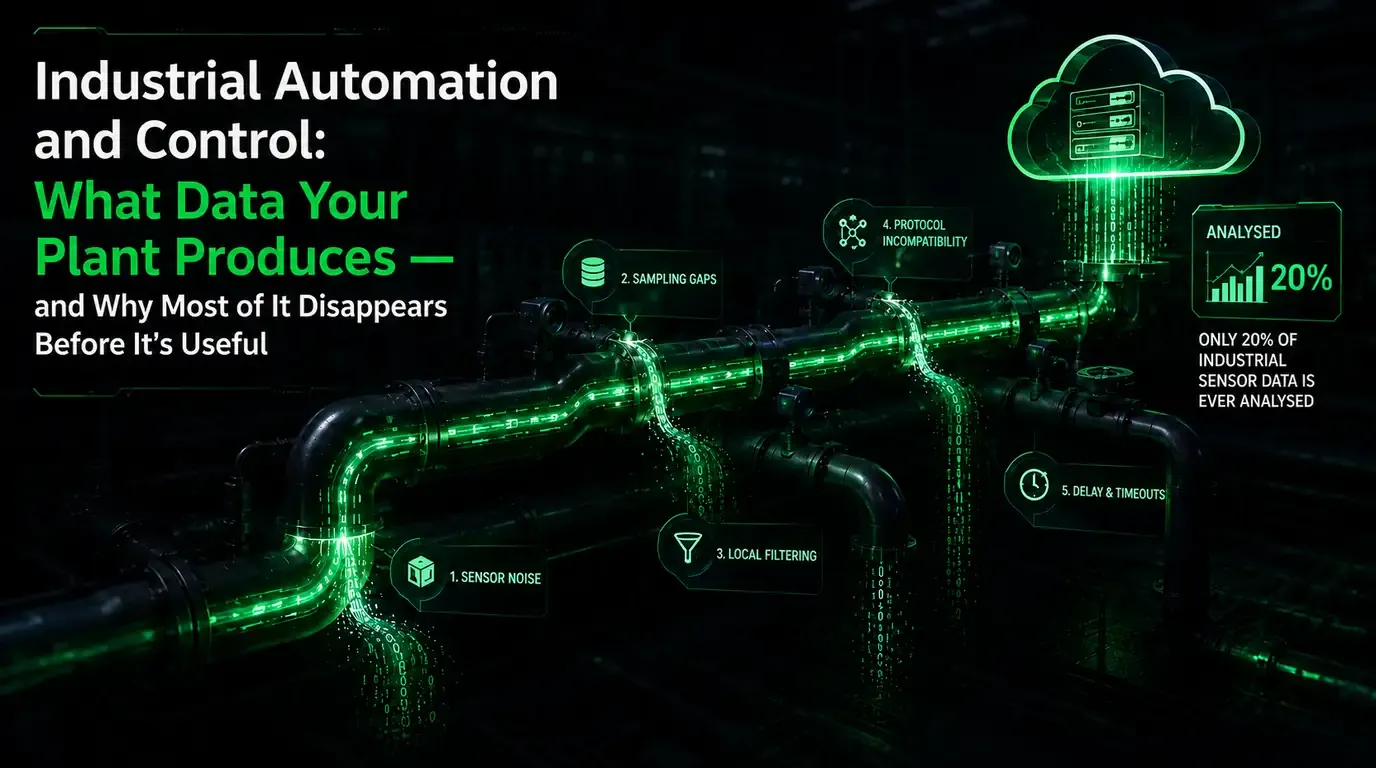
Only 20% of industrial sensor data is ever analysed. The five layers where data is lost between the PLC and the cloud, with a worked example and real

Written by Eduardo Fuentevilla Blanco
Robotics Engineer at Maedcore · Robotics Engineer LinkedIn ↗
Key Takeaways
- ► Only 20% of industrial sensor data is ever analysed; 70% constitutes 'dark data' due to poor system integration (IIoT World 2024/2025; DataStackHub 2025).
- ► Data degrades across five predictable layers — field, control (PLC), supervisory (SCADA/historian), edge/integration, and cloud/application — each with its own auditable failure mode.
- ► A historian with 0.5% deadbanding and a 1-second sampling rate can discard up to 90% of the fast-event data that inspection and quality tools need to detect (engineering judgement).
- ► OPC-DA, the standard in many plants from the 2000s, is incompatible with cloud-native and AR tools; migration to OPC-UA requires a translation gateway, not a PLC replacement.
- ► A full brownfield OT-to-cloud integration project for a 20-machine line costs €25,000–€80,000 and takes 3–6 months — costs that must be included in the business case from day one.
- ► McKinsey estimates that lack of interoperability leaves approximately 40% of the total potential value of industrial IoT applications uncaptured.
Executive Summary
Your plant is already generating data — the problem is that only 20% of it is ever analysed, according to figures presented at the IIoT World Manufacturing Day 2024/2025. A further 70% of industrial IoT sensor data constitutes what analysts call dark data — captured but never examined — primarily due to poor integration between systems, according to DataStackHub (2025). The gap is not in the sensors: it lies in the five layers separating raw data at source from data in use. And the cost of ignoring it is concrete: unplanned downtime costs large plants an average of 27 lost hours per month, with an aggregate impact of $1.4 trillion per year for Fortune 500 companies, according to Siemens’ True Cost of Downtime report (2024).
The “We’re Already Digital” Illusion: What Your Industrial Automation and Control Layer Actually Produces
A PLC generates thousands of tags per second — but without standardised naming, semantic context, or the correct sampling rate, that data is noise to any cloud or AR tool. This is the most common trap we encounter when auditing plants: the operations manager believes that because a SCADA with real-time screens exists, the plant is ready to connect analytics or advanced inspection tools. It isn’t.
What a Tag Is — and Why Its Name Matters More Than You Think
A tag is the smallest unit of data in an industrial automation and control system: a numeric or Boolean value linked to a memory address in the PLC. The problem is that the same tag might be called DB47.DBD12 in one plant and Press3_Force_kN in another — and for a cloud analytics engine or an augmented reality layer, that difference is absolute. Without a standardised name, an engineering unit, a normal operating range, and a reference to the physical asset it belongs to, the data exists but means nothing outside the context of the programmer who created it.
Experts from Prometheus Group and IBM at IIoT World Manufacturing Day 2025 put it precisely: without accurate asset metadata, “alerts are wrong, predictions fail, and dashboards become misleading.”
The Structural Problem: PLCs Were Not Designed for the Cloud
Legacy automation platforms — Allen-Bradley PLC-5, Siemens S7-200, Modicon 984 — predate MQTT, OPC UA, and REST APIs by decades. As documented in research published in the International Journal of Science and Research Archive (2024), traditional SCADA systems “were not designed to support the connectivity and data flow that IoT devices require,” and integrating them with analytics platforms demands “substantial customisation and specialist expertise.”
Minsait confirmed this at MWC 2026: despite the proliferation of connected sensors, “in many factories IT and OT systems continue to operate in parallel, making it difficult to turn data into agile decisions on the shop floor”. The commercial director of Zucchetti Spain summarises it well: “Many companies are in an intermediate phase of digital maturity, where they have information but cannot always integrate or exploit it effectively” (Interempresas TIC, 2025).
The IT/OT Convergence Challenge in Industrial Manufacturing
Spanish manufacturing contributes 76% of national industrial GVA — €172.9 billion in 2024 — yet the industrial sector as a whole represents only 15.65% of GDP versus a European average of 19.20%, according to INE data compiled by Ángel Martínez (2026). The Madrid industrial corridor — home to anchor companies such as Airbus, Iveco, Siemens, John Deere Ibérica, and Gestamp, surrounded by hundreds of specialist SMEs in components and machining, according to Invest in Madrid (2025) — concentrates exactly the plant profile where this gap is most costly.
Many of these facilities have spent years investing in automation — stamping lines, robotic welding cells, machine vision systems — without resolving the integration layer that connects that automation to modern analytics and inspection tools. The Madrid regional government offers grants of up to 25% for Industry 4.0 projects in the Henares Corridor and the Southern Metropolitan area, according to Madrid Cluster de Automoción (2024) — a concrete incentive to address precisely this pending integration.
The global IT/OT convergence market was valued at $50 billion in 2024, with a CAGR of 12.6% through 2030, according to Virtue Market Research. IoT Analytics projects a much larger figure — $1.3 trillion by 2030 at a CAGR of 8.5% — though the discrepancy likely reflects scope: IoT Analytics includes the entire IIoT ecosystem (hardware, connectivity, platforms, services), while Virtue Market Research scopes only the convergence software layer. Beyond the disagreement, the signal is the same: IT/OT integration is a structural investment priority, not a passing trend.
Where Data Is Lost: The Five Layers Between Sensor and Application
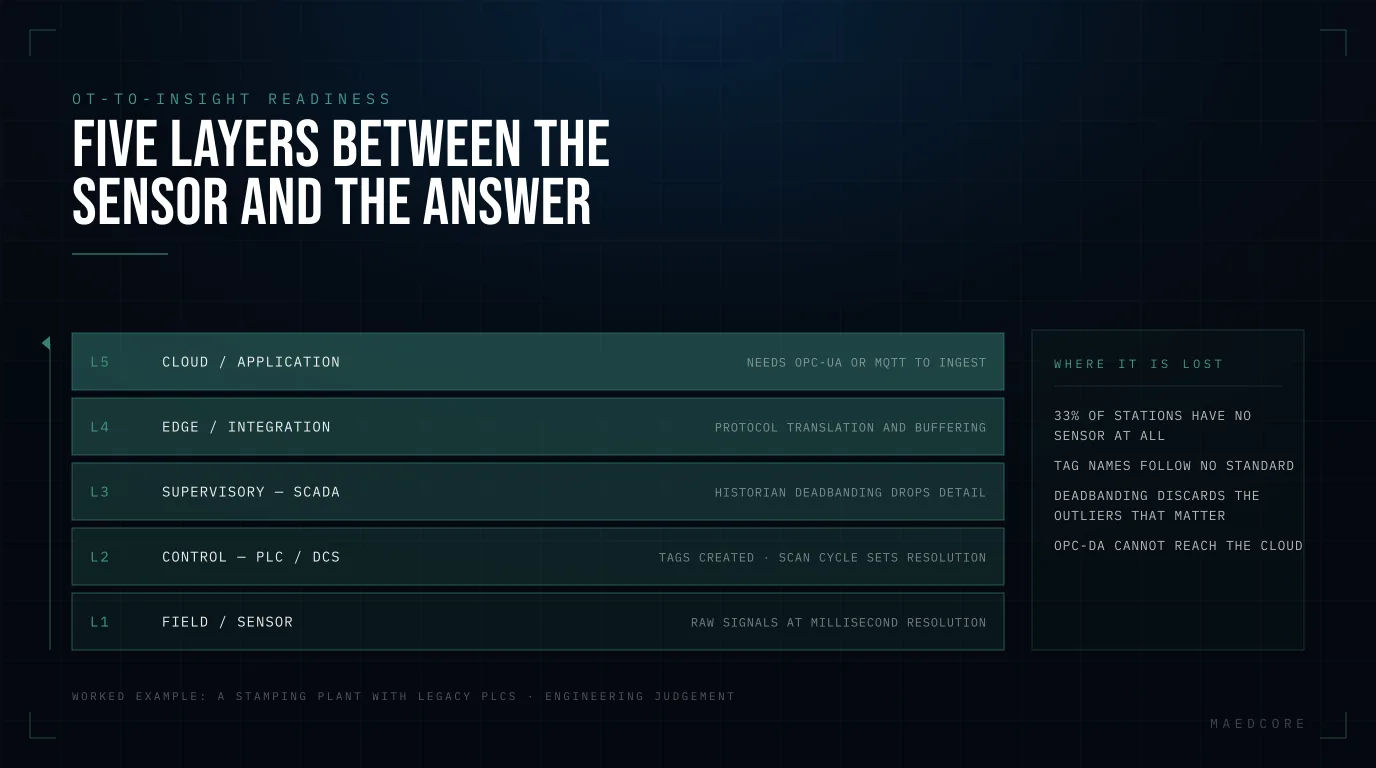
Data does not disappear all at once — it degrades layer by layer, at five predictable failure points that any plant manager can audit before purchasing a single software licence. McKinsey estimates that interoperability is required to capture approximately 40% of the total potential value of IoT applications — meaning fragmented deployments leave a substantial share of the expected return uncaptured.
The OT-to-Insight Readiness Diagnostic: 5 Layers, 5 Questions
This framework evaluates each layer across three dimensions: Completeness (is everything relevant being captured?), Fidelity (is it accurate, correctly timestamped, and semantically contextualised?), and Accessibility (can target tools consume it without bespoke integration work?).
| Layer | What Happens Here | Diagnostic Question | Typical Failure Mode |
|---|---|---|---|
| L1: Field / Sensor | Sensors, actuators, and encoders generate raw signals at millisecond resolution | Are all critical process variables instrumented? Are sensors calibrated? | Instrumentation gaps; analogue sensors without digital output; drift from lack of calibration |
| L2: Control (PLC/DCS) | The PLC executes logic; tags are created; scan cycle determines temporal resolution | Do tag names follow a standard? Is the scan cycle fast enough? Are all relevant data points exposed? | Proprietary naming; scan cycles too slow for quality signals; data locked in vendor memory areas |
| L3: Supervisory (SCADA/Historian) | The SCADA polls PLC tags; the historian stores time-series at the configured interval | What is the historian’s sampling rate? Is deadbanding configured aggressively? Is context stored alongside values? | Deadbanding discards small but critical variations; sampling rate (e.g., 1 s) misses fast events; no semantic context associated with tags |
| L4: Edge / Integration | A gateway or edge device translates protocols, buffers data, and forwards to the cloud | What protocol is used toward the cloud? Is there a unified namespace? Are data normalised before transmission? | Protocol mismatch (Modbus → MQTT without semantic mapping); no buffer → data loss on connectivity drop; timestamp integrity loss |
| L5: Cloud / Application | The cloud platform ingests, stores, and serves data to analytics and AR/VR tools | Does the application receive data at the correct frequency? Is the asset model aligned with the application’s? Can the AR overlay bind to a live tag in under 500 ms? | Batch ingestion instead of streaming; mismatch between SCADA asset model and cloud model; AR overlay polling instead of subscribing → stale data |
Worked Example: A Stamping Plant with Legacy PLCs (Engineering Judgement)
Consider a mid-sized automotive component manufacturer operating a Siemens S7-400 PLC (circa 2008) with WinCC SCADA — a representative profile for many industrial facilities in mature manufacturing regions. The operations manager believes the plant is “already digital.” A layer-by-layer diagnostic reveals the following (all figures are engineering judgement based on comparable projects, not verified data from any specific plant):
- L1 — Field: 12 of 18 press stations have force/displacement sensors; 6 rely on operator visual inspection → 33% instrumentation gap.
- L2 — Control: Tag names follow no standard (
DB47.DBD12vs.Press3_Force_kN); scan cycle is 100 ms, but the historian polls at 1 s → 90% of fast-event data is lost before leaving the PLC. - L3 — Supervisory: WinCC historian has deadbanding set at 0.5% to reduce storage costs → small but quality-critical force variations are never stored.
- L4 — Edge: No edge gateway exists; data leaves via OPC-DA (Windows COM/DCOM-based) to a local server; no cloud connection.
- L5 — Application: The cloud inspection tool the plant is evaluating requires OPC-UA or MQTT streaming; it is incompatible with OPC-DA and cannot connect at all.
Result: The plant is “digital” at L2 but has a complete break at L4/L5. The missing investment is not in sensors or PLCs — it is in the protocol translation, semantic enrichment, and edge ingestion layer that converts control data into application data.
The Cost of Building That Layer (Engineering Judgement)
For a line of 20 machines with mixed-generation legacy PLCs, market references point to:
| Component | Indicative Cost Range |
|---|---|
| OPC-UA gateway (Siemens IOT2050, Moxa UC-8100, Kepware KEPServerEX) | €800 – €3,500 per unit |
| Protocol converter Modbus → EtherNet/IP (e.g., Anybus X-gateway) | €400 – €700 per unit |
| Edge-to-cloud platform (AWS IoT Greengrass, Azure IoT Edge, Ignition Edge) | €200 – €800/month per site (or perpetual licence ~€1,500 – €3,000) |
| Full brownfield project (audit + gateway + historian reconfiguration + cloud connector) | €25,000 – €80,000 depending on complexity |
| Total timeline | 3 – 6 months for a disciplined project |
The OPC-UA gateway market — valued at $268.3 million in 2025 and projected to exceed $1 billion by 2036 at a CAGR of 13% — confirms that this is a structural problem and that the solution ecosystem is maturing rapidly.
The Seven Most Common Failure Modes in OT-to-Cloud Integration Projects
Knowing where projects break before you start saves months of rework and tens of thousands of euros.
1. Misconfigured deadbanding. Historians configured with aggressive deadbanding (1–2%) silently discard the small variations that quality inspection tools need most. The fix is straightforward: audit deadbanding settings by tag class before any cloud integration begins.
2. Tag naming chaos. Without a naming standard (ISA-88 or ISA-95 hierarchy), cloud platforms and AR tools cannot automatically discover asset context. Common SCADA programming errors include poor signal definition and communication failures between PLCs.
3. OPC-DA dependency. Many plants running WinCC or iFIX from the 2000s use OPC-DA (COM/DCOM-based), which is Windows-only, firewall-hostile, and incompatible with cloud-native tools. Legacy serial devices lack native Ethernet connectivity; industrial gateways allow these assets to communicate with modern platforms without immediate hardware replacement.
4. Timestamp integrity loss. When data passes through multiple hops (PLC → SCADA → historian → gateway → cloud), timestamps are frequently overwritten at each hop with the receiving system’s clock. For AR inspection overlays, a 500 ms error renders the data useless for fast-process monitoring.
5. Cybersecurity as an afterthought. Opening OT networks to cloud connectivity without a segmentation strategy (DMZ, unidirectional gateways, IEC 62443 compliance) creates critical infrastructure exposure. The 2025 State of OT Cybersecurity report reveals that while more than 80% of CISOs oversee OT environments, only 35% of organisations have a mature, integrated IT/OT security operations model.
6. Asset model mismatch. The SCADA asset model (organised by control loop) rarely matches the cloud or AR application model (organised by physical equipment or production order). Even when data flows correctly, the AR overlay cannot bind the right tag to the right physical object.
7. Pilot purgatory. Many projects launch a successful pilot on one line and fail to scale because the integration architecture was not designed from the outset for plant-wide deployment.
OPC-UA and MQTT: The Reference Architecture — and Its Real Limits
OPC-UA is today the de facto standard for secure, interoperable machine-to-machine communication in heterogeneous environments; MQTT provides the lightweight transport for sending data from the edge to the cloud. The combination — often described as a “unified namespace” architecture — is the reference pattern for industrial IIoT, with documented interoperability support in hybrid environments (IEEE Xplore, 2025).
However, it is worth being honest about current limits. OPC-UA over TSN (Time-Sensitive Networking) — required for deterministic, low-latency communication — remains in early adoption: the IEEE 802.1AS-2020 standard is ratified, but cross-vendor interoperability testing is ongoing and brownfield field deployments are still rare. In practice in 2026, OPC-UA is the architecturally correct answer, but the full vision of deterministic OPC-UA over TSN is still years away from widespread deployment in legacy plants.
From Control Data to Inspection Data: What Modern Tools Actually Need
Cloud inspection tools and augmented reality overlays have very specific data requirements that traditional SCADA systems rarely meet natively.
A cloud-based inspection tool needs sensor data with precise timestamps, asset context, and sufficient ingestion frequency to detect anomalies before they become defects. In an inspection project we built — Mapper: Inspection Software with Automatic Reports and 3D Maps — we saw first-hand that when the OT layer delivers data with aggressive deadbanding, overwritten timestamps, and tags stripped of semantic context, the analytics engine receives noise, not signal.
For augmented reality layers, a literature review published in the Journal of Manufacturing and Materials Processing (MDPI, September 2025) confirms that AR can overlay digital models onto physical components and guide operators through complex inspection tasks — and that for quality control, AR offers the ability to compare real-time measurements against predefined standards. Industrial XR device shipments grew more than 40% year-on-year in 2025. But the literature treats the data feed as a solved problem; practitioners know it is not.
Checklist: Before Evaluating Any Cloud or AR Tool
Before requesting a demo or signing a licence, answer these five questions about your plant:
- Do you have a complete tag inventory with name, engineering unit, and asset reference? If not, any integration will become a manual mapping project.
- What is your historian’s actual sampling rate? If it is 1 second or more, you need to assess whether that is sufficient for the processes you want to monitor.
- Which version of OPC are you running — DA or UA? If DA, you need a translation gateway before any cloud connection.
- Do you have an edge gateway with local buffering? Without one, any connectivity drop creates gaps in historical data.
- Does your SCADA asset model match the hierarchy your target application expects? If not, integration time will multiply.
Answering “no” to two or more of these questions does not mean you cannot move forward — it means the investment in the integration layer is the first step, and its cost must be included in the business case from the outset.
Related reading
- Industrial Process Digitalisation — the layer model: what to stabilise before anything clever gets built on top.
- Industrial Process Automation — how to pick the first process to automate — and which ones to leave manual.
- Industrial Technology Tools — an evaluation framework for separating a real tool from a demo.
- Industry 4.0 in Practice — what the pyramid diagrams leave out: examples with numbers attached.
- Maedcore — Digital Solutions — what we build in this area.
Frequently Asked Questions
How much does it cost to integrate a legacy PLC with a cloud platform in 2025–2026? A full brownfield project for a 20-machine line — including protocol audit, OPC-UA gateway installation, historian reconfiguration, and cloud connector — costs between €25,000 and €80,000 depending on complexity (engineering judgement based on market rates). Gateway hardware per unit ranges from €800 to €3,500. The typical timeline for a disciplined project is 3 to 6 months.
What is the difference between OPC-DA and OPC-UA, and why does it matter for cloud connectivity? OPC-DA is the classic Microsoft COM/DCOM-based standard: it works well on local Windows networks but is incompatible with modern firewalls and cloud-native architectures. OPC-UA is the current standard: platform-independent, with a built-in security model and support for machine-to-machine communication in heterogeneous environments. Cloud inspection and AR tools require OPC-UA or MQTT; if your plant uses OPC-DA, you need a translation gateway before any integration is possible.
What is deadbanding in a SCADA historian and why can it derail an analytics project? Deadbanding is a filter that prevents the historian from storing a new value unless the change exceeds a configured percentage threshold (typically 0.5–2%). It is used to reduce stored data volume. For quality processes, small but systematic variations are exactly the signal that analytics engines need to detect — and a misconfigured deadband discards them silently, with the analytics engine having no way of knowing the data was missing.
Can a plant with early-2000s PLCs connect augmented reality inspection tools? Yes, but not directly. The chain requires: (1) a gateway that translates the legacy PLC protocol to OPC-UA or MQTT; (2) a semantic normalisation layer that associates each tag with its physical asset; (3) a cloud connector with real-time streaming. Without these three elements, the AR overlay will receive data with excessive latency, incorrect timestamps, or simply fail to connect. The cost of this chain is manageable — the mistake is not including it in the initial business case.
What does McKinsey say about the cost of poor interoperability in industrial IoT? McKinsey estimates that interoperability is required to capture approximately 40% of the total potential value of IoT applications, meaning fragmented deployments leave a substantial share of the expected return unrealised. The implication is direct: the integration layer is not overhead — it is the condition for the business case to hold.
Sources
- IoT Data in Manufacturing: Fixing the 90% Waste Problem — IIoT World, 2025.
- Dark Data Statistics For 2025–2026 — DataStackHub, 2025.
- 5 IoT in Manufacturing Statistics and Trends for 2026 — Modularis (citing Siemens True Cost of Downtime 2024), 2026.
- SCADA in the Era of IoT: Automation, Cloud-driven security, and machine learning applications — International Journal of Science and Research Archive, 2024.
- IT OT Convergence Insights Report 2024 — IoT Analytics, 2024.
- Global IT/OT Convergence Market Report — Virtue Market Research, 2024.
- IT-OT Integration Makes Unified Security a Business Imperative — Mexico Business News (citing Fortinet 2025 State of OT Cybersecurity Report), 2025.
- Protocol Fragmentation in Industrial IoT — Wirtek (citing McKinsey analysis), 2026.
- OPC-UA Gateways Move to the Center of Industrial Modernization — Fact.MR via OpenPR, 2026.
- Integrating Legacy PLCs with Modern IoT Platforms — Industrial Monitor Direct, 2026.
- Interoperability Between OPC-UA and MQTT in Hybrid IIoT Environments — IEEE Xplore, 2025.
- SCADA Systems in 2026: The Complete Guide for Modern Factories — iFactory, 2026.
- Industria 4.0 en España: una transformación a dos velocidades — Interempresas TIC, 2025.
- La industria en España por comunidades autónomas en 2024 — Ángel Martínez (citing INE), 2026.
- La revolución de la fabricación avanzada en la Comunidad de Madrid — Invest in Madrid, 2025.
- Ayudas a la digitalización e Industria 4.0 de pymes industriales de la Comunidad de Madrid — Madrid Cluster de Automoción, 2024.
- Minsait advierte de que la falta de integración entre IT y OT frena el aprovechamiento del dato — Industry Talks (citing Minsait at MWC 2026), 2026.
- Emerging Technologies in AR and VR for Manufacturing Applications — Journal of Manufacturing and Materials Processing, MDPI, September 2025.
- Augmented Reality’s Increasing Role in Advanced Manufacturing Quality Control — Metrology News, 2024.
- XR/AR in Manufacturing in 2026: 7 Real-Life Use Cases — AIMultiple, 2026.
About the Author
Robotics Engineer
For over a decade, I have been driven by a single mission: leveraging AI and robotics to build a world of automated production. I believe that by creating self-sufficient systems, we can empower people to refocus on what truly matters—their families and their passions. My expertise spans from winning prestigious European startup competitions to architecting complex, integrated hardware and software projects. I specialize in bridging the gap between today's industrial challenges and tomorrow's autonomous solutions.
Frequently Asked Questions
How much does it cost to integrate a legacy PLC with a cloud platform in 2025–2026?
What is the difference between OPC-DA and OPC-UA, and why does it matter for cloud connectivity?
What is deadbanding in a SCADA historian and why can it derail an analytics project?
Can a plant with early-2000s PLCs connect augmented reality inspection tools?
What does McKinsey say about the cost of poor interoperability in industrial IoT?
Ready to transform your company?
Book a free 30-minute meeting with an engineer.