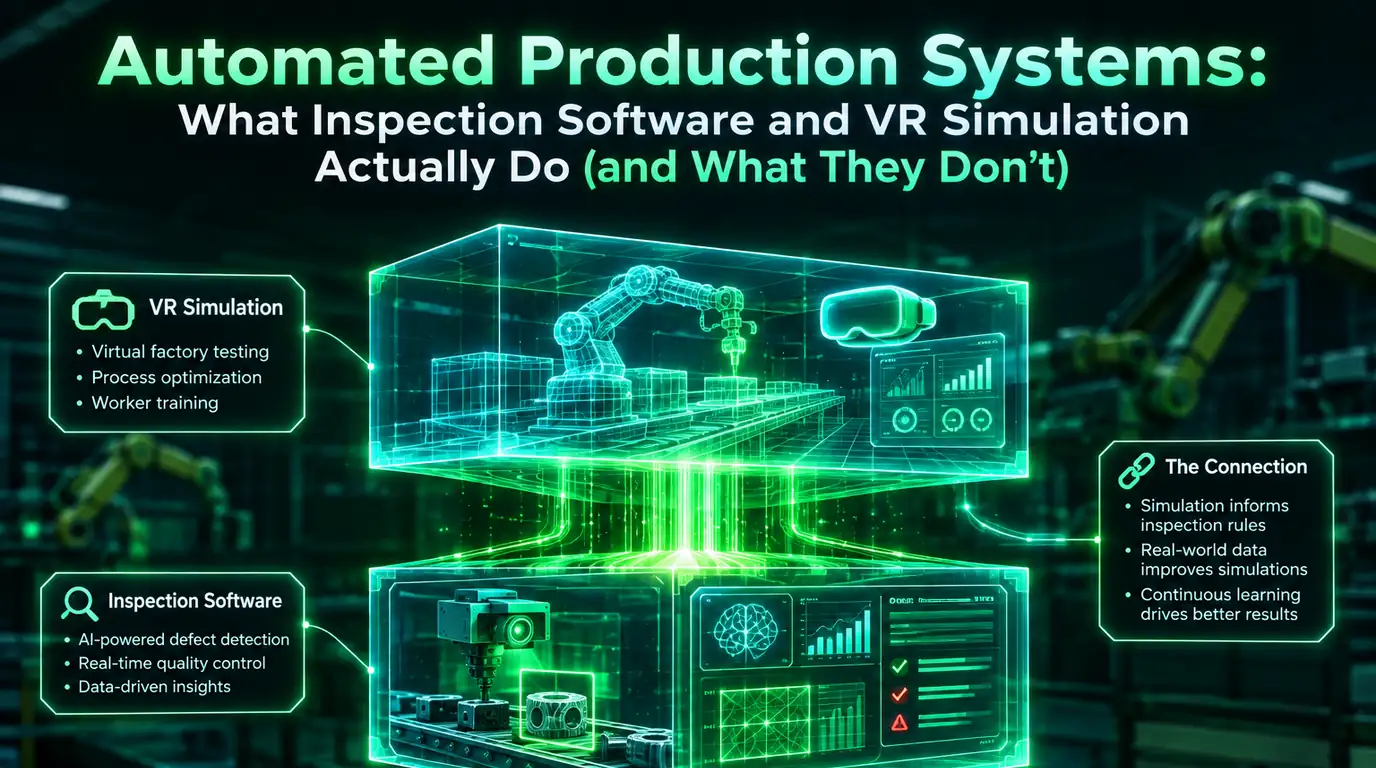
Automated Production Systems: What Inspection Software and VR Simulation Actually Do (and What They Don't)
Only 3.3% of manufacturers have fully digitalised factories. Learn which layer of your automated production system each tool actually occupies — and why

Written by Eduardo Fuentevilla Blanco
Robotics Engineer at Maedcore · Robotics Engineer LinkedIn ↗
Key Takeaways
- ► Only 3.3% of manufacturers have fully digitalised factories despite record robot installations (IFR 2025): the bottleneck is data integration and post-processing, not hardware.
- ► Automated production systems operate across three core layers (L1: PLCs/actuators, L2: SCADA/HMI, L3: MES/ERP); AI inspection software and VR simulation occupy separate layers (L4 and L5) and do not replace any of them.
- ► Human visual inspection misses 20–30% of defects under real conditions; AI vision systems reach 95–99% accuracy — but only for well-defined defects on stable lines. The boundary condition is critical for any ROI calculation (iFactory 2026).
- ► AI inspection station deployment costs USD 30,000–200,000 with 6–12 month payback and USD 100,000–300,000 in annual labour savings per station (iFactory 2026).
- ► VR simulation delivers measurable ROI in two specific contexts: accelerating B2B sales cycles for complex lines (25% faster decisions, Fair Worlds 2023) and reducing assembly errors in pre-commissioning training (Boeing: –30%, AR-based, Meticulous Research 2025).
- ► 55.6% of manufacturers have only partial ERP/MES/SCADA integration (Advanced Factories 2026): no L4 or L5 tool resolves a data architecture problem — structured L3 data is a prerequisite, not a consequence.
Spain installed 5,100 industrial robots in 2024 — third in Europe according to the IFR World Robotics 2025 Report — yet only 3.3% of its manufacturers operate a fully digitalised smart factory, according to the Advanced Factories 2026 Industrial Digitalisation Barometer. The gap is not in sensors or robots: it is in what happens to data after it is captured, and in how automated lines are sold and trained before they go live. AI inspection software and VR simulation do not replace PLCs, robots or SCADA — they operate in entirely different layers of the system — and conflating them is the most expensive mistake automation decision-makers make when evaluating investments.
Automation is accelerating, but integration is still broken
Manufacturers are deploying more robots than ever, but more than half have only partial integration between ERP, MES and SCADA — which means the majority of automated production systems generate data that nobody processes.
The Advanced Factories 2026 Barometer, drawn from more than 500 industrial executives, reveals a structural paradox: 55.6% of professionals acknowledge only partial integration between platforms such as ERP, MES, SCADA and PLM, and just 22.4% report full integration. The gap between large enterprises and SMEs is equally stark: while 70% of large companies have already automated their processes, only 30% of SMEs have taken that step, according to IFAMAC 2025.
A note on market figures: Data Bridge Market Research values the total industrial automation market in Spain at USD 4.04 billion in 2024; Next Move Strategy Consulting values the industrial process automation sub-market at USD 1.18 billion in 2024. Both figures are correct — they measure different scopes — but they are routinely cited interchangeably in trade press. Whenever someone tells you “the automation market in Spain is worth X”, always ask what X actually includes.
This is the environment — more robots, more data, less integration — in which post-processing and visualisation tools fill a genuine gap.
What an automated production system is: the stack that matters
An automated production system is the combination of control hardware (PLCs, actuators, robots) and supervisory software (SCADA, MES) that executes and records the production process without continuous human intervention — and no inspection software or VR tool operates in those layers.
According to MECVIL 2026, industrial automation means replacing manual operations with controlled systems that combine hardware (PLCs, sensors, actuators, robots) and control software (HMI, SCADA) to manage the process without continuous human intervention. What Baker Tilly Techma 2026 documents as a structural trend is the migration of CapEx in hardware toward OpEx-based software subscription models.
The three base layers — and what we do not sell:
- L1 — Physical execution: PLCs, actuators, servo drives, pneumatics. Execute motion and control the physical process in real time.
- L2 — Supervisory control: SCADA, DCS, HMI. Monitor and control L1 in real time; generate process records.
- L3 — Manufacturing execution: MES, ERP integration, traceability. Plan, track and record production orders.
We do not sell or integrate any of these layers. Saying so explicitly is not modesty — it is the most useful piece of information you can have when deciding whether to call us.
The automation layer map: where software fits and where it doesn’t
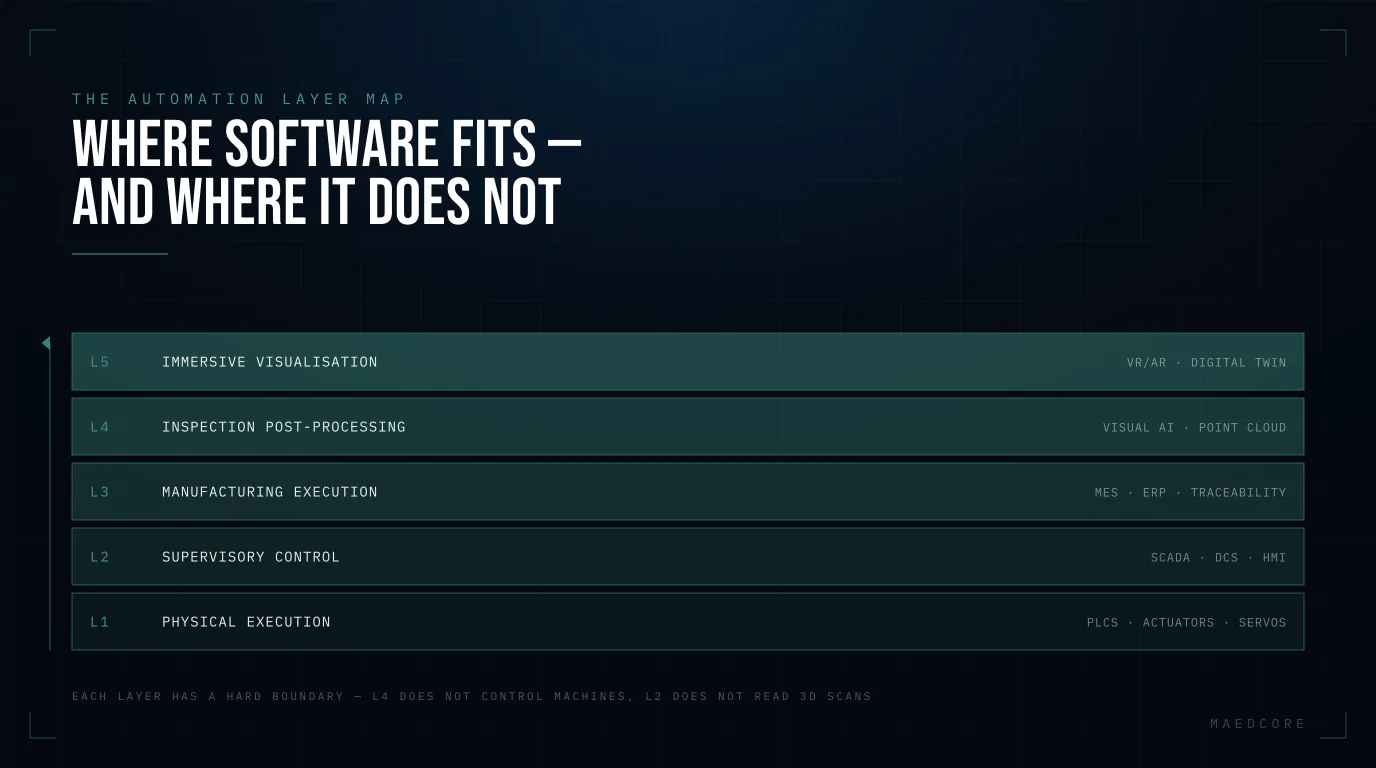
The right question is not “does inspection software replace physical automation?” but “at which layer of the system does each tool actually operate?” — and the answer changes the investment decision entirely.
This is the original contribution you will not find in any generic article on automated production systems: a layer-by-layer map that assigns each technology category to its real position in the workflow, names what it does and what it does not do, and gives automation managers a decision rule for knowing when to invest in each layer.
| Layer | Technology category | What it does | What it does NOT do | Our position | Investment trigger |
|---|---|---|---|---|---|
| L1 — Physical execution | PLCs, actuators, servos, pneumatics | Executes motion; controls the physical process in real time | Does not interpret unstructured data; does not visualise for humans | ❌ Outside our scope | When the bottleneck is cycle time, repeatability or physical throughput |
| L2 — Supervisory control | SCADA, DCS, HMI | Monitors and controls L1 in real time; generates process records | Does not post-process inspection images; does not present to non-technical buyers | ❌ Outside our scope | When the bottleneck is process visibility and alarm management |
| L3 — Manufacturing execution | MES, ERP integration, traceability | Plans, tracks and records production orders | Does not analyse 3D scan data; does not render immersive demos | ❌ Outside our scope | When the bottleneck is production order management and traceability |
| L4 — Inspection data post-processing | Visual AI, point-cloud analysis, defect classification | Converts raw sensor/camera/scanner output into structured, actionable quality intelligence | Does not control machines; does not replace L1–L3 | ✅ Mapper | When inspection data is captured but not actionable; when defect classification is manual or inconsistent |
| L5 — Immersive visualisation and communication | VR/AR configurators, digital twins for sales and training | Communicates complex system configurations to buyers; trains operators on line layouts before commissioning | Does not control production; does not replace physical testing | ✅ Omni Viewer | When the sales cycle stalls because buyers cannot visualise bespoke automated lines; when training requires stopping the line |
The four decision rules
These rules are engineering judgement, not primary-source data — but they are the kind of criteria that rarely appear in writing anywhere:
- If your bottleneck is physical throughput or repeatability → invest in L1–L2 (robotics, PLC, SCADA). We are not your vendor.
- If your bottleneck is inspection data you capture but cannot act on → invest in L4. ROI is measurable in defect escape rate and rework cost.
- If your bottleneck is the sales cycle length for complex automated lines or operator readiness before commissioning → invest in L5. ROI is measurable in close speed and commissioning time.
- If your bottleneck is integration between L2 and L3 → invest in MES/ERP integration. We are not your vendor, although L4 tools need structured L3 data to be meaningful.
Worked example: laboratory equipment manufacturer
Starting position: A laboratory equipment manufacturer has L1–L3 fully operational: robotic assembly cells, SCADA with batch traceability and a MES integrated with ERP. Machine-vision cameras capture images of every part at 10,000 units per hour.
The real problem: Inspection data is stored on a local server. A quality technician manually reviews alarms at the end of each shift. The time between defect capture and rework decision is 4 to 6 hours — during that window, the line keeps producing potentially defective parts.
This is the dark-data problem applied to inspection. Research published in IEEE Xplore (2021) defines it precisely: in Industry 4.0 environments, a significant share of generated data becomes “dark data” — data from which companies cannot extract value due to management and storage issues, losing its informational value before it is used. A subsequent study in ScienceDirect (2025) identifies legacy systems, unstructured data and governance gaps as the primary contributors.
Where L4 fits: An inspection post-processing tool — in an inspection project we built, Mapper does exactly this — takes the raw camera output, classifies defects automatically, generates 3D maps of the inspected component and integrates results into the production data stream in real time, without manual intervention.
The numbers behind the gap: Human visual inspection misses between 20 and 30% of defects under real production conditions, and inter-inspector agreement on defect severity is only 55–70%, according to iFactory 2026. AI vision inspection systems reach 95–99% accuracy — with the critical caveat that this figure applies to well-defined, high-contrast defects on stable lines, not to novel defect types or variable-geometry parts.
Implementation cost and return: Deployment cost ranges from USD 30,000 to USD 200,000 per station depending on complexity, with documented payback periods of 6 to 12 months and annual savings of USD 100,000 to USD 300,000 from labour reduction alone, according to iFactory (May 2026). Forrester cites a 374% average three-year ROI, though this figure originates from studies cited in vendor blogs and should be treated as indicative rather than definitive.
To understand how this type of software fits into a plant’s data architecture, the post Industrial Process Digitalisation: What Works, What Doesn’t and Where to Start develops the selection criteria in more detail.
Where VR simulation fits in automated production systems
VR and AR simulation does not act on the production process itself — it acts on the two phases that surround it: selling the line before it is built, and training the operator before it goes live.
In technical sales of complex automated lines: Fair Worlds (2023) documents that real-time AR personalisation led to a 25% faster decision-making process for B2B customers. Capgemini estimates that virtual facility tours can save up to 45% of the cost associated with traditional on-site visits.
In operator training before commissioning: Stanford documented a 76% improvement in learning retention with immersive simulations; Boeing reported a 30% reduction in assembly errors after using AR-based simulations, according to Meticulous Research 2025. Both figures are secondary citations in market reports, not directly accessible primary studies — which does not invalidate them, but does require treating them with appropriate caution. The global immersive training market was valued at USD 11.9 billion in 2024 with a projected CAGR of 22.4% through 2034, according to Global Market Insights 2024.
The failure modes that never appear in the brochures
From what we have seen in real projects, the most common L5 failures are:
- Building a VR configurator without connecting it to live CAD/BOM data. The demo diverges from the actual product specification within months.
- Using VR for operator training before the line layout is frozen. Training against a configuration that keeps changing wastes the investment.
- Confusing a 3D CAD model, a simulation and a digital twin. This confusion, according to Frame Sixty 2026, is the most common reason projects are scoped incorrectly from the outset.
- Deploying immersive tools only for internal stakeholders, missing the primary ROI driver: shortening the external B2B sales cycle.
Development timelines: a standard VR safety simulation takes 8 to 12 weeks; an AR maintenance application for a single piece of equipment, 3 to 6 weeks; complex multi-scenario programmes with full CAD modelling, 16 to 20 weeks, according to Meticulous Research 2025.
For a deeper look at when a 3D animation is sufficient and when interactive VR justifies the investment: 3D Animations vs. Interactive VR Experiences for Industrial Sales.
The integration pitfalls that affect every layer
The greatest risk is not choosing the wrong tool — it is choosing the right tool and deploying it in the wrong context.
The dark-data problem does not disappear by adding an L4 tool if L3 is not feeding structured data. ScienceDirect (2025) identifies AI-based solutions, role-based access controls and improved data literacy as the most effective mitigation strategies. The 55.6% partial-integration rate documented by Advanced Factories 2026 is not a tooling problem — it is a data architecture problem that no L4 or L5 tool resolves on its own.
The practical rule: before investing in inspection post-processing, verify that L3 data is structured and accessible. Before investing in VR for training, verify that the line layout is frozen. Before investing in VR for sales, verify that the configurator can connect to real product data, not a static mock-up.
The post Industrial Machinery Maintenance: Why the Bottleneck Is No Longer Inspection but Post-Processing develops this problem specifically for maintenance teams.
Related reading
- Industrial Process Digitalisation — the layer model: what to stabilise before anything clever gets built on top.
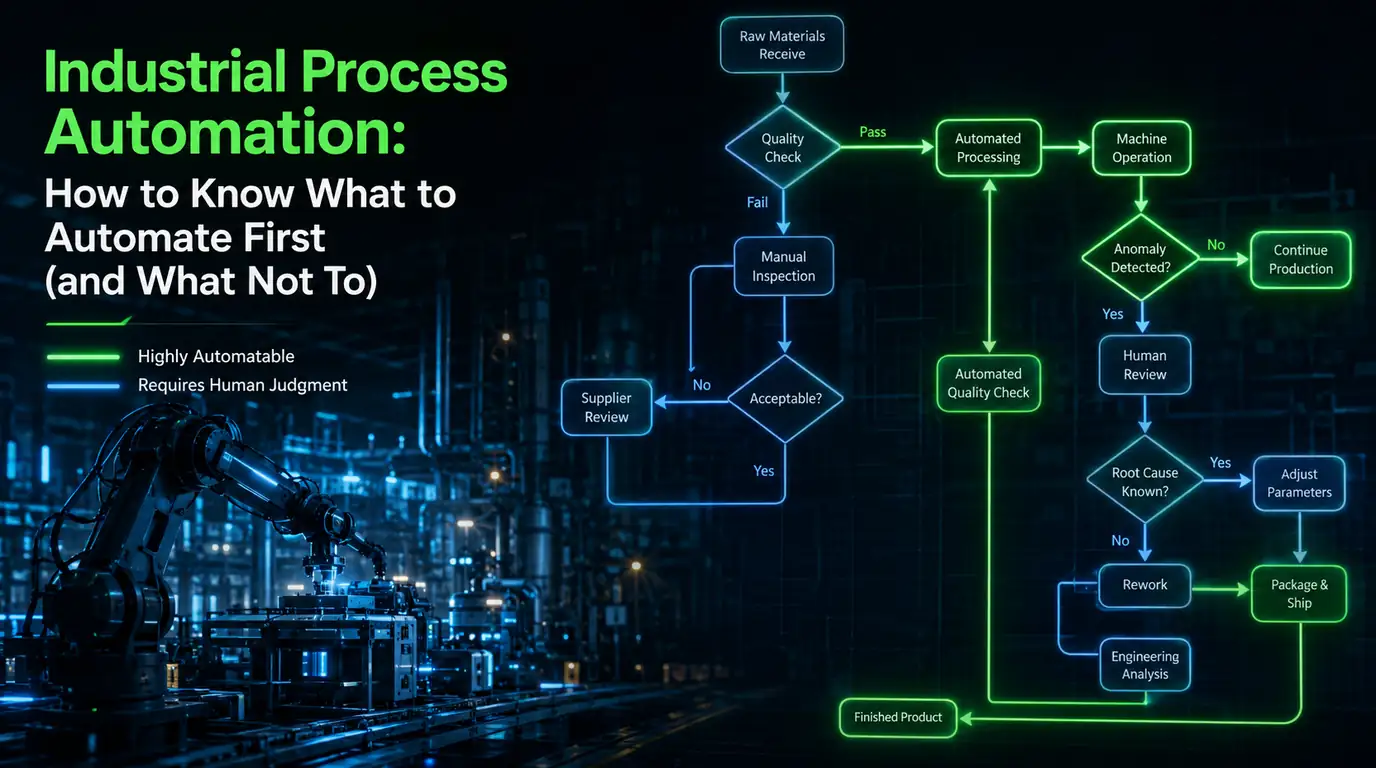
- Industrial Process Automation — how to pick the first process to automate — and which ones to leave manual.
- Industrial Automation and Control — what your plant already measures, and why most of it never becomes useful.
- Industrial Technology Tools — an evaluation framework for separating a real tool from a demo.
- Industry 4.0 in Practice — what the pyramid diagrams leave out: examples with numbers attached.
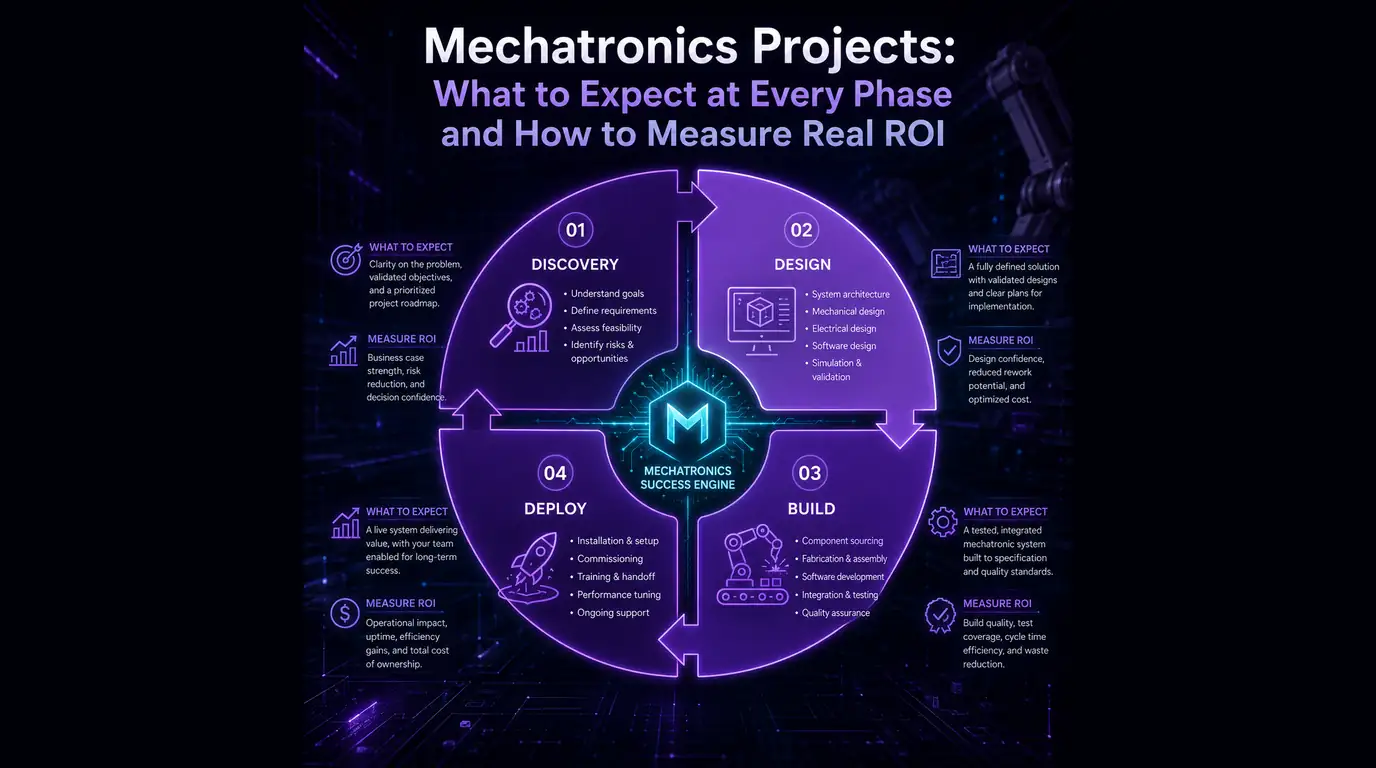
- Mechatronics Projects — what each phase of a hardware-plus-software build actually delivers, and how to measure it.
- Custom Software for Manufacturing — the five-filter decision: build, buy, or leave it alone.
- Maedcore — Mechatronics — what we build in this area.
Sources
- IFR World Robotics 2025 Report — International Federation of Robotics, 2025.
- Advanced Factories 2026 Industrial Digitalisation and Automation Barometer — Advanced Factories / Rautomation, May 2026.
- Spain Industrial Automation Market Size & Forecast to 2032 — Data Bridge Market Research, 2026. (Commercial research firm; indicative use.)
- Spain Industrial Process Automation Market Analysis 2024–2030 — Next Move Strategy Consulting, July 2025. (Commercial research firm; indicative use.)
- Industrial Automation in Spain 2026 — Technology M&A Report — Baker Tilly Techma, 2026.
- Industrial Automation in Spain: Practical Guide for Machinery Manufacturers — MECVIL, May 2026.
- Industrial Automation Madrid: Complete Guide 2026 — Nexum Automatics, April 2026.
- AI Vision Inspection for Manufacturing: Automated Defect Detection Guide 2026 — iFactory, July 2026.
- AI Vision Camera Implementation Cost vs. Manual Inspection — iFactory, May 2026.
- Immersive Training Market — Global Opportunity Analysis and Industry Forecast 2025–2035 — Meticulous Research, 2025.
- Global Immersive Training Market Size & Share 2025–2034 — Global Market Insights, 2024.
- How Immersive Reality (AR/VR) Shortens the B2B Sales Cycle — Fair Worlds, 2023.
- Digital Twin in Manufacturing: Cost, ROI, and Scoping — Frame Sixty, July 2026.
- Understanding and Defining Dark Data for the Manufacturing Industry — IEEE Xplore (peer-reviewed), 2021.
- Unveiling Dark Data in Organisations — ScienceDirect (peer-reviewed), 2025.
About the Author
Robotics Engineer
For over a decade, I have been driven by a single mission: leveraging AI and robotics to build a world of automated production. I believe that by creating self-sufficient systems, we can empower people to refocus on what truly matters—their families and their passions. My expertise spans from winning prestigious European startup competitions to architecting complex, integrated hardware and software projects. I specialize in bridging the gap between today's industrial challenges and tomorrow's autonomous solutions.
Frequently Asked Questions
Can AI inspection software replace a PLC or SCADA system on an automated production line?
At what point in the production workflow does VR simulation make sense?
What is 'dark data' in an industrial plant and how does it affect automated production systems?
How much does it cost to implement an AI visual inspection system on a production line?
When does it NOT make sense to invest in VR or AI inspection software instead of physical automation?
Why do so few manufacturers have fully digitalised factories despite high robot adoption?
Ready to transform your company?
Book a free 30-minute meeting with an engineer.