Industrial Technology Tools: How to Evaluate What's Worth It and What's Just Noise
A 4-step decision framework for evaluating VR/AR, AI, and robotics in manufacturing. ROI benchmarks, go/no-go criteria, and red flags by technology layer.

Written by Eduardo Fuentevilla Blanco
Robotics Engineer at Maedcore · Robotics Engineer LinkedIn ↗

Key Takeaways
- ► 70% of digital transformation projects fail (Gartner/McKinsey); BCG puts the success rate at just 35% — the primary cause is not the technology but choosing it before defining the operational problem.
- ► The correct investment sequence is: OT infrastructure → data/AI layer → human interface (AR/VR) → autonomous physical layer (cobots). Skipping the order is the most common cause of project failure.
- ► Before buying any tool, four readiness questions determine whether the plant is ready: OEE baselined, work instructions digitalised, sensor data available, and cell layout stable for ≥18 months.
- ► Cobot payback is typically 6–18 months; AR/VR 8–18 months; AI predictive maintenance 8–24 months. A minimum IRR of 25% over three years is a sound threshold for industrial technology investments.
- ► The most expensive AR mistake is budgeting only for hardware: 40–50% of a pilot budget must go to content creation and work instruction digitalisation.
- ► 82% of manufacturers still operate with reactive or time-based maintenance — meaning initial AI gains are dramatic but should not be projected as steady-state performance.
Digital transformation failure rates in manufacturing still hover around 70% in 2026, according to Gartner and McKinsey, costing organisations an estimated $2.3 trillion globally each year. The root cause is rarely that the technology doesn’t work — it’s that the tool is chosen before the operational problem it must solve has been clearly defined. This guide offers a four-step decision framework for evaluating industrial technology tools — VR/AR, AI software, and robotics/mechatronics — against concrete shop-floor problems, with ROI thresholds grounded in real project experience, explicit go/no-go criteria, and red flags by technology layer.
Why 70% of Digital Transformation Projects Fail
Most industrial digitalisation projects don’t fail because the technology is broken — they fail because the tool is chosen before the operational problem is defined.
The failure figures are stark, though sources disagree on the exact percentage — and that disagreement is itself instructive. Gartner estimates that 70% of initiatives fall short of their objectives, with only 48% fully meeting their goals. BCG, analysing more than 850 companies, puts the success rate at just 35%. Bain goes further: 88% of business transformations fail to achieve their original ambitions. The spread between 12% and 35% success reflects different definitions of “success” and different sample populations — not bad data.
The scale of investment at stake adds urgency. The global digital transformation market in manufacturing is enormous, and McKinsey attributes the high failure rate to an excessive focus on the direct impact of technology while neglecting organisational factors: training, change management, and integration with existing processes. That insight frames everything that follows.
The Industrial Technology Stack: Three Layers That Must Activate in Order
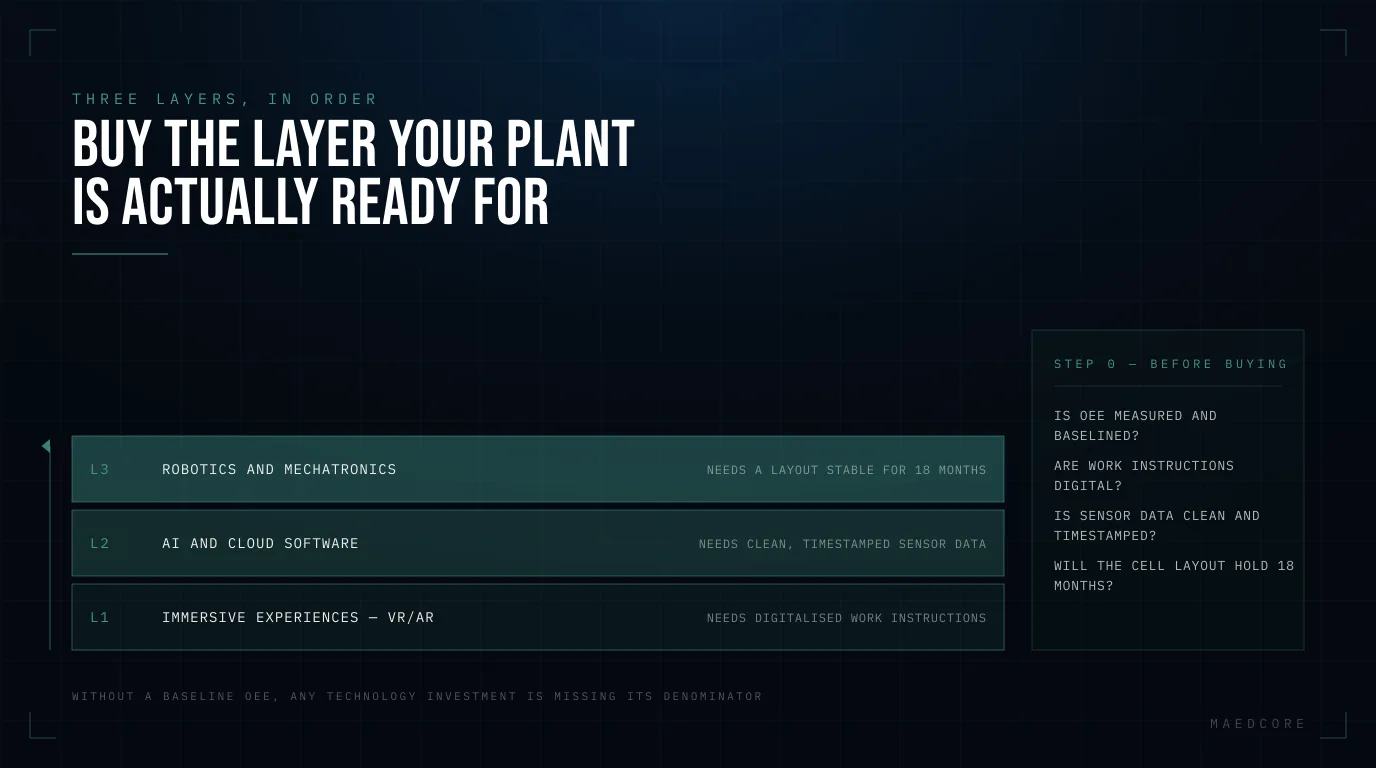
Industrial technology tools fall into three layers that must be activated in sequence: OT data infrastructure, software/AI layer, and human interface or autonomous physical layer. Skipping that sequence is the single most common cause of project failure.
Layer 1 — Immersive Experiences (VR/AR). The global AR/VR market in manufacturing was valued at $12.74 billion in 2024 and is projected to reach $100.01 billion by 2034 (22.88% CAGR). The most mature use cases are overlaid assembly instructions, VR training for high-risk operations, and remote expert support.
Layer 2 — AI and Cloud Software (predictive maintenance, inspection, digital twin). The digital twin market is growing rapidly: MarketsandMarkets projects the Spain segment alone from $398 million in 2025 to $2.63 billion by 2030 (45.8% CAGR). Yet only 5% of global manufacturers have achieved end-to-end digitalised operations, meaning most are starting from a very immature data foundation.
Layer 3 — Robotics and Mechatronics (cobots). 64,542 collaborative robots were installed globally in 2024, up 12% year-on-year, raising their share of total new robot installations to 11.9%. The collaborative robot market is projected to grow 20% annually through 2028.
The sequencing rule is: OT infrastructure → data/AI layer → human interface (AR/VR) → autonomous physical layer (cobots). You cannot extract value from AI without clean OT data. You cannot overlay meaningful information in AR if the underlying process isn’t digitalised. Cobots can be deployed in parallel with the data layer only if the task is purely mechanical and requires no sensor feedback.
Step 0 Before You Buy Anything: The Shop-Floor Readiness Audit
Before evaluating any industrial technology tool, four questions determine whether your plant is ready to benefit from it — or whether you need to solve more basic problems first.
Question 1: Is your OEE measured and baselined? If not, any technology investment lacks a denominator. Priority: implement OEE measurement before purchasing anything else.
Question 2: Are your work instructions digitalised? If they exist only on paper or in tribal knowledge, AR is premature. Augmented reality overlays need a structured, up-to-date data source; without one, operators will stop trusting the system within weeks.
Question 3: Do you have clean, timestamped sensor data on critical assets? If not, AI-driven predictive maintenance is premature. Sensor deployment must precede AI, not run in parallel with it.
Question 4: Will your production cell layout remain stable for at least 18 months? If a reconfiguration is planned, a cobot’s payback won’t close. The typical amortisation window is 6 to 18 months.
If any of these answers is no, the next step is not to evaluate technology — it is to resolve that prerequisite.
The “Problem First” Framework: Decision Matrix by Technology Layer
This is the centrepiece of the guide: a four-step system for mapping your plant’s operational pain to the correct technology layer, with explicit go/no-go criteria and ROI thresholds grounded in engineering experience.
Step 1 — Operational Pain → Technology Layer Matrix
The “Wrong First Move” column is as important as the others: that’s where the money gets wasted.
| Primary Operational Pain | Right First Layer | Second Layer | Wrong First Move |
|---|---|---|---|
| Unplanned downtime on critical assets | AI/IoT Predictive Maintenance | Digital twin for simulation | Replace the entire MES |
| High error / rework rate in complex assembly | AR (guided work instructions) | VR (operator training) | Cobot (wrong problem type) |
| Repetitive manual tasks, labour shortage | Cobot / mechatronics | Machine vision for QC | AR (doesn’t eliminate the task) |
| Slow onboarding / knowledge transfer | VR (immersive training) | AR (on-the-job guidance) | Cobot (doesn’t transfer knowledge) |
| Quality inspection bottleneck | AI vision + IoT | AR (inspector guidance) | VR (no value on the production floor here) |
| Remote expert access / field service | AR (remote assistance) | Digital twin | VR (wrong modality for the field) |
Step 2 — Go/No-Go Criteria by Layer
AR/VR — Go if:
- At least one workflow has a measurable baseline (time per task, error rate, injury frequency).
- The budget includes content creation: target 40–50% of total pilot budget, not just hardware.
- A 90-day decision gate has been set with a pre-agreed 15% improvement threshold.
AR/VR — Not yet if:
- Work instructions exist only on paper or in senior operators’ heads.
- The workflow affects fewer than 10 people (the ROI denominator is too small).
- IT/OT infrastructure cannot support real-time data overlay.
AI Predictive Maintenance — Go if:
- At least 6 months of historical sensor data exist on the target assets.
- The maintenance team has capacity to act on alerts (an alert without action generates zero ROI).
- Target assets represent at least 20% of total downtime cost.
AI Predictive Maintenance — Not yet if:
- Sensors are not yet installed (sensor deployment must precede AI).
- There is no CMMS, or maintenance is managed in spreadsheets.
- The plant operates in pure reactive mode: start with preventive maintenance, then move to predictive.
Cobots — Go if:
- The target task is repetitive, high-cycle, and ergonomically hazardous.
- Cell layout will be stable for at least 18 months.
- A redeployment plan exists for the displaced operator (without one, active resistance destroys adoption).
Cobots — Not yet if:
- The task requires more than three different end-effectors or frequent format changes.
- Throughput requirements exceed the cobot’s speed envelope (use an industrial robot instead).
- The risk assessment under ISO 10218-2:2025 has not been completed.
Step 3 — ROI Thresholds Grounded in Engineering Experience
Anglo-Saxon benchmarks don’t translate directly to every industrial context. These are the reference points we use as a starting position in industrial projects (engineering judgment, not a financial guarantee):
- Minimum acceptable IRR: 25%, reflecting the cost of capital for an industrial SME and a three-year planning horizon.
- Payback ceiling: 18 months for cobots and AR/VR; 24 months for AI predictive maintenance (data maturation takes longer).
- Funding offset: Apply available regional and national digitalisation grants to reduce net capex before calculating payback. In Spain, the Comunidad de Madrid has a specific grant line for industrial SME digitalisation, and FEDER Industry 4.0 funds are relevant for eligible sectors. Next Generation EU funds channelled through the PERTE Industria Conectada 4.0 programme apply to larger-scale projects.
- Accelerated depreciation: Spanish corporate tax law provides for accelerated depreciation on digital assets — verify current conditions with your tax adviser before projecting cash flows.
Step 4 — The Sequencing Rule
OT infrastructure → data/AI layer → human interface (AR/VR) → autonomous physical layer (cobots)
Violating this order is not a prioritisation mistake: it is burning your innovation budget. Cobots can be deployed in parallel with the data layer only if the task is purely mechanical and requires no sensor feedback.
ROI Numbers: What the Sources Say and Where They Disagree
The ROI figures circulating in trend articles are real — but highly dependent on deployment context, and the sources disagree significantly.
In predictive maintenance, McKinsey estimates a 30–50% reduction in unplanned downtime and a 20–40% extension of asset life. Deloitte is more conservative: 10–20% improvement in availability and 5–10% reduction in maintenance costs. The gap matters: the high end is real at maturity and starting from a purely reactive baseline. A plant already running preventive maintenance should model the 30–50% range, not 90%. Siemens’ True Cost of Downtime 2024 report puts the average loss for a large plant at $253 million per year — 65% higher than in 2019. Typical payback on predictive maintenance is 8–14 months.
In AR/VR, 72% of manufacturers that deployed AR solutions reported positive ROI in the first year (PTC, 2025, via secondary source — treat as directional, not guaranteed). A focused AR pilot costs between $25,000 and $75,000 for 5–10 workers over 8–12 weeks — before any grant offset. The most common mistake is budgeting only for hardware: 40–50% of the budget must go to content creation.
In cobots, typical ROI is 6–18 months on high-cycle repetitive tasks. An entry-level cell (UR5e + gripper + safety assessment + programming) costs between €35,000 and €65,000 installed; with a vision system and conveyor integration, €80,000–€150,000. The cobot itself represents 30–40% of total project cost; tooling, guarding, and conveyor modifications account for the rest.
Red Flags by Layer: When a Technology Tool Is Premature
Trend articles describe what each technology does well. Almost none of them say when it’s the wrong moment to adopt it.
AR/VR: Hardware is purchased without a content creation budget (hardware is 20% of the problem; content is 80%). No MES/ERP integration means overlays go stale. The pilot has no pre-agreed KPI — without a reference metric, the project dies at the next budget review. Attempting plant-wide rollout from day one: the most expensive failures we’ve seen follow exactly this pattern.
AI Predictive Maintenance: The maintenance team is already stretched — alerts without response capacity generate alert fatigue; in our experience, a team that ignores the system for 60 days rarely trusts it again. No labelled historical failure data exists. Year-one ROI is projected as steady-state: initial performance is extraordinary because it replaces a reactive baseline, but long-term performance is more modest.
Cobots: Cell redesign costs are underestimated — projects that budget only for the robot invariably overrun. No operator redeployment plan exists: deployments imposed without worker involvement generate active resistance and deliberate underutilisation. Availability of certified integrators varies by region; identifying the right partner from the outset avoids significant delays and cost overruns.
What We’ve Seen in Real Projects
Decision frameworks are useful; real projects are the proof.
In an immersive visualisation project for a company in the industrial rolling sector, the challenge wasn’t technical — it was commercial: selling complete factories to international buyers without being able to bring them on-site. The solution was an interactive visual twin that allowed buyers to walk through the facility in detail before making a purchase decision, shortening sales cycles and raising the technical understanding of the buyer. In industrial inspection projects, the bottleneck is rarely data collection — drones, scanners, sensors — but post-processing: automating that software layer, with instant reports and 3D maps in the cloud, is where the real ROI concentrates.
What these projects share with the framework in this guide: in both cases, the starting point was the operational problem, not the technology. The manufacturing sector — with 82% of manufacturers still dependent on reactive or time-based maintenance and only 5% with end-to-end digitalised operations — has enormous room for improvement. But that room is only captured through disciplined decisions, not trend adoption.
Frequently Asked Questions
Where should an industrial manufacturer start if it wants to digitalise its operations?
Before evaluating any tool, answer the four shop-floor readiness questions: OEE measured and baselined, work instructions digitalised, sensor data available on critical assets, and cell layout stable for at least 18 months. If any answer is no, that prerequisite takes priority over any technology investment. Regional and national digitalisation grant programmes — including specific lines for industrial SMEs — can fund part of the readiness work itself.
How much does an AR pilot in an industrial plant actually cost?
A focused pilot for 5–10 workers over 8–12 weeks costs between $25,000 and $75,000 before any grant offset. The most common mistake is budgeting only for hardware: 40–50% of the budget must go to content creation and work instruction digitalisation. Hardware costs have fallen significantly in recent years, but the device is the smallest part of the real problem.
Are cobots suitable for manufacturers with small or highly variable production runs?
It depends on the variability pattern. Cobots deliver strong ROI on high-cycle repetitive tasks with a stable cell layout for at least 18 months. If production changes format frequently or requires more than three different end-effectors, integration costs escalate and payback doesn’t close. The evaluation must include reprogramming time per product changeover — a factor that standard cobot quotations almost never account for.
Why do so many digital transformation projects fail if the technologies actually work?
McKinsey attributes the 70% failure rate to an excessive focus on the direct impact of technology while neglecting organisational factors: training, change management, integration with existing processes, and the team’s actual capacity to act on the data generated. A technology that works perfectly in an environment with the right prerequisites will fail in one without them. Verifying those prerequisites before committing budget is precisely the purpose of the shop-floor readiness audit described in this guide.
What does the ROI sequencing rule mean in practice?
It means OT infrastructure must come before AI, AI before AR/VR overlays, and AR/VR before autonomous physical systems like cobots — because each layer depends on the one below it for its data. The only exception: cobots can be deployed in parallel with the data layer if the task is purely mechanical and requires no sensor feedback. Violating the sequence doesn’t just delay ROI — it wastes the entire project budget.
Related reading
- Industrial Process Digitalisation — the layer model: what to stabilise before anything clever gets built on top.
- Industrial Process Automation — how to pick the first process to automate — and which ones to leave manual.
- Industrial Automation and Control — what your plant already measures, and why most of it never becomes useful.
- Industry 4.0 in Practice — what the pyramid diagrams leave out: examples with numbers attached.
- Maedcore — Digital Solutions — what we build in this area.
Sources
- Why 70% of Digital Transformation Projects Still Fail — MeltingSpot, 2026
- Digital Transformation in SMEs: Overcoming the High Failure Rate — AMCIS 2024 / AIS eLibrary, 2024
- AR and VR in Manufacturing Market — Precedence Research, 2025
- Spain Digital Twin Market 2025–2030 — MarketsandMarkets, 2025
- AI Transformation in Manufacturing — Meta Intelligence, 2026
- Cobots crecen 12% en 2024: guía para founders manufactureros — Ecosistema Startup, 2026
- Cobots: los nuevos robots colaborativos — Iberdrola
- Ayudas para digitalizar PYMEs industriales en Madrid — ThinkCo / Comunidad de Madrid, 2024
- Predictive Maintenance AI: How Manufacturers Cut Costs 30% & Downtime 50% — SUPALABS, 2026
- State of Manufacturing Maintenance: 2025 Global Industry Report — OxMaint, 2026
- Predictive Maintenance ROI: Case Studies from Global Manufacturing Plants — OxMaint, 2026
- AR in Manufacturing: 5 Use Cases with Proven ROI — KGT Solutions, 2026
- Industrial Augmented Reality: Use Cases, Costs & Platforms — FrameSixty, 2026
- AI ROI for Manufacturing: A 5-Function Benchmark Guide — AI Assembly Lines, 2026
About the Author
Robotics Engineer
For over a decade, I have been driven by a single mission: leveraging AI and robotics to build a world of automated production. I believe that by creating self-sufficient systems, we can empower people to refocus on what truly matters—their families and their passions. My expertise spans from winning prestigious European startup competitions to architecting complex, integrated hardware and software projects. I specialize in bridging the gap between today's industrial challenges and tomorrow's autonomous solutions.
Frequently Asked Questions
Where should an industrial manufacturer start if it wants to digitalise its operations?
How much does an AR pilot in an industrial plant actually cost?
Are cobots suitable for manufacturers with small or highly variable production runs?
Why do so many digital transformation projects fail if the technologies actually work?
What does the ROI sequencing rule mean in practice for industrial technology investment?
Ready to transform your company?
Book a free 30-minute meeting with an engineer.