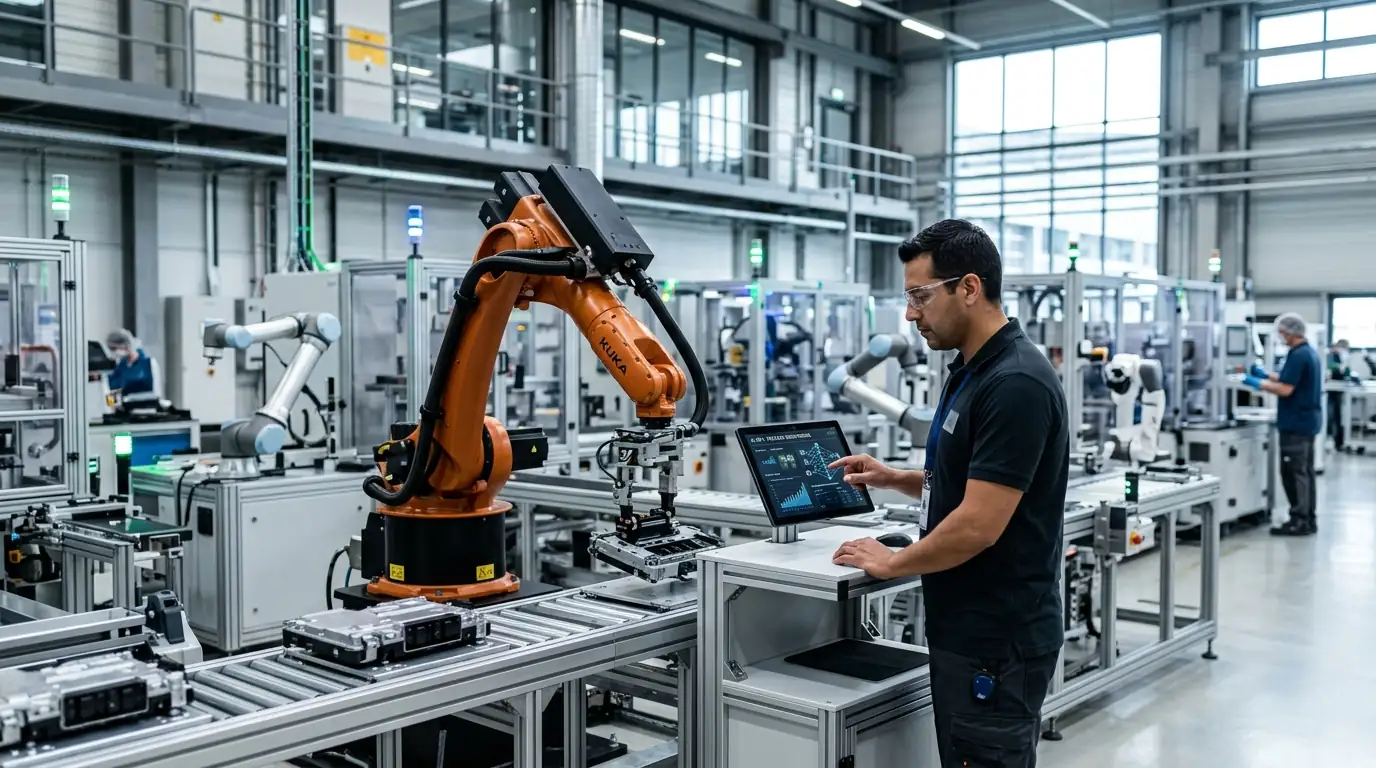
Industry 4.0 in Practice: Real Examples with Measurable Results (No Diagrams)
60% of Spanish manufacturers say they're digitalising, but only 8.9% use AI. Real Industry 4.0 examples with concrete metrics: inspection, sales cycles

Written by Eduardo Fuentevilla Blanco
Robotics Engineer at Maedcore · Robotics Engineer LinkedIn ↗
Key Takeaways
- ► 60% of Spanish industrial companies report positive digitalisation results, but only 8.9% use AI — both figures are simultaneously true and reflect very different adoption stages (INE/Springer, 2025).
- ► AI visual inspection achieves 95–99% detection rates versus 70–80% for humans, with a documented three-year ROI of 374% and 7–8 month payback for single-line pilots (Forrester/iFactory, 2026).
- ► The B2B sales cycle in manufacturing averages over 9 months and has grown 25% in five years; 80% of interactions already occur through digital channels, making the in-person plant visit the primary commercial bottleneck.
- ► The most common AI inspection pilot failure is not the algorithm — it is insufficient training data (minimum 200–500 labelled images per defect class) combined with underestimated OT/IT integration complexity.
- ► Manufacturers in the Madrid region can access grants covering up to 35% of eligible Industry 4.0 investment — including AR, computer vision and robotics — stackable with R&D tax credits and the national Kit Digital programme.
- ► No manufacturing SME in the Henares Corridor has published a quantified Industry 4.0 case study with before/after metrics in the public domain — the first to do so will own the only verified reference of its kind.
60% of Spanish industrial companies report launching digitalisation initiatives with positive results — yet only 8.9% use artificial intelligence technologies, according to INE data cited in the Journal of the Knowledge Economy (Springer, 2025). That gap between the optimistic headline and the structural reality is where this article starts: no nine-pillar framework diagrams, no buzzword bingo — just named operational problems, the technology that solves them, and the measurable results that justify the investment.
The problem with the Industry 4.0 ‘examples’ you find online
Most articles on Industry 4.0 real-world examples name large companies — SEAT, Siemens Gamesa, Repsol — without a single before/after metric, making it impossible for a plant manager to judge whether the technology actually solves their specific problem.
The pattern is always the same: company name + technology + generic benefit. What never appears is the cost of doing nothing, the realistic implementation timeline, or what happens when the project stalls halfway through.
This superficiality has a statistical cause worth understanding. The VIII Smart Industry 4.0 Report (Observatorio de Industria y Tecnología / Structurit, December 2025) reports that nearly 60% of Spanish industrial companies have launched initiatives with positive results — an encouraging headline. But the same report qualifies this: most companies remain at an intermediate stage where technology is beginning to generate value but has not yet become a genuine competitive driver. Meanwhile, INE data show that only 8.9% of industrial companies use AI technologies and just 6.6% use big-data analytics software. Both figures can be true simultaneously: “60% are digitalising” covers everything from a cloud ERP to a full AI-vision inspection line — but trade press almost always quotes only the large number.
The methodology here is different: each example starts from a real operational problem, describes the enabling technology with its implementation requirements, cites the result range with explicit assumptions, and flags the most common failure modes. Where sources disagree, the disagreement is shown.
The inspection bottleneck: when the human eye is not enough
A human inspector misses between 20% and 30% of defects under real production conditions, and accuracy drops a further 15–25% after two hours of continuous observation — a cost that few plants have ever calculated explicitly.
Inter-inspector agreement on defect severity ranges from only 55% to 70%, meaning the same component can receive different verdicts depending on the shift and the person. The Cost of Poor Quality is estimated at around 20% of revenue in manufacturing — though this is a broad industry benchmark that needs plant-level validation.
AI-powered visual inspection systems achieve detection rates of 95–99%, inspect more than 10,000 parts per hour with inference times below 100 ms, and maintain identical standards around the clock. Documented outcomes include a 37% reduction in defects, 85% fewer customer complaints, and a three-year ROI of 374% with a median payback of 7–8 months, according to Forrester analysis cited by iFactory. One electronics manufacturer reduced its defect escape rate from 2.3% to 0.1%, eliminating $1.8 million in annual warranty exposure.
Here it is worth surfacing a discrepancy that the sources do not explain on their own. The 7–8 month payback (Forrester/iFactory) applies to well-scoped, single-line pilots. The 12–18 month payback cited by Averroes AI (2026) applies to broader deployments requiring infrastructure upgrades. A plant manager who reads both figures without this context will make investment decisions on incorrect assumptions.
Failure modes that vendor presentations never mention
The most common failure in AI visual inspection pilots is not algorithm accuracy: it is a lack of training data. A computer vision model needs a minimum of 200–500 labelled images per defect class to generalise reliably. Plants with defect rates below 0.5% can take months to accumulate that volume — and projects stall while the model remains unusable. In our experience, this is the single most frequent reason AI inspection pilots drag on or get abandoned.
The second most common failure is deploying the system on a line with variable ambient lighting without a controlled lighting rig: the model learns the shadows as readily as the defects. The third mistake is treating the AI system as a replacement for the quality engineer rather than as an amplification tool — models require continuous validation and retraining.
Adding to this is the OT/IT integration challenge, which the VIII Smart Industry 4.0 Report identifies as the primary source of delay in SME projects: heterogeneous or legacy infrastructure that makes connecting the vision system to the MES or ERP more time-consuming than building the model itself.
In an automated welding project we built — the Automated Welding Head with Cooled Torch and Inspection Screen — solving the controlled-lighting problem and the data architecture before training the model was what separated that pilot from the ones that get abandoned.
Indicative investment range (engineering judgement, not a quote): single-camera systems: €15,000–50,000 in hardware and integration; multi-camera full-line deployments: €80,000–250,000. Timeline: 2–4 months for a single-line pilot; 6–12 months for full plant rollout.
The industrial sales cycle: why a factory visit can cost more than the demo
The B2B sales cycle in manufacturing averages more than 9 months and has grown 25% over five years, while 80% of interactions already happen through digital channels — making the in-person plant visit the primary commercial bottleneck.
Focus Digital puts the average time to convert a manufacturing prospect from first contact at 130 days. Dentsu B2B research (2024) extends that figure to 379 days measured from when the buyer first starts researching their problem. 43% of B2B sales leaders reported longer cycles over the past 12 months, according to Wave Connect (citing Gartner and McKinsey, 2026). The average number of stakeholders involved in a B2B purchase has grown from 5 to more than 11 over a decade — spread across time zones, with no practical way to bring them all to the plant.
A typical industrial machinery deal involves around 10 interactions. At an estimated average cost of €300 per interaction, meeting costs alone reach €3,000 before counting international travel. For a buyer in LATAM or MENA, adding two transatlantic trips pushes that figure to €15,000–20,000 per opportunity — many of which never close.
The EK Interactive case, documented by MarTech3D, illustrates what happens when that friction is removed: after deploying a 3D virtual showroom, the company cut its sales cycle by 50%, saved approximately £50,000 in meeting costs over two years, and grew 50% year-on-year. The PTC 2025 Industrial AR report found that 72% of manufacturers that deployed AR solutions reported positive ROI within the first year.
Format matters: a browser-based interactive 3D environment — no installation, no additional hardware — allows each of those 11 decision-makers to review it asynchronously. The most common mistake is building something visually impressive that cannot answer technical questions in real time: without integration with up-to-date specification sheets and CRM handoff, it is an interactive brochure, not a sales tool.
Indicative investment range: a WebAR or browser-based interactive 3D pilot costs between €8,000 and €40,000 and is delivered in 6–12 weeks. Native enterprise AR solutions exceed €100,000.
The problem-to-proof decision matrix: the map that does not exist anywhere else
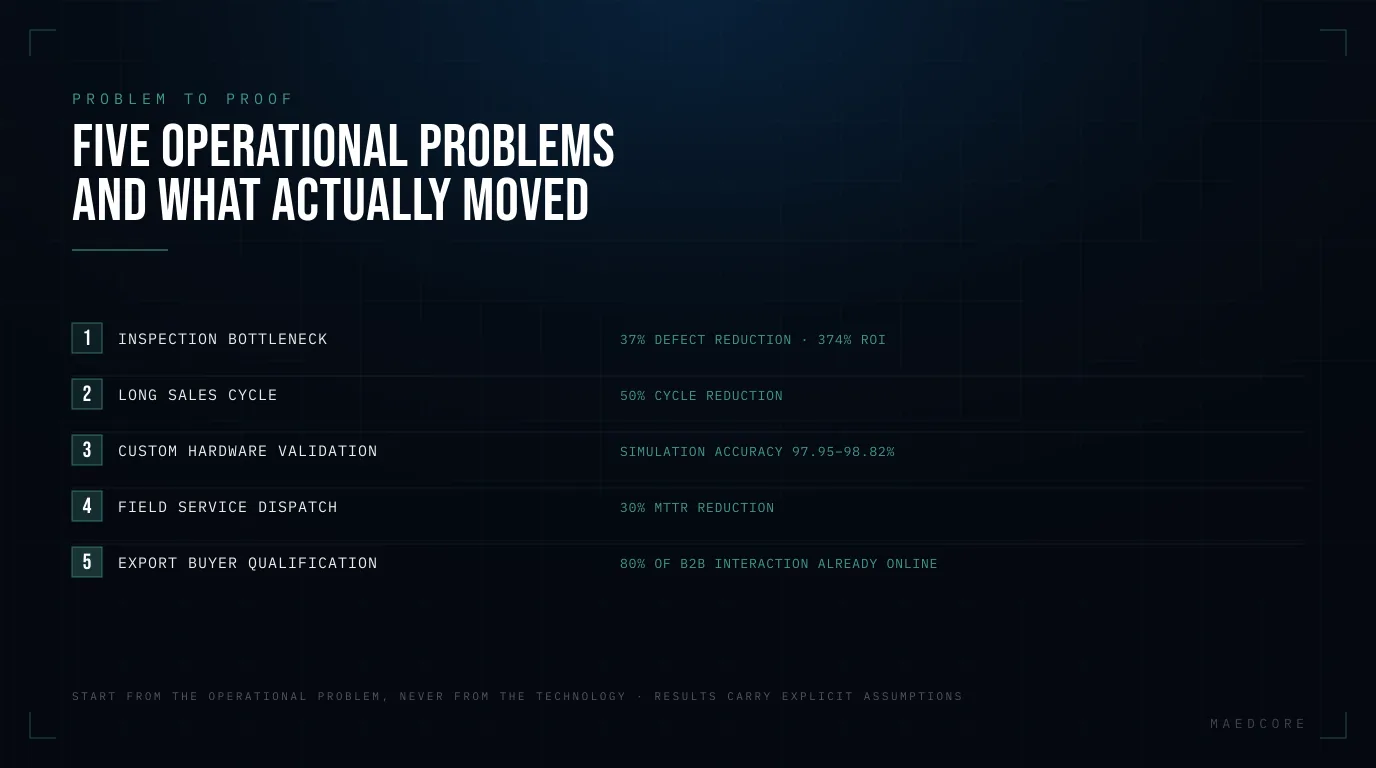
This is the original contribution of this article: a structured matrix linking each operational problem to the enabling technology, the documented result range with explicit assumptions, a realistic timeline, and the available funding levers for manufacturers in Madrid and its industrial corridor.
| Operational problem | Cost of inaction (reference) | Enabling technology | Documented result (explicit assumptions) | Implementation timeline | Funding lever (Madrid / Corridor) |
|---|---|---|---|---|---|
| Inspection bottleneck — manual inspection misses 20–30% of defects; accuracy drops after 2 h | ~20% of revenue in Cost of Poor Quality (industry benchmark; validate per plant) | Computer vision + edge compute | 37% defect reduction; 374% ROI over 3 years; payback 7–8 months (single-line pilot) / 12–18 months (broader rollout) | 2–4 months pilot; 6–12 months full plant | Madrid I4.0 grant: up to 35% of investment (small company, Henares Corridor) |
| Long sales cycle — buyer requires plant visit; cycle 9–13 months | €3,000–20,000 in meeting and travel costs per opportunity | Interactive 3D virtual showroom / immersive demo | 50% cycle reduction (EK Interactive case); 72% of AR-deploying manufacturers report positive ROI in year 1 | 6–12 weeks for WebAR/3D build | Same grant covers AR/VR as ‘manufacturing process digitalisation’ |
| Custom hardware validation — mechatronic system must be validated before manufacturing | Weeks of engineering time + prototype scrap | Digital twin + AR overlay for pre-manufacturing validation | Simulation accuracy 97.95–98.82% vs. real experiment (University of León, Sensors MDPI, 2021) | 4–8 weeks to build the twin | R&D tax credit (Art. 35 CIT Act) stackable with regional grant |
| Field service — technician dispatched for fault diagnosis | €1,200–3,500 per service visit (engineering judgement) | Remote AR-assisted support | 30% MTTR reduction; 20% improvement in first-time fix rate (KGT/PTC 2025) | 2–4 weeks deployment | Kit Digital (national programme) covers remote assistance tools |
| Export buyer qualification — LATAM/MENA buyer cannot visit the plant | Lost deal or 12+ month delay | Virtual plant tour + product configurator | 80% of B2B interactions already on digital channels; removes geography as a qualification barrier | 4–8 weeks | ICEX support for export digitalisation |
How to use this matrix in practice
The first step is identifying which of these five problems generates the highest cost of inaction in your plant or commercial process. An SME in the Henares Corridor selling domestically has a very different problem profile from a machinery manufacturer exporting 60% of its output.
The second step is verifying whether your company qualifies for the available grants before sizing the investment. Companies in the Henares Corridor and Madrid’s South Metropolitan area can access grant intensities of 25% for medium-sized enterprises and 35% for small enterprises, with caps of €350,000 for small and €250,000 for medium companies, according to MentorDay / BOCM. Eligible expenditure explicitly includes augmented reality, collaborative robotics, additive manufacturing, sensors, embedded systems and process control. Stacking these grants with the R&D tax credit under Article 35 of the Corporate Income Tax Act can reduce the effective net cost to 40–50% of gross investment — though this requires individual tax analysis.
The third step is to scope the pilot, not the full deployment. A study by the Universitat Politècnica de València and Cardiff Business School covering 179 Spanish SMEs (December 2025) found that employee engagement and market-need focus are the primary enablers of scaling — suggesting that tightly scoped pilots with operator involvement from day one are far more likely to scale than top-down deployments.
The Henares Corridor context: available funding and benchmarks
The Henares Corridor is Spain’s densest industrial zone by employment, yet no public study exists with Industry 4.0 adoption metrics specific to the area — unlike Catalonia, which has ACCIÓ data on 1,447 companies specialising in I4.0 technologies (a 30.2% increase since 2021).
What is documented is the public investment. The Community of Madrid’s Industrial Plan 2020–2025 was executed at 100%, deploying more than €514 million. Through it, the regional government awarded digitalisation grants to more than 300 companies — 75 of them in the Henares Corridor — totalling €27.5 million, plus €6 million for productive assets in medium-sized companies and €3 million for infrastructure in SMEs and micro-enterprises in the Corridor.
76% of the companies analysed in the VIII Report acknowledge an urgent need to strengthen training programmes and attract technology talent — the most-cited barrier, ranking even above funding. The greatest risk in Industry 4.0 projects is rarely the technology itself: it is the internal capacity to operate and maintain it once the vendor has left the plant.
As of mid-2026, no Spanish SME in the Henares Corridor has published a quantified Industry 4.0 case study with before/after metrics in the public domain. A single real data point — “we cut inspection time from 4 hours to 40 minutes on our welding line” — would be the only verified reference of its kind in English. The UPV and Cardiff study identifies post-implementation knowledge gaps and lack of integration support as the primary barriers to scaling — manufacturers who document their own results help close that gap for the entire ecosystem.
Related reading
- Industrial Process Digitalisation — the layer model: what to stabilise before anything clever gets built on top.
- Industrial Process Automation — how to pick the first process to automate — and which ones to leave manual.
- Industrial Automation and Control — what your plant already measures, and why most of it never becomes useful.
- Industrial Technology Tools — an evaluation framework for separating a real tool from a demo.
- Maedcore — Digital Solutions — what we build in this area.
Frequently Asked Questions
What Industry 4.0 technologies are most widely deployed in manufacturing?
The most widely deployed are industrial cloud computing, ERP and MES systems, and second-generation robotics. By contrast, only 8.9% of industrial companies use AI and 6.6% use big-data analytics software, according to INE data cited in the Journal of the Knowledge Economy (Springer, 2025). The gap between basic and advanced adoption is the most distinctive feature of the Spanish industrial ecosystem relative to Germany or Italy.
How long does it take for an AI visual inspection system to pay back?
For a well-scoped single-line pilot, the Forrester analysis cited by iFactory puts payback at 7–8 months with a three-year ROI of 374%. For broader deployments requiring infrastructure upgrades, the period extends to 12–18 months. The difference lies not in the technology but in the initial scope: a tightly bounded pilot reduces risk and generates training data before scaling.
What grants are available for Industry 4.0 projects in the Madrid region?
Companies in the Henares Corridor and Madrid’s South Metropolitan area can access grant intensities of 25% for medium-sized enterprises and 35% for small enterprises, with caps of €250,000 and €350,000 respectively, according to MentorDay / BOCM. Eligible expenditure includes AR, collaborative robotics, sensors and process control. These grants are stackable with the R&D tax credit under Article 35 of the Corporate Income Tax Act and with the national Kit Digital programme, though stacking requires individual tax analysis.
How does a virtual showroom shorten the industrial sales cycle?
The B2B buying group in manufacturing typically involves 6 to 11 stakeholders from different departments. A browser-based interactive 3D environment — no headset required — allows each decision-maker to review it asynchronously, eliminating dependence on the in-person plant visit. The EK Interactive case documented by MarTech3D shows a 50% reduction in sales cycle length and savings of approximately £50,000 in meeting costs over two years.
How accurate is a digital twin for validating custom hardware before manufacturing?
A study from the University of León published in Sensors (MDPI, 2021) validated digital twin results against real experiments with accuracies of 97.95% and 98.82% on total mission time — sufficient for pre-approval of custom mechatronic systems. The most common failure mode is scope creep: requesting a full-plant twin when a single-line twin delivers 80% of the value at 20% of the cost and time.
Why do Industry 4.0 pilots fail in manufacturing SMEs?
The three most frequent causes are: underestimated OT/IT integration complexity with heterogeneous or legacy infrastructure; insufficient training data for AI models in plants with low defect rates (a minimum of 200–500 labelled images per defect class is required); and lack of internal capacity to operate the system once the vendor has left — a problem acknowledged by 76% of companies in the VIII Smart Industry 4.0 Report.
Sources
- VIII Smart Industry 4.0 Report — Observatorio de Industria y Tecnología / Structurit, December 2025
- Adopting Lean Industry 4.0: Insights from Spanish Manufacturing SMEs — International Journal of Production Research, Universitat Politècnica de València / Cardiff Business School, December 2025
- Technological Collaboration and the Industry 4.0 Transformation: Evidence for Spanish Manufacturing Firms — Journal of the Knowledge Economy, Springer, January 2025
- AI Vision Inspection for Manufacturing: Automated Defect Detection Guide 2026 — iFactory Platform, 2026 (citing Forrester, Intel, Jidoka Technologies)
- AR in Manufacturing: 5 Use Cases with Proven ROI — KGT Solutions, June 2026 (citing PTC 2025 State of Industrial AR)
- How the Virtual Showrooms Generate ROI — MarTech3D (EK Interactive case), 2025
- Average Sales Cycle Length by Industry: 2026 — Focus Digital, 2026 (citing Dentsu B2B research 2024)
- B2B Sales Statistics 2026 — Wave Connect (citing 6Sense, HubSpot, Gartner, McKinsey), 2026
- Digital Twin for Automatic Transportation in Industry 4.0 — Sensors (MDPI), University of León, 2021
- Community of Madrid — Single Window for the Henares Corridor — Comunidad de Madrid, March 2026
- Industry 4.0 SME Digitalisation Grants Madrid — BOCM detail — MentorDay / Comunidad de Madrid BOCM
- Industry 4.0 in Catalonia — Sector Report — ACCIÓ / Catalonia.com, 2024–2025
About the Author
Robotics Engineer
For over a decade, I have been driven by a single mission: leveraging AI and robotics to build a world of automated production. I believe that by creating self-sufficient systems, we can empower people to refocus on what truly matters—their families and their passions. My expertise spans from winning prestigious European startup competitions to architecting complex, integrated hardware and software projects. I specialize in bridging the gap between today's industrial challenges and tomorrow's autonomous solutions.
Frequently Asked Questions
What Industry 4.0 technologies are most widely deployed in manufacturing?
How long does it take for an AI visual inspection system to pay back?
What grants are available for Industry 4.0 projects in the Madrid region?
How does a virtual showroom shorten the industrial sales cycle?
How accurate is a digital twin for validating custom hardware before manufacturing?
Why do Industry 4.0 pilots fail in manufacturing SMEs?
Ready to transform your company?
Book a free 30-minute meeting with an engineer.