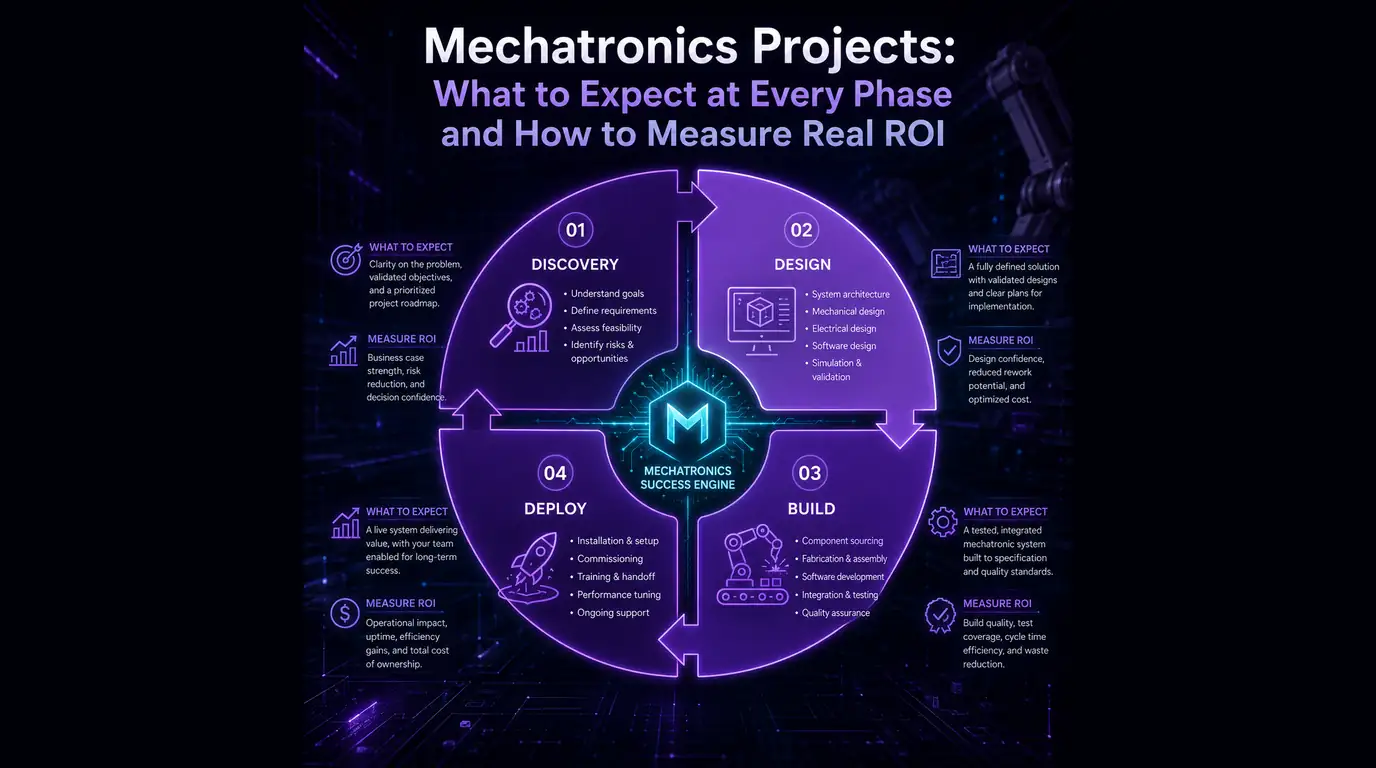
Mechatronics Projects: What to Expect at Every Phase and How to Measure Real ROI
A technical guide to industrial mechatronics projects: from discovery to handover, hidden costs, acceptance KPIs, and when to choose custom vs

Written by Eduardo Fuentevilla Blanco
Robotics Engineer at Maedcore · Robotics Engineer LinkedIn ↗
Key Takeaways
- ► The robotic arm accounts for only 30–45% of the total cost of a working mechatronic installation; tooling, firmware, safety, and commissioning absorb the rest (Nexum Automatics, Standard Bots, 2026).
- ► Scope ambiguity at the discovery phase is the leading cause of industrial cost overruns; complex projects exceed budget by 20–50% and accumulate schedule overruns of 6–24 months (Colony Construction, 2026).
- ► Custom mechatronic development becomes price-competitive with a catalogue cobot once custom tooling exceeds €40,000–€80,000, and it also transfers full intellectual property to the client.
- ► World-class OEE is ≥85%; a practical first-month acceptance threshold is 75%, with a 90-day target of 85%, per the ISO 22400 framework.
- ► HIL validation and firmware verification can consume 20–30% of total project hours in embedded systems work — a proportion that initial budgets consistently underestimate (engineering judgement).
- ► Madrid's 2025 industrial grants programme allows stacking up to €120,000 per beneficiary across Industry 4.0, R&D&I, and digitalisation lines — a meaningful offset for a first mechatronic prototype (AECIM / Ayuntamiento de Madrid, January 2025).
An industrial mechatronics project does not end when the robot arrives at the loading dock: the arm accounts for only 30–45% of the total cost of a working installation; the rest is absorbed by custom tooling, PLC and SCADA integration, safety validation, and commissioning. With 5,100 industrial robots installed in Spain in 2024 — third in Europe after Germany and Italy — and the machine-tool order book contracting 23% by the end of 2024, the pressure to justify every euro of capex has never been higher. This guide breaks down the five phases of a real mechatronics project — from discovery to handover — identifies where cost overruns hide, and specifies which contractual KPIs to demand before signing the acceptance certificate.
Why Mechatronics Projects Are More Complex Than the Catalogue Suggests
The robotic arm is only the tip of the iceberg: the real cost of a functional cell includes end-of-arm tooling (EOAT), safety guarding and CE marking, control cabinets, machine vision, and — above all — integration engineering and commissioning.
A catalogue lightweight cobot starts at ~€15,000 unintegrated; a general-purpose articulated arm sits between €25,000 and €80,000. But that price is only 30–45% of what a production-ready installation will cost. The rest — tooling, firmware, safety, commissioning — is exactly where budgets blow out. Complex industrial projects exceed budget by 20% to 50%, with schedule overruns of six to twenty-four months when scope is not properly defined from the outset.
This context matters because the market is under real pressure: record sales in 2024 (€2.323 billion, +7.7%), but domestic order intake down 45%. Engineering and operations managers approving capex in 2025 need solid ROI arguments, not product brochures.
Phase 1: Discovery and Scope — Where Projects Are Won or Lost
Scope ambiguity is the leading cause of cost overruns in industrial projects, ahead of any technical surprise during execution. A poorly run discovery is more expensive than any electronic component.
What Must Happen in the First Two Weeks
A rigorous discovery session is not a commercial presentation — it is a process audit. The questions a competent partner must ask — and that the internal team must be able to answer — include:
- Interface inventory: Which PLC version controls the line? Siemens S7, Allen-Bradley, Schneider? Is the communication protocol documented, or have undocumented modifications been made?
- Physical envelope: What are the space, temperature, and EMI constraints at the installation point?
- CE pre-assessment: Is this a new machine or a substantial modification of an existing one? This determines whether a full technical file is required.
- Scope freeze: When can all parties commit to a fixed scope? Without this date, the project has no solid contractual foundation.
Legacy systems are the biggest source of surprises: obsolete hardware, unsupported software, undocumented modifications, and missing up-to-date drawings are the norm in many industrial facilities, where equipment 15–20 years old runs alongside active production lines. If a factory-floor visit does not allow access to the PLC control cabinet or the electrical schematic, that is a red flag that must appear in the risk register before anything is signed.
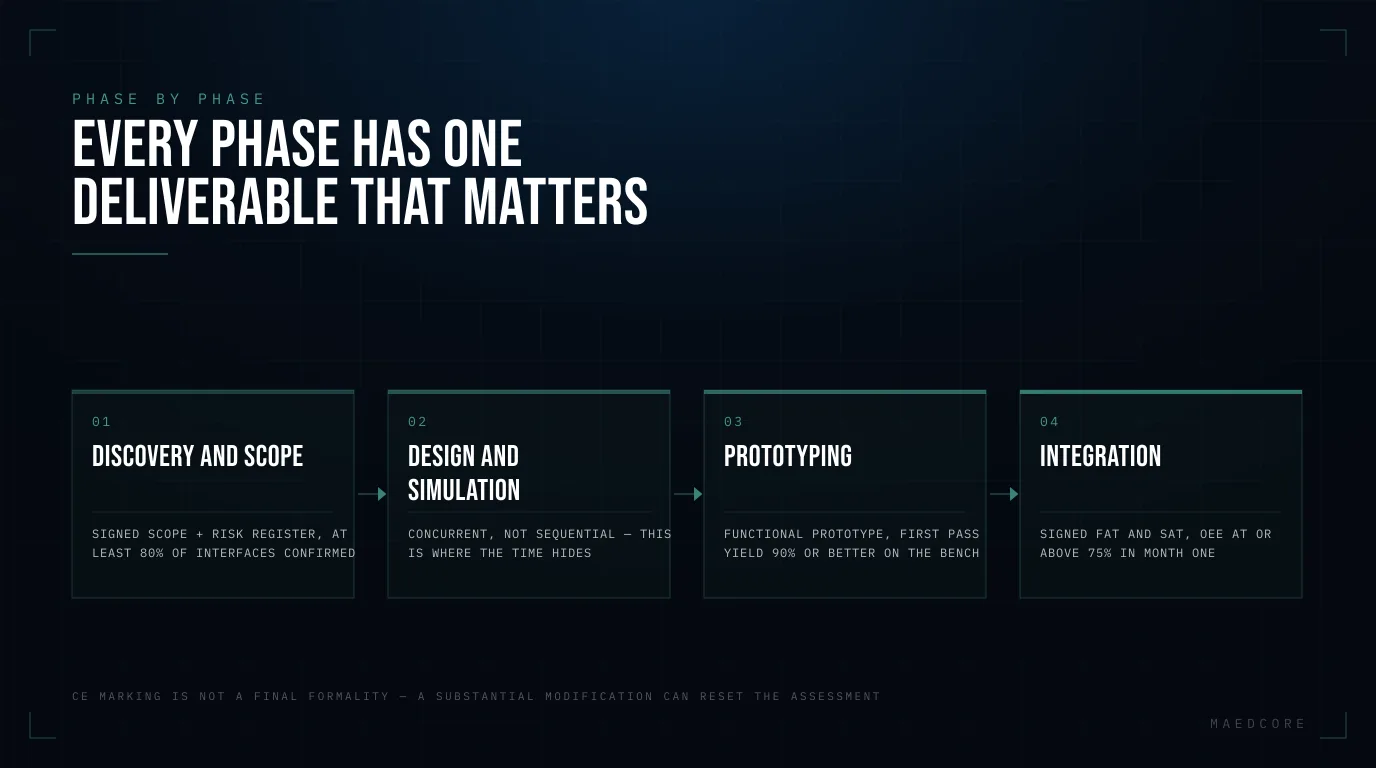
Minimum deliverable for this phase: Signed scope document + risk register with confirmed interfaces (≥80% of interface specifications closed before moving to design).
Phases 2 and 3: Design, Simulation, and Prototyping — Where Time Hides
Functional prototyping is the phase where engineering hours are most consistently underestimated: firmware-hardware interface bugs and actuator lead times are the two most frequent causes of schedule overruns.
Concurrent Design vs. Sequential Delivery
The most common mistake in mechatronics projects is organising work like an assembly line: mechanics first, then electronics, then firmware. This sequential approach guarantees late-stage integration problems. A drone stabilisation system, for example, requires the PID controller, IMU integration, and power management to be designed in parallel — not one after the other — because the constraints of each domain affect the others from day one. Research on firmware platforms for mechatronic systems confirms that drones are the canonical example of this interdependence: they are the culmination of advances in electrical, mechanical, computer, and control engineering that must communicate with each other throughout development.
A documented case study on rapid mechatronic product development — the Spengler cardiovascular project, with teams across three countries — completed mechanical, electronic, and software development in under five months through concurrent engineering, virtual prototyping, and a rapid iterative design cycle. The determining factor was not the speed of any individual team, but the elimination of waiting time between disciplines.
How Long Prototyping Actually Takes
Using commercial off-the-shelf components (catalogue sensors and actuators) alongside DFMA principles, design cycle time can be reduced by approximately 40% compared to a fully custom design, at the cost of up to 2.5% deviation from the target performance specification. This trade-off is acceptable in many industrial applications — but not all: a welding head requiring sub-millimetre seam tracking cannot absorb that deviation.
In our experience, HIL (Hardware-in-the-Loop) validation and firmware verification consume 20–30% of total project hours in embedded systems work — a proportion that initial budgets consistently underestimate. A unified hardware-software framework that supports the full lifecycle from implementation to system-level validation helps shorten these cycles and improve traceability, but it requires upfront investment in architecture.
In a 25-channel embedded electronics project we built for a real-time sensor-driven visualisation system, the complexity lay not in any individual component but in synchronising all 25 channels under strict latency constraints — exactly the kind of challenge that appears in no datasheet and only surfaces during bench integration testing. The Pixel Custic project illustrates how firmware-hardware co-design from day one is the only way to avoid costly redesigns at this stage.
Minimum deliverable: Functional prototype + test report with First Pass Yield ≥90% on the bench, and a defined MTBF target for the production unit.
Phase 4: Integration and Commissioning — The Moment of Truth with Existing Infrastructure
Integration with legacy PLCs and SCADA is where most mechatronics projects lose unexpected weeks; equipment 15–20 years old with no digital documentation is the rule, not the exception, in many industrial sites.
Integration Protocols and the Reality of Installed Base
Standard protocols — Modbus, OPC-UA — are the right starting point for the installed base: Siemens S7, Allen-Bradley, and Schneider are the dominant platforms, and all have documented gateways to these protocols. The problem is not the existence of the protocol; it is the specific PLC firmware version, unexported variable tables, and modifications the original integrator made twelve years ago without leaving a written record.
Virtual commissioning can significantly shorten the production start-up process for mechatronic systems, but it requires a high level of expertise and considerable effort, making it unattractive for SMEs. This is a genuine tension: the technology is proven, but the engineering competence cost of entry is high. For medium-complexity projects, a Factory Acceptance Test (FAT) at the integrator’s facility followed by a Site Acceptance Test (SAT) at the plant remains the most pragmatic approach.
CE Marking Is Not a Final Formality
For new machines — a custom welding head, a drone-based inspection system — the CE technical file must be built from day one, not appended at the end. Retrofitting it can add four to eight weeks and €10,000–€20,000 to the budget (engineering judgement, not an external source). Delays carry compound costs: a high-technology product delayed six months can accumulate a 33% loss in profits over five years.
The Robotic Dog project — an autonomous robot integrating computer vision, NLP, and mechatronics — illustrates the complexity of multi-system integration: each subsystem (locomotion, perception, language) has its own validation cycles, and the final integration is not the sum of the parts but the discovery of unforeseen interactions between them.
Minimum deliverable: Signed FAT and SAT records, with OEE ≥ agreed baseline (e.g., 75% in month one) and MTBF ≥ category benchmark.
Custom Mechatronics or Catalogue Cobot? The Decision Framework You Won’t Find Anywhere Else
The choice between a catalogue cobot and a custom mechatronic development should not be made by intuition. There is an objective boundary, and crossing it in the wrong direction is one of the most expensive ways to waste industrial capex.
Where the Real Boundary Lies
The case for a catalogue cobot is valid in a specific context: standard tasks (palletising, machine tending with regular parts, pick-and-place in open geometry). In that context, a €40,000 cobot replacing an operator with a €60,000/year labour cost can pay back in under 18 months on a two-shift operation. The argument holds.
But there is a systematic trap in that arithmetic: catalogue cobots carry hidden costs — integration fees, complex licensing, non-standard tooling — that can double the original budget. And the arm is only 30–45% of the working installation. If the part geometry is non-standard, if the environment is hostile (temperature, EMI, explosive atmosphere), or if the process requires a custom control loop — such as seam tracking on curved welding surfaces — a catalogue cobot does not solve the problem. Adding custom tooling on top of a catalogue base can cost €40,000–€80,000 extra, at which point custom development is price-competitive and also transfers full intellectual property to the client.
As Fresh Consulting notes, depending on another vendor’s platform “can be disastrous because your fate becomes tied to theirs”; in high-volume applications, owning the design is typically cheaper in the long run because the product can be refined and is not dependent on an uncontrolled source.
Decision Scorecard: Catalogue vs. Hybrid vs. Custom
Score each criterion 1 to 3 according to the column that best describes your situation. The total determines the recommended path.
| Criterion | Catalogue cobot (1) | Hybrid (2) | Full custom (3) |
|---|---|---|---|
| Payload and geometry | Standard (≤20 kg, open space) | Near-standard with minor adaptation | Non-standard (welding head on curved surface, drone in confined space) |
| Cycle time / precision | Catalogue spec meets requirement | Within 20% of catalogue spec | Requires custom control loop (e.g., sub-millimetre seam tracking) |
| Environmental constraints | Clean, ambient temperature, no EMI | Moderate (dust, vibration) | Severe (high temperature, explosive atmosphere, outdoor UAV) |
| Legacy system integration | Standard Ethernet/IO | Modbus/OPC-UA bridge needed | Proprietary PLC protocol, undocumented SCADA |
| Intellectual property | None (process is commodity) | Partial | Full (design is a competitive differentiator) |
| Production volume | Low (1–3 units) | Medium (4–20 units) | High (20+ units — owning the design is cheaper long-term) |
| Regulatory / CE complexity | Standard Machinery Directive | Moderate (custom EOAT) | High (new machine, full technical file required) |
Result: 7–11 points → catalogue cobot; 12–16 → hybrid (catalogue base + custom tooling/firmware); 17–21 → full custom mechatronic development.
The Five Phases with Their KPI Thresholds
This is the phase checklist that no other article provides with real numbers. Cost estimates marked “(EJ)” are engineering judgement, not external sources.
| Phase | Key activities | Deliverable | Main overrun risk | KPI / Acceptance criterion |
|---|---|---|---|---|
| 1. Discovery and scope (weeks 1–2) | Process audit, PLC/SCADA interface inventory, CE pre-assessment | Signed scope + risk register | Undocumented legacy interfaces; no factory-floor access | ≥80% of interface specs confirmed; scope freeze date agreed |
| 2. Concept design and simulation (weeks 3–6) | Multi-domain CAD, kinematic simulation, control architecture, preliminary BOM | CDR (Concept Design Review) + virtual commissioning model | Mechanical and firmware teams working in silos; actuator lead times unverified | Simulation meets target cycle time ±10%; BOM lead times confirmed |
| 3. Prototyping and bench testing (weeks 7–14) | Hardware build, firmware development, HIL testing, first functional test | Functional prototype + test report | Firmware-hardware bugs; sensor calibration drift; non-representative prototype materials | First Pass Yield ≥90% on bench; MTBF target defined for production unit |
| 4. Integration and commissioning (weeks 15–20) | Installation, PLC/SCADA integration (Modbus/OPC-UA), safety validation, CE marking, training | Signed FAT + SAT | Legacy SCADA incompatibility; CE delays; insufficient production line downtime window | OEE ≥ agreed baseline (e.g., 75% month one); MTBF ≥ category benchmark |
| 5. Handover and optimisation (weeks 21–24+) | KPI baselining, predictive maintenance setup, documentation handover, 90-day warranty | As-built documentation; live KPI dashboard | No internal system owner; no training plan | OEE trending to 85%; MTTR ≤4 hours; First Pass Yield ≥ target |
Worked Cost Illustration (Engineering Judgement)
For a custom welding head system — 6-axis arm + custom EOAT + embedded controller + integration with existing PLC — the realistic all-in range is €120,000–€280,000. The arm accounts for 35–45% of the total; tooling, firmware, and commissioning absorb the rest. A catalogue cobot with a standard welding package starts at €60,000–€120,000, but only if the weld geometry is standard. If it is not, adding custom tooling costs €40,000–€80,000 extra — at which point custom development is price-competitive and transfers full intellectual property to the client.
For companies in Madrid, it is worth noting that the Madrid City Council 2025 industrial grants programme — €2.85 million, 14% more than 2024 — includes an R&D&I prototyping line of up to €40,000 per beneficiary and an Industry 4.0 line of up to €50,000, with the possibility of stacking up to €120,000 across all lines. For a first mechatronic prototype, this can cover 15–35% of the total budget.
The KPIs to Demand in the Acceptance Certificate
KPIs for a mechatronic system are not internal tracking metrics: they are the contractual criteria that determine whether the project is complete or not.
The ISO 22400 standard defines the normative framework for KPIs in manufacturing operations management, including two definitions of OEE. The six indicators that must appear in any ATP (Acceptance Test Procedure) for a mechatronic system are:
- OEE (Availability × Performance × Quality): world-class OEE is ≥85%; plant average sits between 60% and 65%. A practical acceptance threshold for the first month of production is 75%, with a target of 85% at 90 days.
- MTBF (Mean Time Between Failures): benchmarks vary significantly by equipment type — CNC machining centres: 1,200–2,000 hours; packaging lines: 400–800 hours; conveying systems: 2,000–5,000 hours. The ATP must specify the applicable category benchmark.
- MTTR (Mean Time To Repair): ≤4 hours is a practical threshold for systems with documented spare parts and a trained technician on site.
- Cycle time: defined in scope; acceptable deviation ±5% from design target.
- First Pass Yield: ≥ the quality target of the process prior to automation (if the manual process had 92% FPY, the automated system must match or exceed it from day one).
- Throughput: parts per shift, verified during the SAT under real production conditions — not laboratory conditions.
Without these thresholds written into the contract, the client has no leverage at handover. “It works” is not an acceptance criterion.
Related reading
- Industrial Process Digitalisation — the layer model: what to stabilise before anything clever gets built on top.
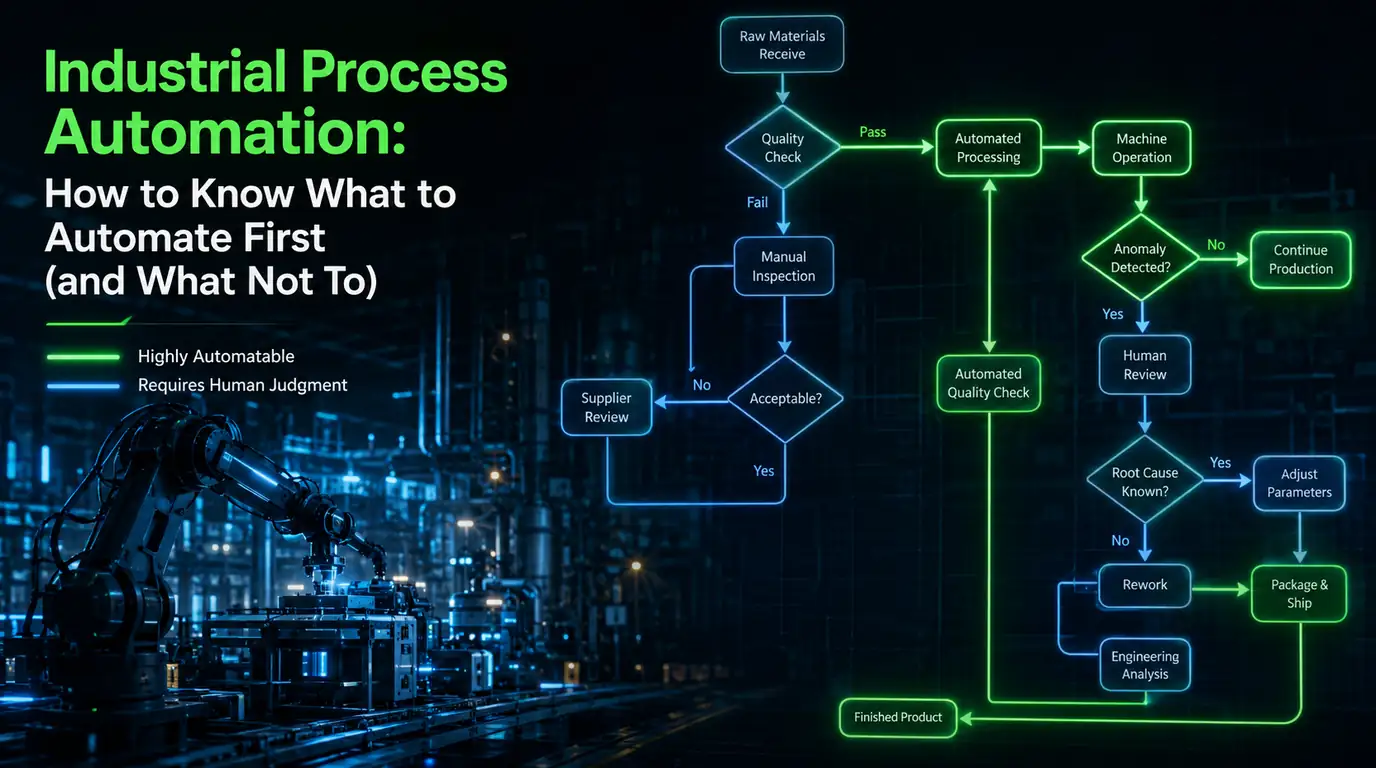
- Industrial Process Automation — how to pick the first process to automate — and which ones to leave manual.
- Industrial Automation and Control — what your plant already measures, and why most of it never becomes useful.
- Industrial Technology Tools — an evaluation framework for separating a real tool from a demo.
- Industry 4.0 in Practice — what the pyramid diagrams leave out: examples with numbers attached.
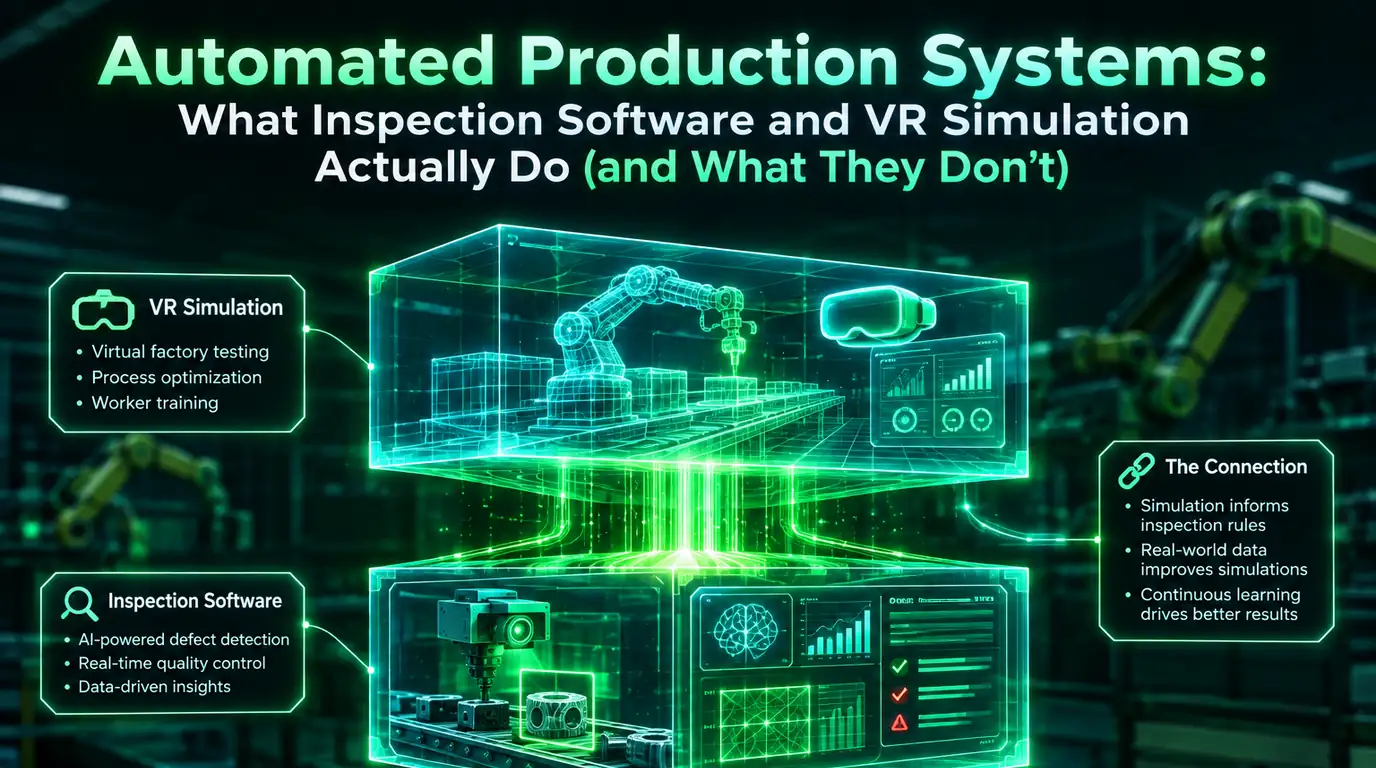
- Automated Production Systems — where inspection software and VR simulation genuinely help — and where they don’t.
- Custom Software for Manufacturing — the five-filter decision: build, buy, or leave it alone.
- Maedcore — Mechatronics — what we build in this area.
Frequently Asked Questions About Mechatronics Projects
Sources
- IFR World Robotics 2025 — Global Robot Demand Doubles Over 10 Years — International Federation of Robotics, September 2025.
- AECIM — Madrid City Council: Industrial Sector Grants 2025 — AECIM / Ayuntamiento de Madrid, January 2025.
- Empresa Exterior — Spanish Machine-Tool Sector 2025 — Empresa Exterior, June 2025.
- Nexum Automatics — Industrial Robot Price: 2026 Buyer’s Guide — Nexum Automatics, June 2026.
- Standard Bots — How Much Do Robots Cost? 2026 Price Breakdown — Standard Bots, 2026.
- Standard Bots — Robots for Manufacturers: 2026 Guide — Standard Bots, 2026.
- Fresh Consulting — Why Custom Robots? Strengths, Applications, and Expected ROI — Fresh Consulting, January 2026.
- Stratos Controls — Hidden Costs in Automation Projects — Stratos Controls, 2024.
- Colony Construction — The Hidden Costs in Industrial Construction Projects — Colony Construction, May 2026.
- MDPI Applied Sciences — Integrated Software Platform for Rapid Prototyping of Mechatronic ECU Systems — MDPI, May 2026.
- NCBI/PMC — Experimental Development of Lightweight Manipulators with Improved Design Cycle Time — PMC, 2024.
- ResearchGate — A Mechatronics Approach to Rapid Product Development: A Case Study — peer-reviewed.
- ResearchGate — Monitoring and Control of Production Processes based on KPIs for Mechatronic Systems — peer-reviewed (ISO 22400 analysis).
- Academia.edu — Virtual Commissioning of Mechatronics Systems with the Use of Simulation — peer-reviewed.
- Academia.edu — A Mechatronics Approach to Rapid Product Development — peer-reviewed, 2008.
- Manufacturing-Metrics.org — Industrial KPI Data & Performance Benchmarks 2026 — Manufacturing Metrics Observatory, 2026.
- Oxmaint — MTBF, MTTR, OEE: Maintenance KPIs Complete Guide 2026 — Oxmaint, July 2026.
- Embedded Computing Design — How Mechatronics Improve Drone Technology — Embedded Computing Design.
About the Author
Robotics Engineer
For over a decade, I have been driven by a single mission: leveraging AI and robotics to build a world of automated production. I believe that by creating self-sufficient systems, we can empower people to refocus on what truly matters—their families and their passions. My expertise spans from winning prestigious European startup competitions to architecting complex, integrated hardware and software projects. I specialize in bridging the gap between today's industrial challenges and tomorrow's autonomous solutions.
Frequently Asked Questions
How long does a medium-complexity industrial mechatronics project take from start to finish?
Which KPIs should I specify in a mechatronic system acceptance contract?
When does custom mechatronics development make more sense than buying a catalogue cobot?
What are the most common causes of delays in mechatronics projects?
What documents should I prepare before the first meeting with a mechatronics partner?
What industrial grants are available to fund a mechatronics or automation project?
Ready to transform your company?
Book a free 30-minute meeting with an engineer.