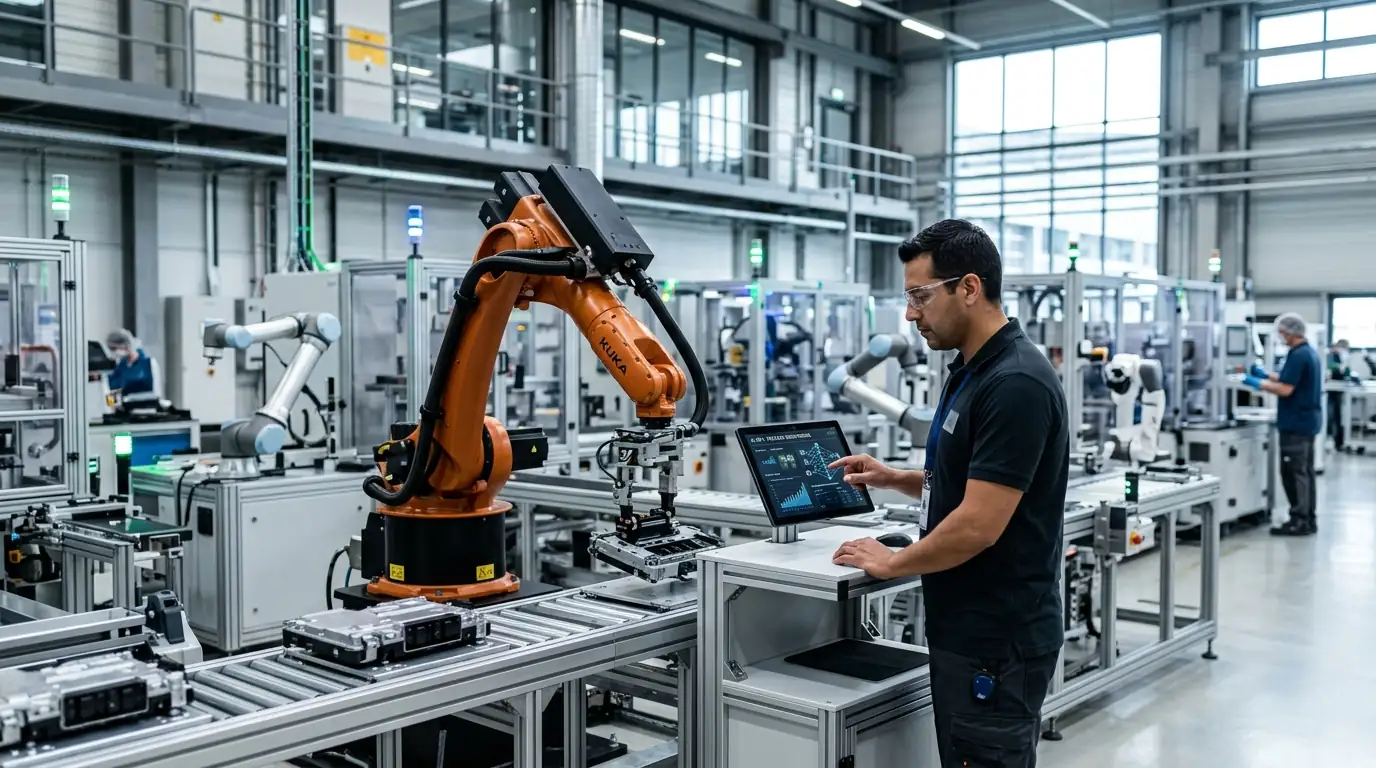
Digital Work Instructions on the Shop Floor: Moving from Paper to Interactive Procedures with AR/VR
How to digitize shop-floor work instructions: a format-selection framework, auditable ROI model with real data, and a step-by-step 90-day implementation

Written by Eduardo Fuentevilla Blanco
Robotics Engineer at Maedcore · Robotics Engineer LinkedIn ↗
Key Takeaways
- ► Digital work instructions reduce errors by 20–60% versus paper; the upper end applies to complex assemblies of more than 20 steps where spatial orientation is critical.
- ► A conservative ROI model for a 50-operator plant yields a net benefit of €78,900 in year one and payback of ~5 months, using only rework, onboarding, and audit-preparation savings.
- ► The format decision rule is objective: if 3 or 4 criteria (complexity, error consequence, turnover, change frequency) score High, AR is justified; if 2 score Medium/High, an interactive tablet is sufficient; otherwise a structured PDF with version control solves the problem.
- ► The most common hidden cost is not the software licence — it is content authoring (€500–8,000 per procedure) and annual maintenance (€5,000–10,000 for 20 active procedures), which can double or triple the first-year investment.
- ► Five predictable failure modes — content obsolescence, operator bypass, authoring bottleneck, integration isolation, and shift-handover gaps — are all mitigated during pilot design, not after deployment.
- ► Before accepting any vendor ROI claim, verify whether implementation and content creation costs are included, not just the licence fee; the peer-reviewed literature warns that rigorous economic analyses of real industrial pilots remain limited.
Paper work instructions generate 20–60% more errors than their interactive digital equivalents, according to multiple industrial studies. Human error causes 23% of manufacturing downtime and up to 80% of quality defects. In a 50-operator plant with 28% annual turnover, digitizing procedures on critical lines can deliver a net return above €78,000 in year one, with payback under six months. This article provides a concrete decision framework — which format to use for which procedure — and an ROI model with auditable assumptions that any operations manager can adapt to their own facility.
The Real Cost of Paper: Why Paper Work Instructions Fail at the Critical Moment
Paper work instructions don’t fail because of carelessness — they fail by design: a printed document is a snapshot of a procedure that keeps changing, and no manual distribution system can guarantee that the night-shift operator is working from the correct revision.
According to Redzone/RZ Software (2026), human error causes 23% of manufacturing downtime and up to 80% of quality defects. 83% of employees have had to recreate lost or incomplete documents, with an efficiency drop of 21.3% when documentation is ambiguous — though this figure should be treated as directional, as the source does not disclose its methodology.
The regulatory impact is equally stark. The FDA reported that in fiscal year 2025, more than 50% of GMP warning letters cited failures in written procedures or deviation management, according to Zamann Pharma (2026). ISO 9001:2015 clause 7.5 requires demonstrating that each operator was trained on the current revision of a procedure at the time of execution — and manual distribution systems cannot guarantee this in a distributed shop-floor environment, as PaperWise (2026) describes.
The diagnosis, in short: paper is not a discipline problem. It is an information architecture problem.
Three Digital Work Instruction Formats: When to Use Each One
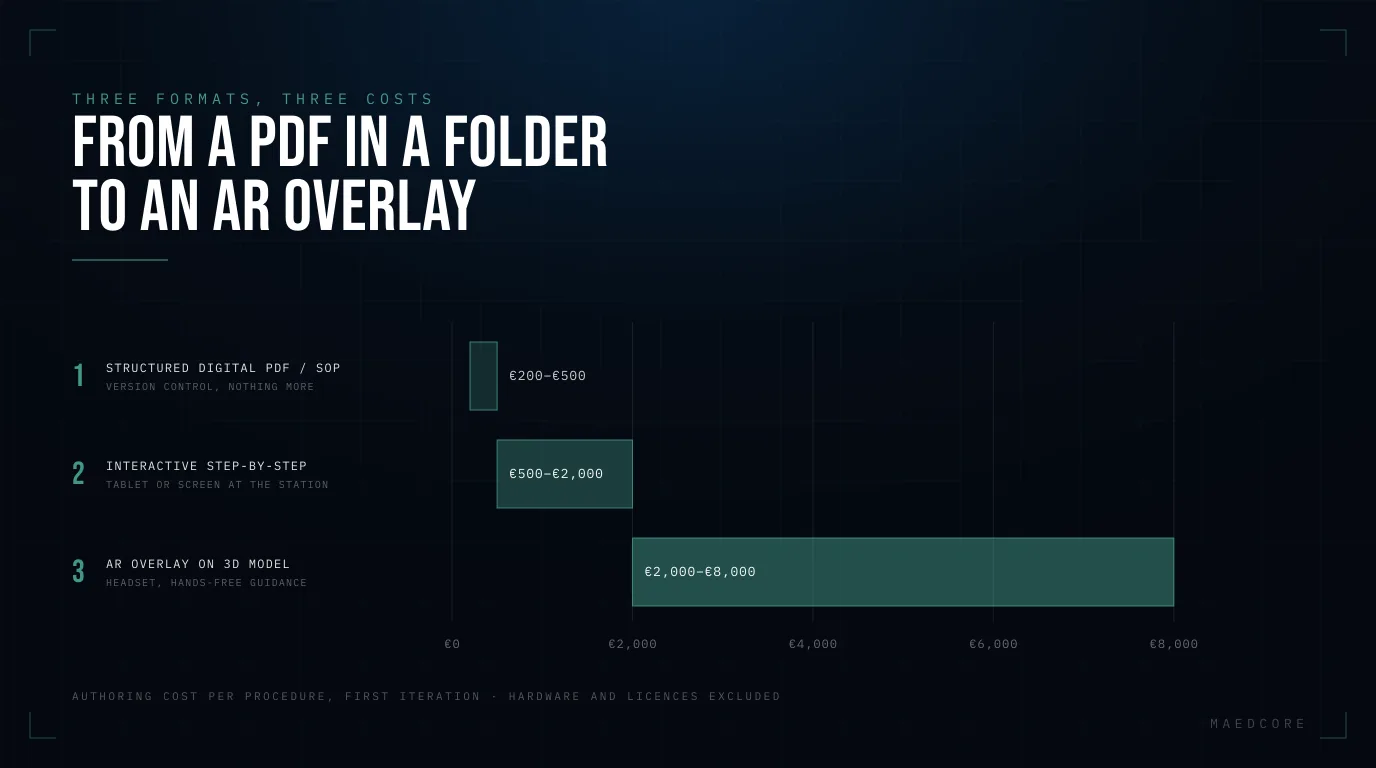
There is no single correct format: a structured PDF with read confirmation solves 60% of version-control problems at minimal cost; an interactive step-by-step guide on a tablet adds full traceability; AR overlay on a 3D model is only justified when spatial orientation or safety is critical.
Tier 1 — Structured Digital PDF/SOP
The document lives in a document management system with version control, the operator confirms reading with an electronic signature, and the system logs which revision was read and when. Authoring cost: €200–500 per procedure (engineering judgment). Additional hardware: none. Error reduction versus paper: 10–20%, primarily by eliminating the version-control problem.
Tier 2 — Interactive Step-by-Step Instruction (Tablet/Screen)
The operator cannot advance to the next step without confirming the current one. The system logs time per step, operator, shift, and outcome. Authoring cost: €500–2,000 per procedure (engineering judgment). Hardware: industrial tablet, €300–800 per workstation. Error reduction: 20–40%, per data from Redzone (2026) and the ICCMETS 2025 study.
Tier 3 — AR Overlay on 3D Model or Headset
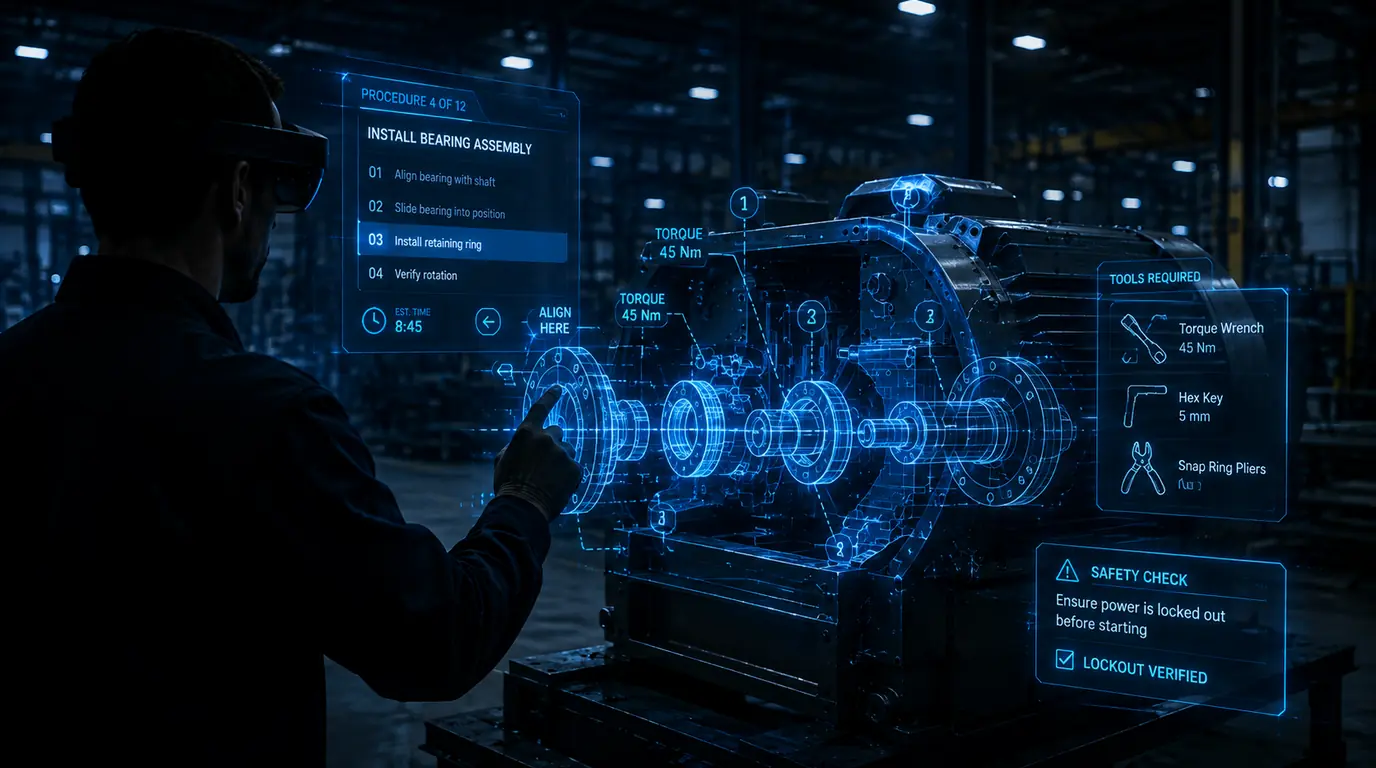
The operator sees the next step overlaid on the physical part, eliminating spatial ambiguity. A study in MDPI Applied Sciences (2026) evaluated AR work instructions using Microsoft HoloLens 2 in a real manufacturing environment and found measurable improvements in training efficiency. The ICCMETS 2025 study reported that tasks were completed 33% faster with AR guidance compared to traditional manuals. Authoring cost: €2,000–8,000 per procedure for the first iteration, though with reusable templates that cost drops 60–70% for subsequent procedures. Hardware: HoloLens 2 ($3,500) or RealWear Navigator 520 ($2,500 in 2025).
Format Comparison Table
| Criterion | Tier 1: Digital PDF/SOP | Tier 2: Interactive (Tablet) | Tier 3: AR / 3D Overlay |
|---|---|---|---|
| Procedure complexity | Low (≤5 steps, 1 operator) | Medium (6–20 steps, branching logic) | High (>20 steps, spatial orientation critical) |
| Consequence of error | Low (rework <€50) | Medium (€50–500 or customer complaint) | High (safety risk, regulatory non-conformance, scrap >€500) |
| Turnover / onboarding frequency | Low (<15% annual on that line) | Medium (15–30%) | High (>30% or seasonal peaks) |
| Change frequency (ECO rate) | Low (<1 revision/quarter) | Medium (monthly revisions) | High (weekly or per-batch) |
| Estimated authoring cost | €200–500/procedure | €500–2,000/procedure | €2,000–8,000/procedure (first time) |
| Hardware cost | €0 (existing PC/tablet) | €300–800/workstation | €2,500–3,500/headset |
| Typical error reduction | 10–20% vs. paper | 20–40% | 30–60% (process-dependent) |
| Audit trail quality | Partial (read confirmation) | Complete (step-by-step with timestamp) | Complete + spatial (step + confirmed position) |
Decision rule: Score each procedure against the four criteria above. If 3 or 4 criteria score “High”, go to Tier 3. If 2 criteria score “Medium/High”, Tier 2. Otherwise, Tier 1 is sufficient and the ROI of upgrading is negative.
An honest caveat on the ranges: the 20–60% error-reduction interval is too wide to present to a CFO. Actual reduction is a function of process complexity — high-precision multi-step assemblies see the upper end; simple repetitive tasks see the lower. The peer-reviewed ScienceDirect study (2021) describes the improvement as “dramatic” without giving a percentage, but adds a valuable finding: the improvement persists after AR support is removed, indicating genuine skill transfer rather than guidance dependency.
Format Selection Framework and ROI Model: The Tool You Won’t Find Anywhere Else
Most articles on digital work instructions list benefits and suggest platforms without saying anything about how to calculate whether the project makes financial sense before committing. What follows is an ROI model with explicit, auditable assumptions — not a vendor headline.
Model Assumptions (Assembly Plant, 50 Operators)
| Assumption | Value | Source |
|---|---|---|
| Operators on target line | 50 | Plant scenario |
| Annual turnover rate | 28% = 14 departures/year | Talent Traction 2026 / Manufacturing Lead Generation 2026 |
| Cost per departure (production operator) | €9,000 (~$9,800, mid-range) | The Resource Company 2025 |
| Current defect rate (paper SOPs) | 3% of units | Plant scenario — requires real baseline |
| Error reduction with Tier 2 digital instructions | 30% (conservative, mid-range) | Redzone 2026 / ICCMETS 2025 |
| Average rework cost per defect | €120 | Engineering judgment |
| Units produced per year | 100,000 | Plant scenario |
| Tier 2 platform cost (50 users) | €25,000/year | Operations1 / market data 2026 |
| Implementation + content authoring (20 procedures) | €30,000 one-time | Engineering judgment |
ROI Calculation — Year 1
Rework savings: 100,000 units × 3% defect rate × 30% reduction × €120 rework cost = €108,000
Onboarding time savings: 14 new hires × 2 weeks less to competency × €800/week labour cost = €22,400
Audit preparation savings: 2 quality engineers × 5 days/year × €350/day = €3,500
Total estimated annual benefit: ~€133,900
Total Year 1 cost: €25,000 (licence) + €30,000 (implementation) = €55,000
Net Year 1 benefit: €78,900 | ROI: 143% | Payback: ~5 months
This model deliberately excludes three categories that would improve the ROI but are harder to quantify: avoided customer-complaint costs, material scrap savings, and reduced regulatory penalty risk. It also excludes content maintenance costs — budget €5,000–10,000/year for 20 active procedures, depending on your engineering change rate.
The instruction for anyone reading this: replace the 3% defect rate and €120 rework cost with your own line data. If you don’t have that baseline today, measuring for four weeks before launching any digitization project is the first step — without a baseline, there is no internally demonstrable ROI.
An important context note: the PTC 2025 State of Industrial AR report (cited via secondary sources) claims that 72% of manufacturers who deployed AR reported positive ROI in year one. However, the peer-reviewed MDPI Applied Sciences (2026) study explicitly warns that “real industrial pilot studies combining strategic evaluation tools, continuous improvement frameworks, and economic analysis remain limited.” Before accepting any ROI figure from a vendor, ask how they define “positive ROI” — does it include implementation and content creation costs, or just the licence fee?
Five Failure Modes Nobody Mentions — and How to Avoid Them
The failure rate of industrial digital transformation initiatives is high: PwC (2024) finds that only 32% of industrials say their operational technology investments delivered expected results. EY estimates that 70% of digital manufacturing investments fall short of their objectives. Narrow, use-case-specific deployments — such as work instructions for a single production line — have significantly better success rates than large platform rollouts. The argument for starting with work instructions rather than a full MES is precisely that.
That said, digital work instruction projects fail for predictable reasons:
1. Content obsolescence. Digital instructions go stale just as fast as paper ones if there is no owner and no change-management process connecting engineering change orders (ECOs) to instruction updates. Connecting the instruction system to the PLM or MES is the core value proposition.
2. Operator bypass. If the system can be skipped, operators revert to habit. Mandatory step-locking — no advancement without confirmation — is a non-negotiable configuration requirement.
3. Authoring bottleneck. Quality engineers become the content-creation bottleneck. Mitigation: use AI-assisted authoring tools and train line supervisors to draft initial versions.
4. Integration isolation. A work instruction platform that does not connect to the MES or ERP creates a new data silo. With 55.6% of manufacturers reporting only partial integration between their systems, this is a live risk. Demand API documentation and integration references before selecting a vendor.
5. Shift-handover traceability gaps. The most frequent traceability gap occurs at shift change — when a new operator picks up a partially completed procedure. Platforms must support procedure handover with a chronological log of completed steps.
90-Day Implementation: The Sequence That Works
Forcing a complex platform onto an unprepared workforce is the fastest way to kill a connected-worker initiative. The recommended sequence: one use case, 10–20 operators, 90 days before scaling.
Weeks 1–4: Baseline measurement (defect rate, rework hours, onboarding time, audit findings). Selection of pilot procedures using the Format Selection Matrix. Platform selection and contracting.
Weeks 5–8: Content authoring for 3–5 pilot procedures. Operator and supervisor training. Go-live on the pilot line.
Weeks 9–12: Data collection. Comparison against baseline. ROI validation with real plant data.
Month 4 onwards: Scale to remaining procedures and lines. Introduce AR overlay for the highest-complexity procedures identified in the matrix.
In an industrial visualisation project we built for a heavy equipment client, the 3D modelling and content structuring phase was the most underestimated bottleneck — not the technology itself. The hidden cost is not the software licence: it is the time required to author quality content.
The platform landscape in 2026 has seen significant consolidation: Redzone (acquired by QAD), Poka (by IFS), Parsable (by CAI Software), and SwipeGuide (by L2L) have all changed ownership. Buyers should verify roadmap continuity before committing. Pricing ranges from free tiers (Tulip) to over €10,000/year plus €3,000–50,000 in implementation (Operations1, Dozuki). The most common pricing surprise is not the licence — it is the implementation, training, and integration costs, which can double or triple the first-year investment.
Related reading
- Work Instructions Beyond the PDF — the wider picture: what replaces the PDF and how to decide where to start.
- Safe Work Procedures — the permit-to-work and safety-audit case, with a verifiable real-time record.
- Digital Work Orders — closing the loop: how the job gets assigned, executed and traced without paper.
- Digital Technical Documentation — the reporting end: turning inspection findings into automated technical reports.
- Industrial Machinery Maintenance — why the constraint moved from the inspection visit to manual post-processing.
- Maedcore — Digital Solutions — what we build in this area.
Frequently Asked Questions About Digital Work Instructions
How long does it take to digitize work instructions for a production line?
A pilot covering 3–5 procedures with 10–20 operators can be live in 8 weeks if current procedures are already documented. The bottleneck is not the technology — it is content authoring. Complex procedures involving 3D models or AR require 2–6 weeks of authoring on the first iteration; with reusable templates, that time drops 60–70% for subsequent procedures.
Are digital work instructions valid for ISO 9001 or GMP audits?
Yes. ISO 9001 clause 7.5 requires “documented information” without specifying the physical medium. A digital system with operator confirmation, timestamps, and version traceability meets and exceeds the requirements. For GMP environments, the system must be validated under EMA Annex 11 or 21 CFR Part 11 principles, which adds a project step but eliminates the risk of warning letters for written-procedure failures — which appeared in more than 50% of FDA inspections in FY2025.
When does augmented reality justify its cost over a standard tablet?
AR is justified when spatial orientation is critical, when errors carry serious safety or regulatory consequences, or when turnover exceeds 30%. For most manufacturing SMEs, Tier 2 on a tablet is the right entry point: lower hardware cost (€300–800 versus €2,500–3,500 per headset), lower adoption friction, and demonstrable ROI in year one.
What KPIs should I measure before launching the project to prove ROI internally?
Four baseline metrics are sufficient: defect rate by operator or shift on the target line, weekly rework hours and unit cost, average time-to-competency for new hires, and the number of procedure-related findings in the last audit. Without those pre-launch figures, ROI cannot be demonstrated internally even if the project performs well.
What if operators ignore the system and keep using paper?
Bypass is the most frequent and most predictable failure mode. The technical mitigation is mandatory step-locking — the system does not allow advancement without confirming the previous step. The organisational mitigation is involving line supervisors from the pilot design phase, not just at final training. Evidence from the ScienceDirect study (2021) is relevant here: task-accuracy improvements with AR persist even after the guidance is removed, suggesting that a well-designed system changes behaviour rather than merely directing it.
What does digital work instruction implementation actually cost, beyond the software licence?
A Tier 2 platform licence for 50 users runs approximately €25,000/year. Add €30,000 for implementation and content authoring for 20 procedures in year one (engineering judgment), plus €5,000–10,000 annually for content maintenance. Implementation, integration, and training costs can double or triple the licence cost in year one — something vendors rarely highlight in their initial proposals.
Sources
- Digital Work Instructions: A Complete Guide — Redzone / RZ Software, 2026
- Augmented Reality as a Tool for Training Assembly Line Workers — Applied Sciences (MDPI), peer-reviewed, 2026
- The Efficacy of Augmented Reality (AR) in Vocational Training — ICCMETS 2025 Conference Proceedings, 2025
- Exploring Augmented Reality for Worker Assistance versus Training — Advanced Engineering Informatics, ScienceDirect, peer-reviewed, 2021
- SOP Checklist in 2026 for GMP Inspection Risks — Zamann Pharma (citing FDA FY2025 inspection data), 2026
- SOP Management for Manufacturers: Keeping Shop Floor Teams Current — PaperWise, 2026
- Cómo crear manuales de instrucciones para la fabricación — Mantenimiento Eléctrico, 2024
- Industrial Augmented Reality: Use Cases, Costs & Platforms — Frame Sixty (citing PTC 2025 State of Industrial AR Report), 2026
- Work Instruction Software Pricing: What Every Platform Costs in 2026 — Manual.to, 2026
- Industrial Workforce Retention in 2026 — Talent Traction, 2026
- Manufacturing Turnover Statistics 2025–2026 — Manufacturing Lead Generation (citing BLS JOLTS, Deloitte, NAM, SHRM), 2026
- Digital Operations ROI for Industrials and Manufacturing — PwC, 2024 Digital Trends in Operations Survey, 2024
- Maximizing ROI² in Advanced Manufacturing — EY, 2026
About the Author
Robotics Engineer
For over a decade, I have been driven by a single mission: leveraging AI and robotics to build a world of automated production. I believe that by creating self-sufficient systems, we can empower people to refocus on what truly matters—their families and their passions. My expertise spans from winning prestigious European startup competitions to architecting complex, integrated hardware and software projects. I specialize in bridging the gap between today's industrial challenges and tomorrow's autonomous solutions.
Frequently Asked Questions
How long does it take to digitize work instructions for a production line?
Are digital work instructions valid for ISO 9001 or GMP audits?
When does augmented reality justify its cost over a standard tablet?
What KPIs should I measure before launching the project to prove ROI internally?
What if operators ignore the system and keep using paper?
What does digital work instruction implementation actually cost beyond the software licence?
Ready to transform your company?
Book a free 30-minute meeting with an engineer.