Safe Work Procedures: From Paper Permits to Real-Time Verifiable Digital Records
677 fatal workplace accidents in 2024 with no structural improvement since 2019. How to digitise your PTW with real traceability, VR briefings and a

Written by Eduardo Fuentevilla Blanco
Robotics Engineer at Maedcore · Robotics Engineer LinkedIn ↗
Key Takeaways
- ► Spain recorded 647,200 lost-time workplace accidents in 2024 — identical to 2019 — with an industry incidence rate of 4,582.3 per 100,000 workers, indicating no structural improvement over five years (INSST, 2025).
- ► Paper PTW failures are design failures, not isolated human errors: inaccessible permits, invisible SIMOPS conflicts and knowledge that does not transfer at shift handover generate incidents at plants with apparently compliant documentation.
- ► ISO 45001:2018 clause 8.1 requires verifiable controls for high-risk activities; serious infringement penalties under equivalent regulatory frameworks range from €2,046 to €40,985 per finding, and stack when multiple non-compliances are identified simultaneously.
- ► A five-gate framework (G0–G4) — from risk classification to automatic permit closure — connects VR briefing with digital PTW so that no step advances without a timestamped, verifiable record.
- ► VR training outperforms traditional methods in hazard recognition (45% vs. 26% in AHP ranking, Al-Hamad & Gilányi, Elsevier 2025); the PwC study documents training up to 4× faster, though in soft-skills contexts rather than industrial safety procedures specifically.
- ► The estimated ROI for a 250-worker plant in the Madrid industrial corridor points to an 18–24 month payback period, with an estimated annual net benefit of ~€48,400 from Year 2 (explicit assumptions; engineering estimate, not a guaranteed outcome).
Spain recorded 647,200 lost-time workplace accidents in 2024 — exactly the same figure as 2019, before the pandemic — meaning five years of preventive effort have produced zero structural improvement (INSST, 2025). The most common root cause in industry is not a missing signed permit: it is that the paper-based permit-to-work (PTW) system fails precisely when it is needed most — at shift handover, during simultaneous operations, on the plant floor at two in the morning. This article explains why paper-based safe work procedures have structural design flaws, what Spanish and international regulation actually demands, and how to build a verifiable digital chain — from pre-task briefing to automatic permit closure — with an ROI calculation anchored to real costs at a plant in the Madrid industrial corridor.
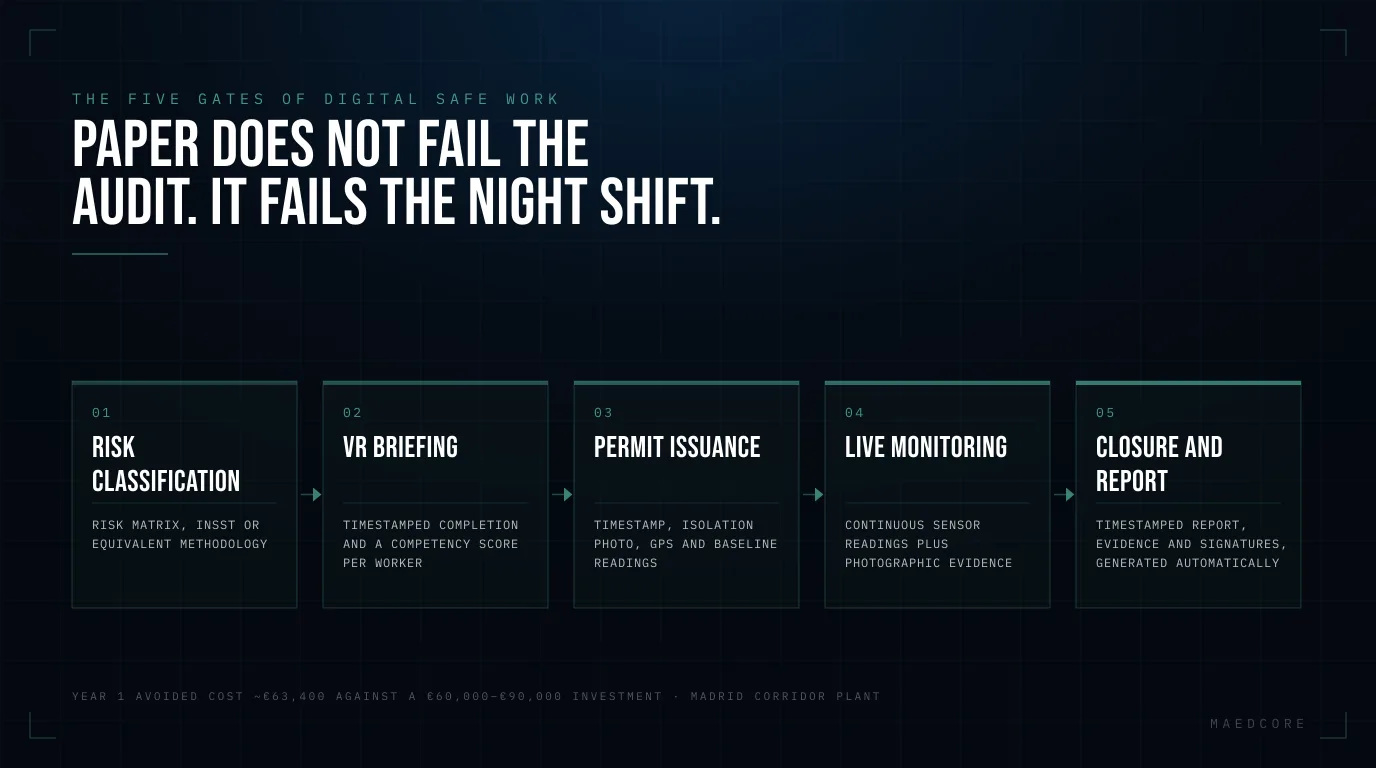
Paper Doesn’t Fail the Audit — It Fails the Night Shift
The 647,200 lost-time accidents in 2024 are not an anomaly: they are the normalisation of an unresolved problem. The incidence rate in industry stands at 4,582.3 accidents per 100,000 affiliated workers — more than double the cross-sector average (INSST, 2025). Fatal accidents during working hours reached 677 in 2024, up 9% on the previous year.
The UK Health and Safety Executive documents that two thirds of accidents in the chemical industry occur during maintenance, and that PTW system failures are the single most frequent cause (IChemE / HSE). The most well-documented failure mode is not the permit that was never issued — that gets caught. It is the permit that was correctly issued, duly signed, and then lost its operational meaning at shift handover: “when the intention behind a permit is lost, the permit becomes a piece of paper” (PermitToWorkGuide, 2026).
The most uncomfortable truth is this: serious incidents occur at plants where permit documentation appears compliant. A paper audit verifies that procedures exist and that signatures are in place. It does not verify how the system behaves under real operating conditions (PermitToWorkGuide, 2026).
Why Paper-Based Permit Systems Have Structural Design Flaws
Paper’s failures are not isolated human errors: they are predictable consequences of a system with no real-time traceability.
First, permits become inaccessible. In a plant with 40 high-risk permits active simultaneously, the shift supervisor has no real-time visibility of which jobs are live, who authorised them, or when they expire (FacilityBot, 2026).
Second, SIMOPS conflicts are invisible. Simultaneous operations — for example, hot work and confined-space entry in adjacent areas sharing the same ventilation system — are the scenario where paper is most dangerous. Nobody has cross-checked the permits because doing so manually takes time that nobody has at the start of a shift (SmartQHSE, 2026). This problem is particularly acute at plants in the Madrid industrial corridor where multiple contractors work in parallel under multi-employer coordination requirements.
Third, human error is the dominant failure mode. Between 70% and 90% of industrial accidents and incidents are rooted in human error, manual control processes or inadequate procedures (Evotix, 2026). A system that depends on no human making an error across a 12-step chain is not a control system — it is wishful thinking.
One important caveat on the data: there is no quantified paper-PTW audit failure rate specific to Spanish plants. What does exist is an outcome figure: when Pfizer implemented a digital control-of-work system across its European plants, it reduced permit-related incidents by 94% in one year (Wolters Kluwer / Enablon, 2025). This is a vendor case study, not an independent study, and should be read as such — but it is the most robust publicly available outcome data point.
The Legal Framework and What an ISO 45001 Audit Actually Requires
ISO 45001:2018 clause 8.1 requires documented controls for high-risk activities including maintenance and contractor work; clause 8.1.4 addresses contractor management specifically, where the PTW is the standard control mechanism auditors look for as evidence (SmartQHSE, 2026). In Spain, the Ley 31/1995 de Prevención de Riesgos Laborales (LPRL) requires that controls be both effective and verifiable — a paper permit with no execution traceability struggles to meet that standard under a substantive inspection.
What makes the regulatory risk concrete is the penalty regime. A serious infringement — for example, failing to maintain verifiable safe work procedures for high-risk activities — is classified under Article 13 of the LISOS with fines of between €2,046 and €40,985 per infringement. In an inspection that uncovers multiple simultaneous non-compliances, penalties stack: for a mid-sized plant, a single inspection with several findings can exceed €100,000 before remediation costs are counted. EU-OSHA has identified digital workplace safety as an institutional priority in occupational health and safety (Archivos de Prevención de Riesgos Laborales, 2025).
The Digital Safe Work Chain: From VR Briefing to Verified Closure
An effective digital safety chain is not about replacing paper with a mobile app: it is about connecting five control gates so that no worker can advance to the next step without completing the previous one, and so that each step generates a timestamped, verifiable record that will survive any audit.
This five-gate framework is the original contribution of this article: the existing literature does not contain a structure that connects immersive pre-task briefing with automatic permit closure, with explicit go/no-go criteria at each stage, anchored to an international regulatory framework.
The Five Gates of Digital Safe Work
| Gate | Step | Tool | Verifiable Output | Go / No-Go Criterion |
|---|---|---|---|---|
| G0 | Risk classification | Risk matrix (INSST / equivalent methodology) | Risk level: Low / Medium / High / Critical | Critical/High → mandatory VR briefing + digital PTW; Medium → digital PTW without VR; Low → digital checklist |
| G1 | Pre-task VR briefing | Immersive VR platform | Completion timestamp + competency score per worker | Score ≥ defined threshold AND all workers completed → permit request unlocked |
| G2 | Digital permit issuance | PTW software | Timestamped permit, photo of isolation point, GPS location, baseline sensor reading | All fields complete + authoriser’s digital signature → permit active |
| G3 | Real-time monitoring | PTW software + IoT sensors | Continuous sensor readings + photographic evidence at checkpoints | Sensor deviation > threshold → automatic alert + permit suspension |
| G4 | Closure and automatic report | Inspection software | Timestamped report, photographic evidence, signatures, sensor log | All checkpoints confirmed + no open deviations → report generated automatically |
The value of this structure lies not in any individual gate but in the fact that the system cannot advance without verified evidence. The supervisor does not need to remember whether the worker completed the briefing — the system will not issue the permit if the briefing is not on record.
Why the VR Briefing at G1 Is Not an Optional Extra
VR training outperforms traditional methods on the dimensions that matter most for safety. Using the Analytic Hierarchy Process (AHP) with 10 subject-matter experts, VR training scored 45% against 29% for computer-based training and 26% for traditional methods (Al-Hamad & Gilányi, Results in Engineering, Elsevier, 2025). The PwC study (Eckert & Mower, 2020) documented that participants completed VR training up to four times faster than classroom sessions and showed 275% greater confidence in applying what they had learned (Cornerstone on Demand) — though that study measured soft skills with managers, not industrial safety procedures; the speed and confidence data are transferable, but the extrapolation to procedural error reduction on the plant floor is reasonable rather than proven, and should be treated as such. What the peer-reviewed scientific literature does confirm without ambiguity is that workers who learn safety procedures through VR demonstrate substantially greater hazard awareness than those using traditional methods (Scientific Reports, Nature/Springer, 2025).
In a VR systems engineering project we built for field deployment on Meta Quest, we saw first-hand the adoption challenges with users who had no prior VR experience: scenario design — maximum 15-minute sessions, 3DoF content to minimise motion sickness, on-headset instructions — largely determines whether the tool gets used or gets shelved (VR Systems Engineering: Multi-World Platform on Meta Quest).
Worked ROI Calculation: Madrid Industrial Corridor Plant
This calculation is an engineering exercise with explicit assumptions. It is not a guarantee of results; it is a framework that each plant can populate with its own data.
Scenario assumptions:
- Mid-sized manufacturing plant, Madrid industrial corridor (Alcalá de Henares / Torrejón de Ardoz), 250 workers
- 40 high-risk permits active per month
- 2 lost-time accidents attributable to PTW failures per year (conservative estimate based on INSST incidence data)
- Average cost per lost-time accident: ~€45,000 (direct and indirect costs; engineering estimate based on INSST methodology — not verified against a specific Spanish primary source)
- Digital PTW + VR briefing implementation: €60,000–€90,000 in Year 1
- Assumed incident reduction: 50% in Year 1 — conservative relative to Pfizer’s 94%, justified by partial adoption curve
Year 1 — avoided cost balance:
| Item | Calculation | Value |
|---|---|---|
| Lost-time accident avoided (1 of 2) | 1 × €45,000 | €45,000 |
| Labour inspectorate fine avoided (1 finding resolved) | Mid-range estimate | ~€10,000 |
| Reduced audit preparation time | 2 technicians × 3 days × 4 audits/year × €350/day | €8,400 |
| Total avoided costs Year 1 | ~€63,400 | |
| Year 1 investment | €60,000–€90,000 | |
| Net position Year 1 | –€26,600 to +€3,400 |
Year 2 onwards (no new hardware investment):
- Annual software maintenance + licences: ~€15,000
- Estimated annual net benefit: ~€48,400/year
- Payback period: 18–24 months (engineering judgement)
This estimate does not incorporate the serious-accident scenario, where potential liability and operational shutdown costs can run into hundreds of thousands of euros. Including that tail risk strengthens the economic case considerably.
The Digital Implementation Failure Modes Nobody Talks About
Most articles on digital PTW list benefits. These are the most common failure modes, with their mitigations.
1. The supervisor bypass. Workers photograph a step without having executed it. Mitigation: GPS-geotagged, timestamped photos cross-referenced with sensor data — if the sensor does not record the baseline reading at the same moment as the photo, the system flags it.
2. Mobile UX failure in industrial environments. Touchscreens with gloves and poor Wi-Fi coverage drive workers back to paper. Mitigation: offline-capable applications with Bluetooth sync; ruggedised tablets certified for ATEX zones where applicable.
3. VR motion sickness. Between 15% and 20% of first-time VR users experience discomfort. Mitigation: seated-position scenarios, 3DoF content for briefings, sessions capped at 15 minutes, flat-screen alternative for those who cannot tolerate the headset.
4. Permit overload at shift start. Non-compliance occurs because permit volume turns the process into a race against the clock (SmartQHSE, 2026). The digital system must include a permit-conflict dashboard visible to the supervisor before work begins.
5. Integration with legacy CMMS/ERP. If the digital PTW does not integrate via API with SAP PM or the equivalent work-order system, the audit trail is fragmented. Validate the integration before signing the contract.
6. Evidence format for labour inspectors. Labour inspectorates in most jurisdictions expect documentation with clearly identified signatories. Not all international platforms generate this by default — verify it during the evaluation phase.
Platform Cost Ranges and Selection Criteria
The global PTW software market exceeded $1 billion in 2024 and is growing at 10–12% per year. Two analyst firms offer different figures — Growth Market Reports cites $1.32 billion; DataIntelo, $1.67 billion (Growth Market Reports, 2025; DataIntelo, 2025) — neither with published methodology. Both figures serve only to establish the order of magnitude.
| Segment | Representative platforms | Indicative cost (mid-sized plant) | Implementation |
|---|---|---|---|
| Enterprise | Cority, Enablon/Wolters Kluwer, Evotix | €50,000–€150,000/year | 3–6 months |
| Mid-market | SmartQHSE, FacilityBot, Prysmex | €10,000–€40,000/year | 4–8 weeks |
| Specialised with inspection and sensors | Tools such as Mapper | Mid-market with photographic evidence and sensor data integration | Variable |
The selection criteria most frequently missing from procurement specifications:
- Does it generate reports with clearly identified signatories in the required language and format?
- Does it work offline in areas without Wi-Fi coverage?
- Does it have a documented API for SAP PM or the plant’s existing CMMS?
- Can it be configured to trigger SIMOPS conflict alerts?
- Does it integrate IoT sensor data into the permit record?
VR training reaches cost parity with classroom training at around 375 learners, according to the PwC study. For plants with high contractor turnover, that threshold is reached relatively quickly, making VR content investment economically neutral over a two-to-three-year horizon.
Related reading
- Work Instructions Beyond the PDF — the wider picture: what replaces the PDF and how to decide where to start.
- Digital Work Instructions on the Shop Floor — what it looks like at the workstation: AR, tablets and step-by-step interactive procedures.
- Digital Work Orders — closing the loop: how the job gets assigned, executed and traced without paper.
- Digital Technical Documentation — the reporting end: turning inspection findings into automated technical reports.
- Industrial Machinery Maintenance — why the constraint moved from the inspection visit to manual post-processing.
- VR Systems Engineering: Multi-World Platform on Meta Quest and Field Deployment — Maedcore
- Maedcore — Digital Solutions — what we build in this area.
Sources
- Informe Anual de Accidentes de Trabajo en España. Datos 2024 — INSST / MITES, 2025
- Ley 31/1995, de 8 de noviembre, de Prevención de Riesgos Laborales — BOE / Government of Spain, 1995 (in force)
- Permits-to-Work in the Process Industries — IChemE / HSE
- Control of Work Industry Case Study: Manufacturing (Pfizer/Enablon) — Wolters Kluwer / Enablon, 2025
- Immersive VR Safety Training: Enhancing Hazard Recognition and Compliance — Al-Hamad & Gilányi, Results in Engineering, Elsevier, June 2025
- Exploring the Effectiveness of VR-Based Training for Sustainable Health and Occupational Safety in Industry 4.0 — Scientific Reports, Nature/Springer, August 2025
- PwC, The Effectiveness of Virtual Reality Soft Skills Training in the Enterprise (Eckert & Mower, 2020) — verified via Cornerstone on Demand
- Permit-to-Work Audit Checklist — PermitToWorkGuide, 2026
- Complete Guide to Permit to Work Systems 2026 — SmartQHSE, 2026
- Permit to Work Software for Manufacturing — FacilityBot, 2026
- Mitigating Risks: The Advantages of Digital Permit to Work Solutions — Evotix, 2026
- Archivos de Prevención de Riesgos Laborales, Vol. 28 No. 2 — EU-OSHA / DOAJ, May 2025
- Permit to Work Software Market Research Report 2033 — Growth Market Reports, 2025 (commercial figure; use with caution)
- Permit-to-Work Software Market Research Report 2033 — DataIntelo, 2025 (commercial figure; conflicts with previous source)
- VR Systems Engineering: Multi-World Platform on Meta Quest and Field Deployment — Maedcore
About the Author
Robotics Engineer
For over a decade, I have been driven by a single mission: leveraging AI and robotics to build a world of automated production. I believe that by creating self-sufficient systems, we can empower people to refocus on what truly matters—their families and their passions. My expertise spans from winning prestigious European startup competitions to architecting complex, integrated hardware and software projects. I specialize in bridging the gap between today's industrial challenges and tomorrow's autonomous solutions.
Frequently Asked Questions
What is the practical difference between a paper permit to work and a digital one for regulatory compliance?
How much does it cost to implement a digital PTW system at an industrial plant?
Does a VR pre-task briefing actually reduce procedural errors before workers enter a hazardous area?
How does a digital system handle SIMOPS conflicts that paper permits miss?
What happens if the plant has no Wi-Fi coverage across all work areas?
What if some workers cannot use VR headsets without experiencing motion sickness?
Ready to transform your company?
Book a free 30-minute meeting with an engineer.