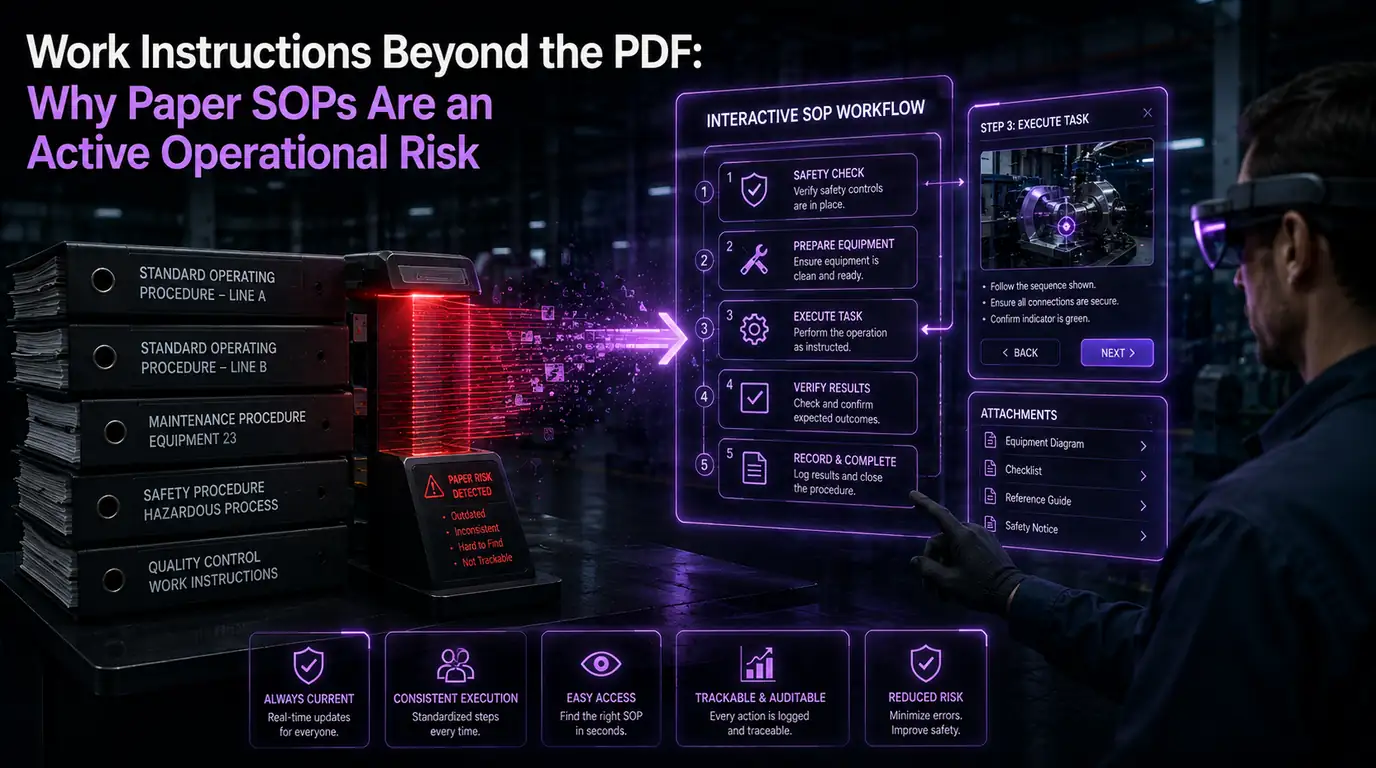
Work Instructions Beyond the PDF: Why Paper SOPs Are an Active Operational Risk
PDFs aren't real digitisation. Learn how immersive (VR) work instructions and cloud checklists cut errors and shrink onboarding time — with real numbers.

Written by Eduardo Fuentevilla Blanco
Robotics Engineer at Maedcore · Robotics Engineer LinkedIn ↗
Key Takeaways
- ► A meta-analysis of 52 studies (Scorgie et al., *Safety Science* 2024) shows VR improves procedural knowledge retention (g = 0.838) more than immediate learning — critical because procedures are applied weeks or months after training.
- ► VR and cloud checklists are complementary layers, not alternatives: VR teaches the procedure; the checklist audits real-world execution. Most plants deploy them in isolation, losing the compounding benefit.
- ► VR reaches cost parity with classroom training only at 375 learners (PwC model); for plants of 50–150 operators, a cloud checklist has a far lower break-even threshold and is the logical first investment.
- ► The Living Work Instruction Maturity Ladder (Stages 0–4) lets plant managers diagnose their current state with five questions and prioritise the highest-immediate-ROI step.
- ► For a 150-operator plant, the Stage 1-to-3 transition carries an estimated 4–10 month payback — highly sensitive to onboarding cost and the plant's own rework baseline.
- ► 42% of frontline workers abandon digital SOPs because of poor mobile UX — interface design on the plant floor is as critical as platform selection.
A paper work instruction — or its digital clone, the PDF in a shared folder — is not a documentation problem: it is an active operational risk. A meta-analysis of 52 studies published in Safety Science shows that workers trained with virtual reality retain significantly more than those trained with traditional methods (Hedges’ g = 0.838) — Scorgie et al., 2024. The argument here is concrete: a work instruction must become a living digital artefact with two complementary layers — immersive training to learn the procedure, and a cloud checklist to execute and audit it — and neither layer works well without the other.
The Hidden Cost of Paper-Based Work Instructions
A printed procedure is not an inert document: its cost accumulates every shift, every version change that never reaches the floor, and every signature nobody can locate during an ISO audit.
EU-OSHA is deliberately cautious with percentages: although estimates vary, it is widely accepted that human error is present in the majority of accidents — EU-OSHwiki, “Human Error”, 2025 — and violation of OSH procedures is one of its most frequent forms — EU-OSHwiki, “Violation of OSH Rules”, 2025. The oft-cited figure of 75% of accidents attributed to human error originates from patent documents (USPTO), not peer-reviewed studies — USPTO 10955803 — and should be treated as an industry estimate, not established science.
Operational data are more concrete. In 2024, the U.S. manufacturing sector recorded 332,600 non-fatal injury cases, at a rate of 2.7 per 100 workers — above the national average of 2.3 — VoxelAI / BLS-OSHA, 2026. The U.S. Chemical Safety Board repeatedly cites two root causes in its investigations: outdated and inaccurate operating procedures, and poor shift-handover communication — Process Improvement Institute / CSB. Both are failures of the procedure management system, not of the individual operator.
Why Switching to a Digital PDF Doesn’t Fix the Problem
Converting a paper procedure to an on-screen PDF is not digitalisation: it is the same problem with a different interface.
A truly digital work instruction is interactive, accessible in real time, and immediately updatable — Solvace, 2025. A network-shared PDF meets none of the last two conditions: when a procedure changes, someone must replace the file, notify every shift, and retrieve printed copies — none of those steps leave an automatic trace.
This matters for concrete regulatory reasons. Clause 7.5 of ISO 9001:2015 requires “documented information” to support the operation of processes — Factory AI, 2026. In automotive plants subject to IATF 16949 and aerospace facilities under AS9100, traceability of who executed which procedure, at which revision, and when, is a certification requirement. A cloud checklist automatically records every action, creating a complete, searchable audit trail with no manual preparation — OrcaLean.
But “digital” does not guarantee adoption. 42% of frontline workers cite poor mobile design as the primary reason for not adopting digital SOPs — Manual.to, 2026. A checklist that requires five taps to log a single reading will be abandoned in favour of paper within a week.
The Two-Layer Architecture Nobody Explains
Immersive tools (VR/AR) and cloud checklists are not competing alternatives: they are complementary layers of the same system.
- Learning layer (VR): the operator learns the procedure in a simulated environment before touching the real machine — repeatable, consequence-free, muscle-memory-building.
- Execution and audit layer (cloud checklist): on the floor, the operator follows the procedure step by step, with photographic evidence, deviation alerts, and shift sign-off recorded automatically.
What most plants are missing is the connection between the two layers: a deviation flagged in the checklist should automatically trigger a refresher module in the training system. That integration is the goal of Stage 4 in the maturity model developed below.
The Evidence on Immersive Training: What the Science Says — and What It Doesn’t
VR training demonstrably improves knowledge retention; whether that translates into fewer accidents at a specific plant requires your own measurement.
The Scorgie et al. meta-analysis (Safety Science, 2024), which analysed 52 studies across 14 industries, shows that VR outperforms traditional methods both in immediate learning (g = 0.640) and — especially — in delayed retention (g = 0.838) — Scorgie et al., 2024. The retention figure is the more operationally relevant one: procedural knowledge is applied weeks or months after training — Skillsive, 2026. The meta-analysis itself cautions that the strongest evidence is for knowledge outcomes, not accident rates.
A second relevant meta-analysis, Gong et al. (Safety Science, 2024), adds an important nuance about augmented reality — Gong et al., 2024: AR has a significant positive impact on safety training overall, but shows no advantage over traditional training specifically for knowledge acquisition. This points to a role division that most articles ignore: VR is superior for learning new procedures (onboarding, SOP walkthroughs); AR may be better suited to in-situ guidance during live execution, overlaid on the real machine.
On economics, the PwC model shows that VR content production requires up to 48% more upfront investment than comparable classroom or e-learning content, and that cost parity with classroom training is not reached until 375 learners; with e-learning, until 1,950 — Skillsive / PwC, 2026. For a plant of 50–150 operators, the arithmetic is less straightforward than vendors tend to suggest.
The Living Work Instruction Maturity Ladder: A Diagnostic Framework for Plant Managers
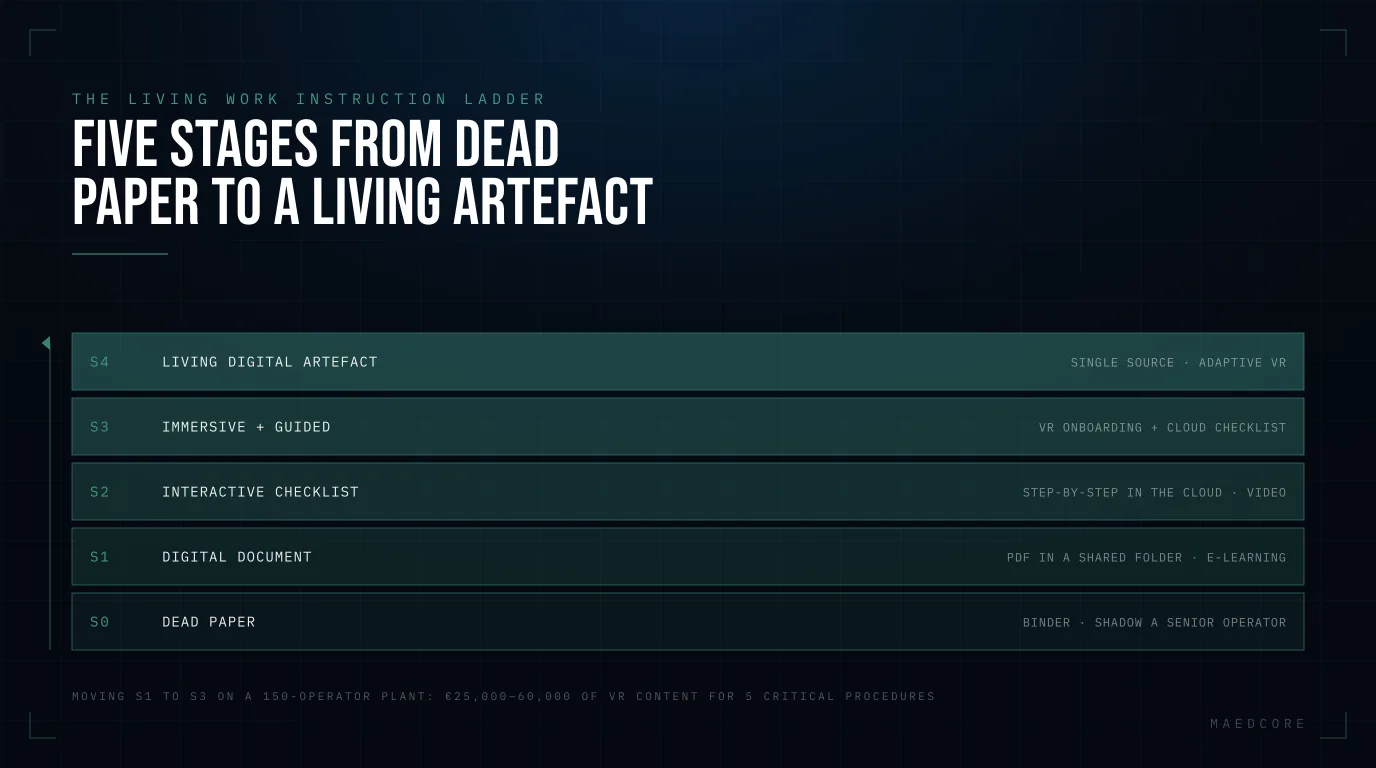
No existing article on work instructions maps a plant’s current state to a roadmap that integrates immersive training and cloud-based execution. This framework is intended to fill that gap.
The Four Stages
| Stage | Label | SOP Format | Training Method | Execution & Audit | Primary Pain Point |
|---|---|---|---|---|---|
| 0 | Dead Paper | Binder / printed PDF | Shadow a senior operator | Paper signature | Version drift; no audit trail |
| 1 | Digital Document | PDF in shared folder / Word | E-learning module | Digital signature on PDF | Still static; no real-time guidance |
| 2 | Interactive Checklist | Step-by-step cloud checklist | Video-based e-learning | Timestamped checklist with photographic evidence | Training and execution disconnected |
| 3 | Immersive + Guided | VR for onboarding + cloud checklist for execution | VR simulation | Checklist with deviation alerts | High upfront content cost; update lag |
| 4 | Living Digital Artefact | Single source: VR scene + checklist generated from the same data model | Adaptive VR (AI-triggered refreshers) | Deviation → corrective action loop in real time | Requires data-integration maturity |
Self-Diagnosis: Five Questions for the Operations Manager
- How many versions of the same procedure currently coexist on the floor? (More than one = Stage 0–1)
- Can you prove, with a timestamp and operator ID, that a specific procedure was correctly followed last Tuesday? (No = Stage 0–1)
- When a procedure changes, how long does the update take to reach every shift? (More than one week = Stage 0–2)
- Do new hires shadow experienced operators for more than four weeks before working independently? (Yes = Stage 0–1)
- Can your quality manager pull the full deviation log for any SOP in under five minutes? (No = Stage 0–2)
If you answered yes to three or more warning signs, you are at Stages 0–1, and the transition to Stage 2 (cloud checklist) is the highest-immediate-ROI step — before investing in VR content.
Indicative ROI Calculation: Stage 1 to Stage 3 Transition for a 150-Operator Plant
All figures are engineering estimates based on published ranges. Plant managers should substitute their own baseline costs.
Explicit assumptions:
- 150 operators; 20 new hires per year
- Fully loaded labour cost: €25/hour
- Current onboarding: 12 weeks; post-implementation target: 8 weeks (33% reduction, based on — ProcessReel, 2026)
- Annual rework cost from defects: €150,000 (mid-size plant estimate; use your own figure)
- Expected defect reduction: 18% (figure from a consumer-goods plant case — BairesDev — no named primary source; treat as an illustrative range)
| Item | Estimate | Basis |
|---|---|---|
| VR content production (5 critical SOPs) | €25,000–60,000 | Engineering estimate; varies by scene complexity |
| Cloud checklist platform (annual) | €8,000–20,000 | Estimated market range |
| Change management and trainer training | €5,000–10,000 | Engineering estimate |
| Total Year 1 investment | ~€38,000–90,000 | |
| Onboarding: 4 weeks saved × 20 hires × 40 h/week × €25/h | ~€80,000 | Based on 33% reduction from ProcessReel |
| Rework reduction (18% × €150,000) | ~€27,000 | Based on BairesDev figure — unverified; use your baseline |
| Audit preparation time saved (38% reduction) | ~€5,000 | Based on — OxMaint, 2026 |
| Estimated Year 1 benefit | ~€112,000 | |
| Payback period | ~4–10 months | Highly sensitive to onboarding cost and rework baseline |
The onboarding estimate dominates the calculation: €80,000 in potential savings against an investment of €38,000–90,000. But that saving assumes the four weeks freed up translate into real productivity, not idle capacity. Sensitivity to plant size is high: with 50 operators and 7 new hires per year, the payback period extends to 2–4 years, and the VR investment may not be justified until Stage 2 is in place first.
The Most Common Implementation Mistakes
The content obsolescence trap is the most frequently cited failure: VR scenes built from a CAD snapshot become inaccurate the moment the line is modified. Without a defined workflow — who triggers the update, who executes it, and within what timeframe — a VR SOP becomes as stale as the PDF it replaced.
Starting too broad is the second most common mistake. The practical recommendation is to prioritise the 20–30 SOPs with the highest risk, highest frequency, or greatest impact on upcoming audits, demonstrate value, then scale — Manual.to, 2026.
Change resistance is systematically underestimated: 42% of workers cite it as the primary obstacle — Manual.to, 2026. In our experience, the most effective mitigation is involving operators in content creation: having them validate VR scenes and record their own procedure videos. Authorship generates ownership.
From Theory to the Plant Floor: Realistic Timelines and First Steps
The transition from Stage 1 to Stage 3 in a 150-person plant is not a six-week project. Realistic timelines from engineering experience:
- Phase 1 — SOP audit and prioritisation: 2–4 weeks
- Phase 2 — Digitalise the top 20 priority SOPs as cloud checklists: 4–8 weeks
- Phase 3 — VR content pilot for 2–3 highest-risk procedures: 8–16 weeks
- Phase 4 — Full rollout and operator training: 3–6 months
- Total to a functional “living artefact”: 6–12 months
The broader industrial context is worth noting: in 2023, 9.2% of Spanish companies had adopted AI solutions, above the European average of 8.0% — European Commission, Spain 2024 Digital Decade Country Report. Spanish industrial output grew 0.5% in 2024, contrasting with declines in Germany (−4.6%), Italy (−3.5%) and France (−0.2%) — Industry Talks ES, 2024. Plants in the Madrid–Toledo–Guadalajara industrial corridor are in a relative investment window where work instruction digitalisation is one of the most traceable ROI vectors available.
In a field inspection project we built with deployment on Meta Quest, the primary operational lesson was not technical but about change management: users who participated in defining the workflow adopted the tool naturally; those who received it as a top-down mandate looked for ways around it — VR Systems Engineering: Multi-World Platform on Meta Quest and Field Deployment. The pattern repeats across almost every procedure digitalisation project.
The most pragmatic first step: identify the three procedures where a deviation carries the highest cost — in safety, quality, or downtime — and run a digital checklist pilot on those three. You do not need VR to start. VR makes sense when the cost of classroom training or onboarding errors exceeds the cost of producing immersive content, and that threshold varies by plant.
Frequently Asked Questions
How much does it cost to digitalise a work instruction with VR?
The range is wide: a simple 360° video walkthrough can cost €3,000–8,000; an interactive VR simulation generated from CAD, €15,000–40,000 per procedure. Hardware (Meta Quest 3, €500–1,500/unit) is secondary to content production costs. The economics improve significantly when existing 3D assets or digital twins can be reused.
Does VR actually reduce accidents, or does it only improve test scores?
The Scorgie et al. meta-analysis (Safety Science, 2024) demonstrates robust improvements in knowledge (g = 0.640) and retention (g = 0.838) versus traditional methods, but the study itself cautions that the strongest evidence is for knowledge outcomes, not accident rates. Whether improved retention translates into fewer incidents at your plant requires your own measurement against pre-implementation baselines. Do not accept accident-reduction claims without named plant data and a stated control methodology.
Is VR or AR better for plant-floor work instructions?
The two Safety Science meta-analyses (2024) point in different directions: VR outperforms traditional training in learning and retention of new procedures (Scorgie et al.); AR shows a positive overall impact on safety training but no advantage over traditional methods specifically for knowledge acquisition (Gong et al.). The practical split: VR to learn the procedure before touching the machine; AR for overlaid guidance during live execution.
How do you keep a VR SOP current when the procedure changes?
This is the friction point most frequently raised by plant managers. The long-term architectural solution is to generate the VR scene and the checklist from the same data model (Stage 4), so that updating the procedure updates both layers simultaneously. Without that integration, it is essential to define — before launch — who triggers the update, who executes it, and within what timeframe. Without that documented workflow, a VR SOP becomes obsolete at the first line change, replicating the exact problem of the PDF.
How many operators do I need for VR to be cost-effective?
The PwC model shows that VR reaches cost parity with classroom training at 375 learners, and with e-learning at 1,950. For plants of 50–200 operators, VR ROI is not automatic: it depends on onboarding error costs, rework rates, and turnover frequency. A cloud checklist has a much lower break-even threshold and is the logical step before committing to immersive content.
Related reading
- Digital Work Instructions on the Shop Floor — what it looks like at the workstation: AR, tablets and step-by-step interactive procedures.
- Safe Work Procedures — the permit-to-work and safety-audit case, with a verifiable real-time record.
- Digital Work Orders — closing the loop: how the job gets assigned, executed and traced without paper.
- Digital Technical Documentation — the reporting end: turning inspection findings into automated technical reports.
- Industrial Machinery Maintenance — why the constraint moved from the inspection visit to manual post-processing.
- Maedcore — Digital Solutions — what we build in this area.
Sources
- Scorgie et al., “Virtual Reality for Safety Training: A Systematic Literature Review and Meta-Analysis” — Safety Science, Vol. 171, 2024. Peer-reviewed.
- Gong et al., “Applications and Effectiveness of Augmented Reality in Safety Training: A Systematic Literature Review and Meta-Analysis” — Safety Science, Vol. 178, 2024. Peer-reviewed.
- EU-OSHwiki, “Human Error” — EU-OSHA, updated 2025.
- EU-OSHwiki, “Violation of OSH Rules and Procedures” — EU-OSHA, updated 2025.
- European Commission, Spain 2024 Digital Decade Country Report — European Commission, 2024.
- Process Improvement Institute / CSB, “Human Factors Elements Missing from Process Safety Management” — Process Improvement Institute.
- VoxelAI, “45 Manufacturing Safety Statistics” — VoxelAI, 2026. Aggregated BLS/OSHA data.
- Skillsive, “Why VR Training Is More Effective Than Traditional Training” — Skillsive, July 2026.
- Manual.to, “The Paper-to-Digital SOP Playbook” — Manual.to, February 2026.
- OxMaint, “Inspection Management Software: Digital Checklists and Compliance Automation” — OxMaint, March 2026.
- OrcaLean, “How Digitized Standard Work Helps Meet Stringent Industry Compliance”) — OrcaLean.
- Solvace, “Digital SOPs” — Solvace, 2025.
- Factory AI, “SOP Full Form: The Definitive Guide to Standard Operating Procedures in Modern Manufacturing” — Factory AI, 2026.
- ProcessReel, “Are Your SOPs Delivering?” — ProcessReel, 2026.
- BairesDev, “How Could VR and AR Improve Manufacturing?” — BairesDev.
- Industry Talks ES, “La industria española en 2024: entre la recuperación y la transformación estructural” — Industry Talks, 2024.
- USPTO, Patent 10955803 — Patent document; industry figure, not peer-reviewed.
- VR Systems Engineering: Multi-World Platform on Meta Quest and Field Deployment — Maedcore.
About the Author
Robotics Engineer
For over a decade, I have been driven by a single mission: leveraging AI and robotics to build a world of automated production. I believe that by creating self-sufficient systems, we can empower people to refocus on what truly matters—their families and their passions. My expertise spans from winning prestigious European startup competitions to architecting complex, integrated hardware and software projects. I specialize in bridging the gap between today's industrial challenges and tomorrow's autonomous solutions.
Frequently Asked Questions
How much does it cost to digitalise a work instruction with VR?
Does VR actually reduce accidents, or does it only improve test scores?
Is VR or AR better for plant-floor work instructions?
How do you keep a VR SOP current when the procedure changes?
How many operators do I need for VR training to be cost-effective?
Ready to transform your company?
Book a free 30-minute meeting with an engineer.