Digital Work Orders: How Industrial Plants Go Paperless Without Losing Traceability
A paper work order consumes up to 47 min of active labour cost. Learn how to digitise it, calculate your real ROI, and eliminate traceability gaps.

Written by Eduardo Fuentevilla Blanco
Robotics Engineer at Maedcore · Robotics Engineer LinkedIn ↗

Key Takeaways
- ► A paper work order consumes 21–47 minutes of active labour cost (capture, review, re-entry and filing) versus 4–6 minutes in a structured digital workflow.
- ► At 500 orders/month and a €22/h labour rate, digitalising work orders saves over €6,300 per month net; break-even is under one month.
- ► 49% of plants with a CMMS still run parallel spreadsheets, creating data silos and audit gaps that cancel out much of the digital benefit.
- ► McKinsey puts maintenance cost reduction at 15–30% through digital work order management — not the 20–50% that requires the full IoT and AI stack; do not conflate the two figures.
- ► 25% of CMMS implementations fail primarily due to workforce resistance and lack of management buy-in; the change management plan is as critical as the tool itself.
- ► Four metadata elements — immutable timestamp, user identity, geolocation and version history — are the minimum needed to satisfy ISO 45001 clause 9.1 and pass third-party audits.
A paper work order consumes between 21 and 47 minutes of active labour cost — capture, review, re-entry and filing — compared with 4–6 minutes in a structured digital workflow. According to McKinsey, maintenance accounts for 20–60% of industrial operating expenditure, yet only 20% of organisations actually know what an unplanned stoppage costs them when it happens (Fracttal, 2026). The work order is the capture instrument that, once digitalised, makes that cost visible in real time. This guide breaks down the complete workflow stage by stage and provides a calculation model with explicit assumptions so any plant manager can make an informed decision before speaking to a single vendor.
The Real Problem: What a Paper Work Order Actually Costs
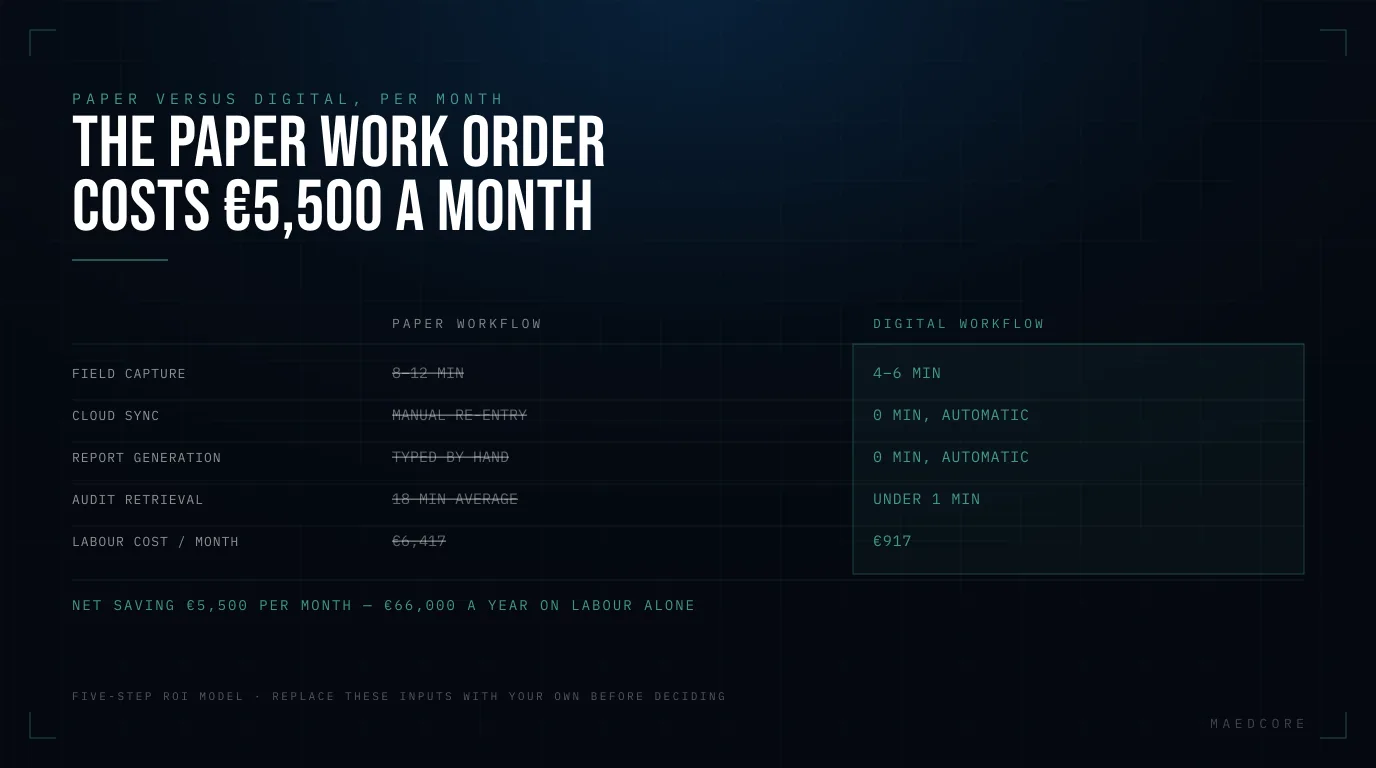
A paper work order is not just a form; it is a measurable drain on technical time that most plants have never precisely quantified.
Retrieving a specific record from a physical filing system takes an average of 18 minutes per document. Multiplied by the frequency of audits, warranty claims or incident investigations, that time becomes a real cost line that never appears in any maintenance budget.
The productive-time figure is even more sobering. According to structured digital-dispatch data, actual productive time — time spent repairing, not coordinating or documenting — is only 24.5% of the working day in paper-and-radio systems. A separate industry analysis (Heavy Duty Journal, 2026) states that technicians spend “a quarter of their day on paperwork”. Both figures are consistent: if 25% of the day goes on paperwork and coordination, and actual productive time is only 24.5%, the rest of the shift dissolves into travel, waiting and informal communication. The actionable number is the first one: your technicians are only wrenching for roughly one quarter of their shift.
This plays out against a backdrop of structurally high costs. McKinsey estimates that 30–50% of OEE losses originate in poor maintenance, and 61% of organisations experience unplanned stoppages on critical assets at least once a month (Fracttal, 2026 — vendor survey, n=2,300; treat as an upper-bound estimate, not a general average).
Paper work orders do not cause stoppages, but they do prevent you from seeing them clearly. They are the first piece that needs to change.
The Complete Paper Work Order Workflow: Where Time and Traceability Are Lost
The cost is not just in writing the work order; it is in the five steps that follow, each carrying its own risk of error and information loss.
The table below breaks down the real workflow for a preventive inspection work order in a typical industrial plant. Capture and re-entry times are engineering estimates based on standard form-completion benchmarks; the retrieval time comes from OxMaint (2026).
| Stage | Activity | Estimated Time | Primary Risk |
|---|---|---|---|
| 1. Field capture | Technician fills in paper form by hand | 8–12 min | Illegibility, missed fields, incorrect asset ID |
| 2. Transit / handover | Physical transport to supervisor or office | 5–15 min | Document lost in transit |
| 3. Supervisor review | Clarifying illegible or incomplete fields | 3–8 min (≈30–40% of orders require clarification) | Delay in the decision chain |
| 4. Re-entry into CMMS or spreadsheet | Manual transcription by admin staff | 5–10 min | Transcription errors, duplicates |
| 5. Filing and retrieval | Physical archive; ad-hoc retrieval | 18 min when retrieved | Permanent loss, audit gap |
| Total per order (active cost) | ~21–45 min | ||
| Total amortising retrievals | Assuming 1 retrieval per 10 orders | ~23–47 min |
The most costly and least discussed phenomenon is the hybrid-system trap. 49% of plants that already have a CMMS or EAM still run their own parallel spreadsheets (Grand View Research, 2024). The result is double data entry, information silos and audit gaps: the paper order says one thing, the CMMS says another, and neither is the single source of truth. In our experience on industrial inspection projects, hybrid systems deliver a much smaller fraction of the benefits of a fully digital system, because the effort of reconciling two sources consumes the time saved at capture.
On the regulatory side, work order traceability is not just good practice — it is a requirement. ISO 45001:2018, clause 9.1 requires organisations to retain documented information as evidence of monitoring, measurement, analysis and evaluation results. A paper work order without a verifiable timestamp, electronic signature and auditable chain of custody does not meet that requirement with the same rigour as a digital record with immutable metadata. The same applies to statutory inspections under the Low Voltage Electrical Regulations (REBT) or maintenance plans required by INSST: record traceability is the most frequent failure point in third-party audits.
Digital Work Order ROI Calculator: A 5-Step Model for Plant Managers
Before evaluating any tool, calculate what your current system is actually costing you. This model is built with explicit assumptions so you can substitute your own plant data at every step.
Step 1 — Map Your Current Workflow
Use the table above as your starting point. The only data you need to measure directly is the number of work orders your plant generates per month and the proportion that requires clarification or correction afterwards. In our experience, plants that have never measured this typically discover that 30–40% of their orders have at least one problematic field.
Step 2 — Calculate the Labour Cost of the Paper Workflow
Model assumptions:
- 500 work orders/month (mid-size plant, preventive + corrective maintenance)
- Average time per order: 35 min (midpoint of the 23–47 min range)
- Technician/admin hourly rate: €22/h (estimate based on industrial maintenance salary ranges; verify against your applicable collective agreement)
Calculation: 500 orders × 35 min ÷ 60 × €22/h = €6,417/month in paper-workflow labour cost
Step 3 — Calculate the Cost of Errors and Re-inspections
Model assumptions:
- 15% of orders with a material error requiring follow-up (conservative estimate; upper bound from field experience is 30–40%)
- 75 orders with errors/month
- Cost per re-inspection: 2 h of technician time × €22/h = €44
Calculation: 75 orders × €44 = €3,300/month in re-inspections
Step 4 — Estimate the Digital Workflow
| Stage | Digital workflow (mobile app + cloud) | Time |
|---|---|---|
| Field capture | Guided form, photo, GPS, asset QR scan | 4–6 min |
| Cloud sync | Automatic on regaining connectivity | 0 min |
| Report generation | Automatic PDF with timestamp | 0 min |
| Audit retrieval | Search by asset, date or technician | < 1 min |
| Total per order | 4–6 min |
Digital labour cost: 500 orders × 5 min ÷ 60 × €22/h = €917/month
Re-inspection cost with digital (assuming 80% reduction in material errors, consistent with the 30% error reduction documented as a conservative lower bound): 75 × 0.20 × €44 = €660/month
Step 5 — Calculate Net Savings and Break-Even
| Cost category | Paper (monthly) | Digital (monthly) | Saving |
|---|---|---|---|
| Labour cost (capture + re-entry) | €6,417 | €917 | €5,500 |
| Re-inspections and corrections | €3,300 | €660 | €2,640 |
| Software licence (SaaS market range) | — | €300–800 | — |
| Net monthly saving | ~€6,340–7,140 | ||
| Break-even point | < 1 month |
All values are illustrative with explicit assumptions. The real exercise requires three pieces of your own data: orders per month, average time measured with a stopwatch over one week, and the actual hourly rate from your collective agreement. The model is deliberately conservative: it excludes savings from reduced unplanned stoppages and the value of regulatory traceability, which in sectors such as food or chemicals can represent non-conformance costs of several thousand euros per incident.
A practical caveat: McKinsey estimates a 15–30% reduction in maintenance costs through digital optimisation of planned maintenance, and a 20–50% reduction in downtime with the full IoT, AI and predictive-analytics stack. Attributing 50% to work order digitalisation alone would be an overstatement; 15–30% is the honest range for a work order digitalisation project without additional IoT.
From Theory to the Shop Floor: What Tools Exist and How to Choose
The work order management software market is growing rapidly: the global CMMS market was valued at $1.29 billion in 2024 and is projected to reach $2.41 billion by 2030 at an 11.1% annual rate (Grand View Research, 2024). Cloud solutions already account for 60% of all deployments.
The main categories are:
Generalist CMMS platforms (Fracttal One, UpKeep, MaintainX): focused on work order and asset management in the broad sense. The right fit if your primary need is planning and tracking corrective and preventive work orders.
Specialist inspection software: designed for the specific flow of field inspection → automatic report → georeferenced record. The key difference from a generalist CMMS is that the report is the final deliverable, not a by-product of closing the order. In an inspection project we built, the time between field capture and report delivery to the client dropped from several days to minutes, with data synchronised in real time and a 3D map generated automatically.
Selection criteria for a plant manager:
- Offline mode is non-negotiable. Many industrial environments have poor WiFi coverage. Any tool must capture data without a connection and sync automatically when connectivity is restored. Do not compromise on this.
- Mandatory fields and conditional logic. Without them, digital forms reproduce exactly the same problems as paper.
- QR-to-asset linking. Scanning the asset QR before opening the form eliminates the wrong-asset-ID error from day one.
- Automatic report generation. If the supervisor still has to build the report manually, you have gained very little.
- Auditable chain of custody. Timestamp, user identity, geolocation and version history are the four minimum metadata fields needed to satisfy ISO 45001 §9.1.
- Integration with your existing CMMS or ERP. If you already run SAP PM or similar, ensure the field tool can write back to it — not just export PDFs.
The Five Mistakes That Sink Digital Work Order Projects
25% of CMMS implementations fail primarily due to workforce resistance and lack of management buy-in (Verified Market Research, 2026). These are the most common failure patterns:
1. The hybrid-system trap. Keeping paper orders for “difficult cases” guarantees that 49% of your data stays in parallel spreadsheets. Commit to a hard cut-over date and hold to it.
2. Underestimating the habit change. Lack of technical skills is the number-one barrier, cited by 34% of companies (Fracttal, 2026). The training plan is not optional.
3. Starting with too wide a scope. Pick one work category and a pilot group of 3–5 technicians. Measure for 30 days before rolling out further. Projects that launch plant-wide from day one typically collapse under the support burden.
4. Not auditing the first month. Digital systems surface patterns that paper concealed: completion rates, cycle times by technician, frequency of blank fields. Reviewing that data in the first four weeks is the only way to correct the process before bad habits become entrenched.
5. Ignoring plant connectivity. If technicians cannot sync because there is no WiFi on the shop floor, they will revert to paper. Map your coverage before choosing a tool and insist on offline mode with automatic sync.
Frequently Asked Questions About Digital Work Orders
How long does it take to implement a digital work order system in an industrial plant?
A field-inspection-focused project can be live in 2 to 6 weeks with a modern SaaS tool. The usual limiting factor is not the technology but process definition: which fields are mandatory, who approves the order, and how it integrates with the existing CMMS. Plan at least two weeks for that design phase before configuring a single screen.
Do digital work orders meet ISO 45001 audit requirements and statutory inspection standards?
Yes, provided the system records an immutable timestamp, user identity, geolocation and record version history. Those four metadata elements cover the documented-information requirements of ISO 45001 clause 9.1 and the traceability demanded under statutory inspection frameworks. A PDF generated manually from a paper order does not offer the same integrity guarantees, because its creation date can post-date the actual event.
What about technicians working in areas of the plant with no WiFi or mobile coverage?
Offline mode is non-negotiable in industrial environments: the tool must capture the work order without a connection and sync it automatically when connectivity returns. If a vendor cannot demonstrate this live in a demo with the device in flight mode, disqualify them. Most modern tools run on ruggedised low-cost tablets (€80–150) that the plant can manage as standard work equipment.
How many work orders per month do I need before digitalisation pays off?
Using this guide’s model assumptions (€22/h, 35 min/paper order, 15% error rate), break-even is reached in under a month at volumes of 50–60 orders per month. Below that threshold, pure labour savings may not cover the licence cost, but regulatory traceability and the elimination of re-inspections still justify the switch in sectors with frequent audits — food, chemicals, electrical installations.
Is a full CMMS or a specialist inspection tool the better choice for digitalising work orders?
It depends on your primary workflow. If your problem is planning and closing corrective and preventive work orders, a generalist CMMS is the natural choice. If your critical flow is field inspection → certified report → georeferenced record, a specialist tool generates the report as the final deliverable — not a by-product — cutting delivery time from days to minutes. Many plants end up using both, integrated to avoid the double-entry trap.
How do you handle technician resistance when moving from paper to digital?
Lack of technical skills is the number-one barrier, cited by 34% of companies (Fracttal, 2026), and 25% of CMMS implementations fail primarily because of workforce resistance (Verified Market Research, 2026). What works: start with a voluntary pilot group of 3–5 technicians, measure real improvements in their own working day, and have them present the results to the rest of the team before the wider rollout.
Related reading
- Work Instructions Beyond the PDF — the wider picture: what replaces the PDF and how to decide where to start.
- Digital Work Instructions on the Shop Floor — what it looks like at the workstation: AR, tablets and step-by-step interactive procedures.
- Safe Work Procedures — the permit-to-work and safety-audit case, with a verifiable real-time record.
- Digital Technical Documentation — the reporting end: turning inspection findings into automated technical reports.
- Industrial Machinery Maintenance — why the constraint moved from the inspection visit to manual post-processing.
- Maedcore — Digital Solutions — what we build in this area.
Sources
- McKinsey — The Future of Maintenance for Distributed Fixed Assets — McKinsey & Company, 2020.
- McKinsey — More Uptime, Lower Cost: Boosting Organizational Health in Maintenance — McKinsey & Company, 2024.
- Fracttal — Industrial Downtime Diagnostic 2026 — Fracttal, 2026.
- Grand View Research — Computerized Maintenance Management System Market — Grand View Research, 2024.
- mpulse Software — Why Maintenance Contractors Need Digital Work Orders — mpulse, 2026.
- OxMaint — Maintenance Digital Logbooks: Replacing Paper-Based Maintenance Records — OxMaint, 2026.
- Heavy Duty Journal — Digital Work Orders: How Paperless Systems Reduce Job Time — Heavy Duty Journal, 2026.
- Verified Market Research — CMMS Software Market — Verified Market Research, 2026.
About the Author
Robotics Engineer
For over a decade, I have been driven by a single mission: leveraging AI and robotics to build a world of automated production. I believe that by creating self-sufficient systems, we can empower people to refocus on what truly matters—their families and their passions. My expertise spans from winning prestigious European startup competitions to architecting complex, integrated hardware and software projects. I specialize in bridging the gap between today's industrial challenges and tomorrow's autonomous solutions.
Frequently Asked Questions
How long does it take to implement a digital work order system in an industrial plant?
Do digital work orders meet ISO 45001 audit requirements and statutory inspection standards?
What about technicians working in areas of the plant with no WiFi or mobile coverage?
How many work orders per month do I need before digitalisation pays off?
Is a full CMMS or a specialist inspection tool the better choice for digitalising work orders?
How do you handle technician resistance when moving from paper to digital work orders?
Ready to transform your company?
Book a free 30-minute meeting with an engineer.