Industrial Product Configurator: How to Close Complex Technical Sales Without Bottlenecking Your Pre-Sales Engineer
How an industrial product configurator eliminates the pre-sales engineer bottleneck, shortens the sales cycle, and qualifies buyers before the first call.

Written by Eduardo Fuentevilla Blanco
Robotics Engineer at Maedcore · Robotics Engineer LinkedIn ↗
Key Takeaways
- ► 86% of B2B purchases stall during evaluation (Forrester, 2024, n=16,000); in manufacturing, the most common cause is pre-sales engineer unavailability, not price.
- ► 80% of the B2B buying process now occurs without supplier contact (Gartner, 2024); an industrial product configurator captures that autonomous evaluation phase before the sales rep enters the picture.
- ► A mid-market industrial manufacturer with 40 opportunities/year and 18 pre-sales hours per deal spends ~€21,000/year on engineering for deals that never close. A configurator can recover half that capacity.
- ► Market reports cite cycle reductions of 48–65% with integrated CPQ configurators, but methodology is unpublished; the correct ROI framework is to calculate using your own hours and deal volume data.
- ► The configurator does not replace the pre-sales engineer. It eliminates early specification work on unqualified opportunities so the engineer focuses time on closing mature deals.
- ► Only 62% of European manufacturers in Spain reach basic digitalisation versus a 68% EU average (DESI, 2025); technical configurators are not yet a subsidised category, representing a genuine differentiation window.
86% of B2B purchases stall during the evaluation phase, according to Forrester (2024, n=16,000). In industrial manufacturing, the most common cause is that the only professional capable of correctly specifying the product is already tied up with another opportunity. Price and competition come second. A well-implemented industrial product configurator resolves that blockage by allowing prospects to self-qualify before the pre-sales engineer ever enters the picture. Manufacturers that have deployed one document cycle reductions of 48%–65%, though that figure comes from market reports without published methodology and should be treated as directional.
The Bottleneck Nobody Names: Your Pre-Sales Engineer as a Scarce Resource
The biggest brake on industrial technical sales is the one person capable of specifying the product correctly, who is already committed to another deal. Price and competition matter less.
The average sales cycle in manufacturing sits at 130 days from first contact to close (Focus Digital, 2024). But that figure understates the real magnitude: measured from the moment a buyer begins researching their need to the moment they sign, the number scales to 379 days (Dentsu, 2024), a figure that has grown 16% since 2021. The gap reflects the fact that most of the buying process happens before the seller even knows an opportunity exists.
When the prospect finally makes contact, they expect an immediate technical response. Industrial manufacturing proposals include drawings, compliance certifications, detailed pricing models, and manufacturability validations. No generalist salesperson can produce these alone. The pre-sales engineer becomes the critical resource on every opportunity, and that resource is, by definition, scarce. The first vendor to respond wins 50% more deals (NetSuite, 2025). Slowness usually points to a process architecture problem rather than an attitude problem.
The Industrial Buyer No Longer Waits for a Sales Rep: The Self-Service Imperative
80% of the B2B buying process now happens without direct contact with the supplier, and manufacturers that do not offer technical self-service are losing the evaluation phase before their sales rep picks up the phone.
The progression is documented and consistent: in 2015, 57% of the buying process occurred without sales contact (CEB/Gartner); by 2024, Gartner confirms 80%. The McKinsey B2B Pulse Survey 2024 (n≈4,000, 34 sectors, 13 countries) confirms this from a different angle: buyers spend roughly one-third of their total interaction time on digital self-service. 39% of B2B buyers already place orders exceeding $500,000 via self-service or remote interactions (McKinsey, 2024).
Here the sources are not unanimous, and that tension is more useful than a simple assertion. Gartner (March 2026) finds that 67% of B2B buyers prefer a rep-free experience. But the same Gartner research warns that 69% prefer to validate AI-generated insights with a human representative before committing. The operational synthesis: buyers prefer self-service for exploration and shortlisting; they prefer the human expert for validation and internal alignment. An industrial product configurator serves exactly the first function and frees the pre-sales engineer for the second.
What an Industrial Product Configurator Actually Is (and What It Is Not)
An industrial product configurator is a logic layer that translates real manufacturing constraints into valid options that a customer can combine without needing an engineer at their side. It has little in common with a colour-picker on a consumer website.
The qualification asymmetry is the differential value that most category articles fail to develop: when the configurator does its job, the prospect arrives at the first call with a named configuration already in hand (dimensions, materials, capacity, voltage, mounting options). The engineer spends that time closing, not educating. That difference determines how many opportunities a single technical sales professional can manage simultaneously.
Types of Configurator Relevant to Industrial B2B
| Type | Logic | CAD Integration | Visualisation | Implementation Time | Ideal Use Case |
|---|---|---|---|---|---|
| Rules-based | Fixed constraints (if A, then not B) | Limited | 2D / static images | 2–8 weeks | Modular catalogues with discrete options |
| Parametric | Continuous variables (dimensions, capacities) | High (SolidWorks, CATIA) | Dynamically generated 3D | 3–6 months | Custom machinery with variable geometry |
| Guided selling | Need questions → recommendation | None | Spec sheets | 4–10 weeks | Complex products with many non-technical decision-makers |
| 3D visual + CPQ | Rules + parametric + real-time pricing | Very high (PLM/ERP) | Photorealistic render / AR / VR | 3–9 months | High-value configurable industrial equipment |
For manufacturers with a complex technical catalogue, high-value B2B sales, and long cycles, the relevant type is the last one. The most widely used platforms in this segment in Europe include Tacton CPQ (strong in complex manufacturing, SAP/Salesforce integration), KBMax/Epicor CPQ (native 3D visualisation), DrivWorks (SolidWorks ecosystem, popular among engineering firms), and Configee (developed in Spain, with ERP integration and BOM generation).
The Immersive Layer: Why 3D Visualisation Is the Mechanism, Not a Nice-to-Have
A PDF data sheet does not convince an operations director that a machine fits their line, but a 3D configuration they can share with their team does.
The highest-value moment of the configurator occurs during the evaluation and internal alignment stages, exactly where the buyer needs to answer: “Can this fit in my facility?” and “How do I explain this to my team?” The average B2B deal involves 6.8 decision-makers; for deals above $50,000 ACV, that figure rises to 11.2 (Gartner). A shareable 3D view, where every member of the buying committee can explore the configuration from their own device without the sales rep present, meaningfully compresses those alignment rounds.
The quality of 3D assets is non-negotiable. Industrial buyers are engineers: they immediately detect when rendered geometry does not match the real product, or when the movement of an articulated component makes no mechanical sense. Low-fidelity visualisation fails to help, and it also damages the seller’s technical credibility.
In a 3D industrial animation project we built for a manufacturer in the rolling-mill sector, a photorealistic visualisation of a complete plant was the element that unlocked the conversation with the buying committee, because it allowed the full production process to be shown before it physically existed. The case is documented in Industrial 3D Animation: Selling Twin Factories with Maedcore. The operational lesson applies directly to the configurator: visualisation is the mechanism that converts an abstract specification into a purchasable decision.
ROI Framework: How Many Engineering Hours Does an Industrial Product Configurator Actually Recover?
This is the section no existing configurator article develops with explicit numbers and declared assumptions. The goal is to give you the method to calculate your own figure, since no universal one exists.
Step 1 — The Pre-Sales Hour Audit
Ask your sales team to log, across ten consecutive opportunities, the engineering time invested in each activity:
| Activity | Hours/deal (reference) |
|---|---|
| Initial specification call (requires engineer) | H₁ |
| Internal technical feasibility validation | H₂ |
| Proposal preparation (drawings, BOM, pricing) | H₃ |
| Proposal revision rounds (no. of rounds × hours/round) | H₄ |
| Demo preparation and travel | H₅ |
| Total pre-sales hours per opportunity | Σ H |
Multiply: Σ H × annual opportunity volume × engineer hourly cost = annual pre-sales spend on opportunities that may never close.
Step 2 — Worked Example (Mid-Market Industrial Manufacturer)
Declared assumptions (engineering judgement; consistent with the cost references in the research dossier):
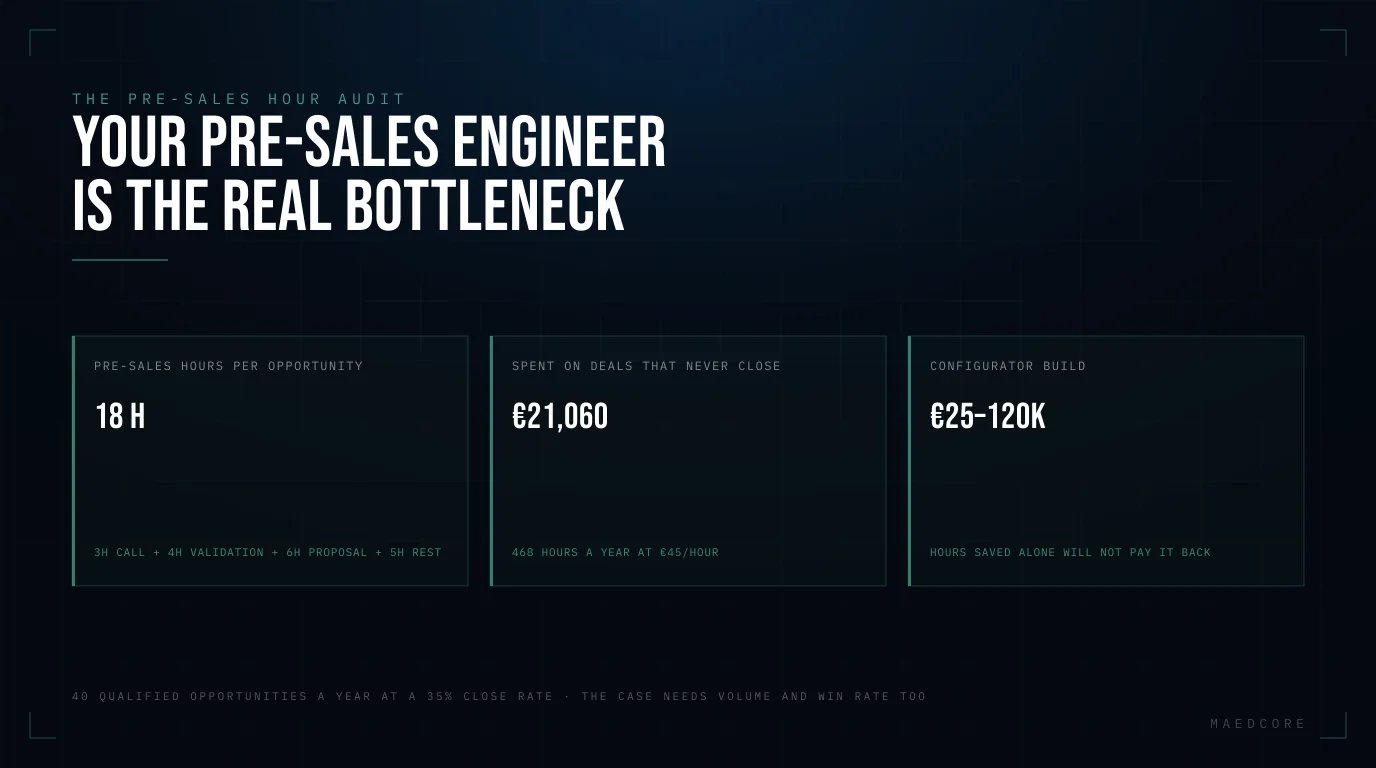
- Σ H = 18 hours/opportunity (conservative estimate: 3h initial call + 4h validation + 6h proposal + 3h revisions + 2h demo)
- Annual volume = 40 qualified opportunities
- Engineer hourly cost = €45/hour (derived from the median sales engineer salary in manufacturing per BLS: $101,940/year, adjusted for the European market)
- Close rate = 35% → 26 lost opportunities per year
Calculation:
- Total pre-sales spend: 18h × 40 deals × €45 = €32,400/year
- Hours invested in lost deals: 26 × 18h = 468 hours/year
- Cost of those hours: 468 × €45 = €21,060/year in engineering spent on opportunities that never close
A configurator that shifts 50% of early specification work to customer self-service recovers approximately €10,500/year in engineering capacity, before accounting for cycle compression or the increase in manageable opportunity volume. If the configurator allows the same team to handle 30% more annual opportunities (40 → 52), the calculation changes dramatically.
What does implementation cost? 3D configurators with CPQ logic, ERP integration, and industrial visualisation start at €25,000–€120,000 in initial build (engineering judgement), plus maintenance. At €10,500/year in direct engineering savings, the payback through that channel alone is 2.5–11 years in the conservative scenario. That is why the real business case requires including the impact on deal volume and close rate as well.
A note on published cycle-reduction figures: market reports such as Dataintelo (2026) cite cycle reductions of 48–65% for 3D configurators integrated with CPQ, with ROI in 12–18 months. NetSuite explicitly warns that calculating CPQ ROI with precision is a formidable challenge, because the benefits depend on quote volume, the current cost of the manual process, and implementation investment. Use the framework above with your own data before committing to any external figure.
Step 3 — Decision Matrix: Is a Configurator the Right Intervention?
| Criterion | Justifies a configurator? | Indicative threshold |
|---|---|---|
| Product has >3 configurable dimensions | ✅ Yes | Size, material, voltage, capacity, mounting… |
| Pre-sales hours per opportunity | ✅ Yes if >8h | Below that, ROI is weak |
| Annual volume of qualified opportunities | ✅ Yes if >20/year | Below that, payback exceeds 3 years |
| Proposal revision rounds | ✅ Yes if >1.5 on average | Indicates specification ambiguity the configurator resolves |
| On-site demo travel required | ✅ Strong signal | Each avoided visit saves €500–2,000 |
| Can the sales rep specify without the engineer today? | ❌ No = critical signal | If the answer is “no”, the bottleneck is confirmed |
| Product rules change >2 times/year | ⚠️ Caution | High maintenance burden; evaluate the update workflow |
| Every order is fully bespoke (clean-sheet engineering) | ❌ Not the ideal candidate | Consider guided selling instead |
Implementation Failures That Turn the Configurator into Abandoned Software
The decision to deploy a configurator is only the beginning. Failures follow recognisable patterns.
Rule drift. The configurator is built at a point in time. When the product evolves (new materials, updated certifications, discontinued options), the rules must be updated or the system generates technically invalid configurations. 39% of companies report delays or cost overruns due to compatibility issues during CPQ implementation (Mordor Intelligence, 2026); the same fragility persists post-launch if no maintenance process is defined.
The sales team ignores it. If the configurator is deployed as a customer-facing tool but the sales team does not trust it, they will continue specifying manually and the tool becomes shelfware. Adoption requires that sales co-designs the logic and does not simply receive a finished product.
Insufficient 3D asset quality. A low-fidelity render in an industrial sales context actively damages technical credibility.
No handoff protocol. The customer-generated configuration (BOM, spec sheet, 3D view) must flow directly into the CRM and the sales engineer’s workflow. Without that link, the engineer re-specifies from scratch and the time savings disappear.
Treating it as a web feature rather than a process change. The configurator only compresses the cycle if it is integrated into the buyer’s evaluation journey: linked from outreach campaigns, embedded in the website, referenced in the first sales call. Deploying it as a hidden tool on a product page delivers minimal ROI.
The European Context: Why the Window Is Open Now
Europe’s industrial digitisation gap is simultaneously a risk and an opportunity for forward-thinking manufacturers. Only 62% of Spanish manufacturing companies reach a basic level of digitalisation, compared to a 68% European average (Fundación BBVA / Ivie, DESI data, July 2025). Among SMEs, barely 31% sell online and only 28% use sector-specific software (ONTSI / INE, 2024).
Product configurators are not yet a recognised category in Spain’s Kit Digital subsidy programme. There is no wave of mass adoption pressure, but equally no competitive saturation. Manufacturers across Spain’s industrial corridor and the Mediterranean arc that deploy technical configurators in the next 18–24 months have a genuine differentiation window over competitors still selling with PDFs and in-person visits. The same logic applies to any European industrial exporter competing for international buyers who expect digital self-service as a baseline.
The global CPQ market sits between $2.5 billion and $3.1 billion in 2024 depending on the analyst house (figures diverge across Mordor Intelligence, Verified Market Research, and Market Growth Reports, so use them as directional indicators, not precise measurements), with projected growth of 12–16% annually through 2031–2032. Manufacturing leads adoption with a 32% share of the CPQ market (Mordor Intelligence, 2026).
Frequently Asked Questions
How much does it cost to implement an industrial product configurator?
How long does it take to implement a configurator in a manufacturing company?
What makes an industrial product configurator different from an e-commerce one?
Is my product too customised for a configurator?
How do I ensure the sales team actually adopts the configurator?
Can an industrial product configurator replace the pre-sales engineer?
Related reading
- Industrial VR in Practice: four use cases with the metrics companies actually recorded.
- VR Training vs. Traditional Training: the training-specific ROI comparison against classroom instruction.
- Virtual Reality in Industry: the overview of use cases, benefits and the technologies underneath.
- VR Showroom for Industrial Machinery Sales: the sales-side application, showing the machine without shipping it.
- Industrial 3D Animation: Selling Twin Factories with Maedcore: Maedcore case study, rolling-mill sector.
- Maedcore: Immersive Experiences, what we build in this area.
Sources
- Gartner Sales Survey: 67% of B2B Buyers Prefer a Rep-Free Experience — Gartner, March 2026.
- Gartner: AI Is Reshaping B2B Buying, but Human Sellers Still Close the Confidence Gap — Demand Gen Report citing Gartner CSO & Sales Leader Conference, May 2026.
- Five Fundamental Truths: How B2B Winners Keep Growing — McKinsey B2B Pulse Survey 2024 — McKinsey & Company, September 2024.
- McKinsey’s Ninth Global B2B Pulse Survey — European Business Magazine — European Business Magazine, September 2024.
- Forrester State of Business Buying 2024 — cited via ENaiBLD — Forrester, 2024 (n=16,000+ global buyers).
- B2B Sales Cycles Are Getting Longer — Equinet Media — Equinet Media, March 2026 (citing Focus Digital 2024 and Dentsu 2024).
- Average Sales Cycle Length by Industry: 2026 — Focus Digital — Focus Digital, July 2026.
- Configure Price and Quote (CPQ) Software Market — Mordor Intelligence — Mordor Intelligence, January 2026.
- Calculating CPQ ROI: A Guide — NetSuite — Oracle NetSuite, November 2025.
- Sales Engineers: Occupational Outlook Handbook — U.S. Bureau of Labor Statistics — BLS (primary government source).
- Marketing industrial en España: guía completa para empresas B2B — Aspid Marketing — Aspid Marketing, April 2026 (citing DESI data from Fundación BBVA / Ivie, July 2025).
- Digitalización de PYMEs en España 2026 — 10Code — 10Code, January 2026 (citing ONTSI TIC 2024; INE; Red.es Kit Digital 2024).
- How Much Does a Product Configurator Cost in 2025? — AR-Range — AR-Range, October 2025.
- Industrial 3D Animation: Selling Twin Factories with Maedcore — Maedcore.
About the Author
Robotics Engineer
For over a decade, I have been driven by a single mission: leveraging AI and robotics to build a world of automated production. I believe that by creating self-sufficient systems, we can empower people to refocus on what truly matters—their families and their passions. My expertise spans from winning prestigious European startup competitions to architecting complex, integrated hardware and software projects. I specialize in bridging the gap between today's industrial challenges and tomorrow's autonomous solutions.
Ready to transform your company?
Book a free 30-minute meeting with an engineer.