Industrial VR in Practice: Real Results Companies Are Achieving
Four industrial VR use cases with real metrics: maintenance training, factory layout, remote FAT, and technical demos. Includes a decision matrix for pilots.

Written by Eduardo Fuentevilla Blanco
Robotics Engineer at Maedcore · Robotics Engineer LinkedIn ↗
Key Takeaways
- ► VR reaches cost parity with classroom training at around 375 learners for soft skills (PwC, 2020); for industrial procedures with modules costing €15K–€40K to develop, the equivalent threshold ranges from 150 to 500 technicians.
- ► The average cost of an on-site FAT visit is $40,000 (ProPharma, 2023); a virtual FAT infrastructure costs €2,000–€8,000 as a one-time investment, with payback at the very first event.
- ► Boeing and the University of Sheffield's AMRC demonstrated a potential 50% throughput increase using VR combined with Discrete Event Simulation, before the factory physically existed.
- ► Interactive demos convert at 38% versus a 25% B2B average (Optifai, 2026), though no published study with a named methodology yet isolates VR-specific conversion for industrial capital equipment.
- ► CAD file incompatibility (CATIA/SolidWorks → Unity/Unreal) adds 20–40% to development time; agreeing on a STEP/FBX export pipeline at project kick-off is the most effective mitigation.
- ► The Use Case Decision Matrix lets you prioritise the right VR pilot in ten minutes: remote FAT and technical sales demos offer the fastest payback for machinery OEMs with international buyers.
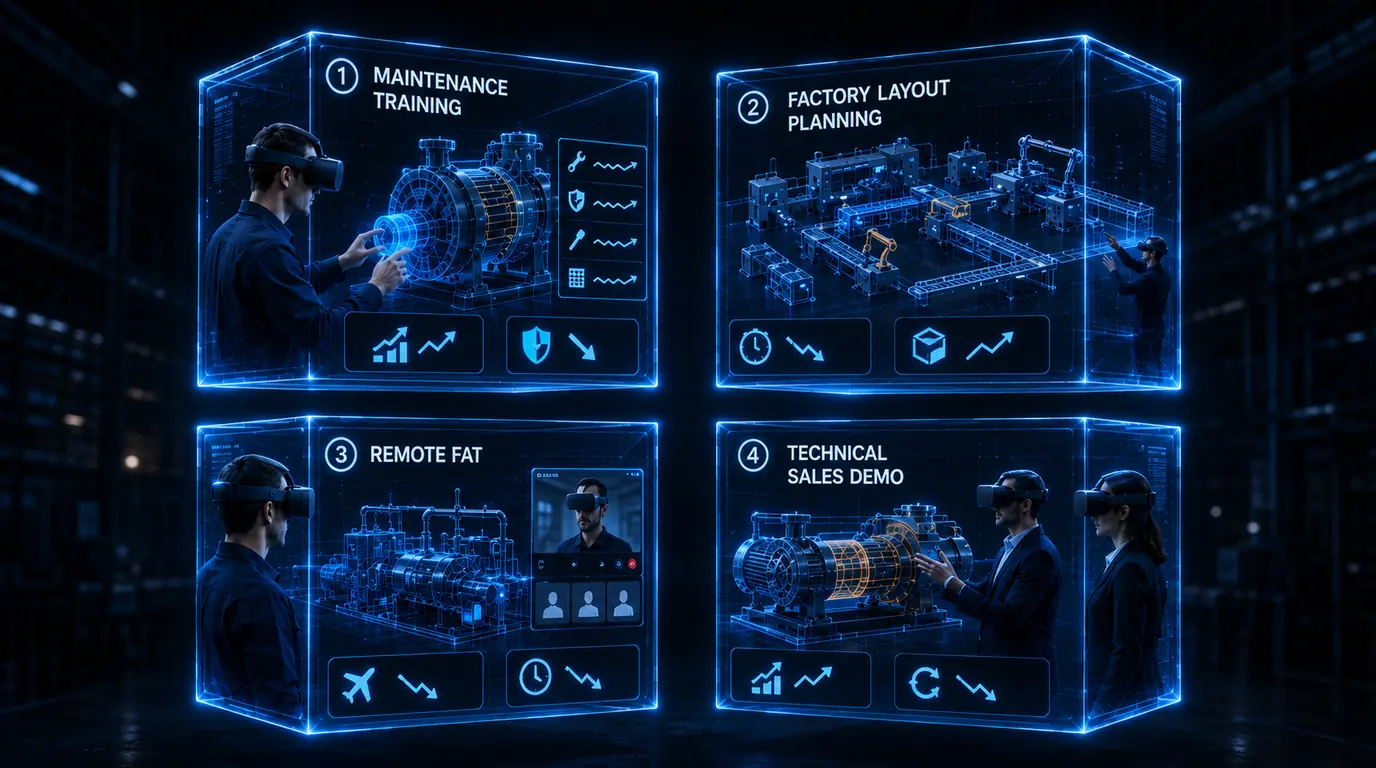
Industrial VR has moved out of the lab: companies that have deployed it report training up to 4× faster than classroom instruction (PwC, 2020), potential savings of $40,000 per eliminated on-site FAT visit (ProPharma, 2023), and interactive demo conversion rates of 38% against a 25% B2B average (Optifai, 2026). This article is a practical guide to four specific applications (maintenance training, factory layout review, remote FAT, and technical sales demos), with the numbers you need to justify a pilot to your CFO, plus a decision matrix that tells you which to tackle first based on your plant’s profile.
Why the “industrial VR case studies” you find online don’t actually help manufacturers
Most industrial VR articles cite Boeing and Airbus without a primary source and without a break-even threshold, which is useless for planning a pilot at a 200-person plant. Search for content on industrial VR use cases and you will find the same pattern repeated: a list of sectors, brand names with no link to the original document, and a summary of benefits without a single quantified threshold.
Spain’s industrial sector invested €37.45 billion in fixed assets in 2024, of which 74.1% came from manufacturing companies (INE, 2026). The Madrid region accounts for 11.1% of national industrial turnover, with strengths in aerospace, automotive, machinery and electronics (Invest in Madrid, 2025). The VIII Smart Industry 4.0 Report (2025) confirms that the main obstacle to industrial digitalisation in Spain is no longer technological but strategic: more than 70% of companies identify a shortage of digital talent as the primary barrier (LYL Ingeniería / Smart Industry, 2025). VR projects that fail usually lack a selection framework, and hardware rarely has anything to do with it.
What no existing article answers is the question that actually matters: which of the four use cases should you pilot first, given your plant size and sales cycle length?
| Gap in existing content | Why it matters to practitioners |
|---|---|
| No use-case prioritisation logic | Where do I start with a €20K–€50K budget? |
| No reference costs outside the US/UK | All benchmarks are in dollars or pounds |
| No break-even calculation | How many trained technicians does it take to pay off the module? |
| No sales-cycle data for VR demos | The claim “shortens the sales cycle” has no number of days attached |
| No failure-mode taxonomy | What actually causes an industrial VR project to fail in practice? |
| No guidance for SMEs | Every case study features Boeing, Airbus or Hyundai |
Use case 1: Maintenance training — when industrial VR is cheaper than the classroom
VR reaches cost parity with classroom training at around 375 learners for soft skills (PwC, 2020); for industrial procedures with modules costing €15,000–€40,000 to develop, the equivalent threshold ranges from 150 to 500 technicians, a figure many industrial SMEs cannot reach with a single module.
The PwC study is the most cited reference and also the most misread: it was conducted on soft-skills training (inclusive leadership), not industrial procedures. Extrapolating the 4× figure to a hydraulic press maintenance sequence is common in content marketing but methodologically imprecise. Data specific to industrial tasks are more modest but equally relevant: Boeing achieved a 33% improvement in wiring speed and accuracy and cut training time by 75% by replacing paper diagrams with immersive 3D guides (Treeview Studio, 2026). The Capgemini Research Institute estimates that VR can reduce accidents by up to 43% in high-risk environments (Treeview Studio, 2026). A systematic review of 86 studies published on ResearchGate concludes, however, that VR complements hands-on practice but does not replace it, particularly for tasks requiring physical force or tactile feedback (ResearchGate / peer-reviewed, 2020).
A VR training module for a single industrial procedure costs between €8,000 and €40,000 to develop; hardware (Meta Quest 3 or HTC Vive Focus 3) adds €500–€1,800 per headset. The three most common failure modes are:
- Content obsolescence. Machine models change; VR assets do not update themselves. Budget 15–20% of the original development cost annually for asset maintenance.
- Simulator sickness. Cap sessions at 20 minutes and require a minimum refresh rate of 90 Hz.
- Break-even volume mismatch. If your plant trains 60 technicians a year with a €25,000 module, the per-learner cost in VR may exceed classroom training for several years. Design modular, reusable content libraries, or share development costs across multiple plants within the same group.
Use case 2: Factory layout review — validate before moving a single machine
Airbus cuts engineering verification time by 75% with VR; Boeing and the University of Sheffield’s AMRC demonstrated that a new plant could increase throughput by 50%, before it physically existed (AMRC, University of Sheffield).
Unlike training, factory layout review has a compressed payback horizon: the value is created before the physical investment. Moving a machining line to the wrong position can cost tens of thousands of euros in downtime, transport and rewiring. The AMRC–Boeing case comes from a primary institutional source: using VR combined with Discrete Event Simulation, the team demonstrated a potential 50% throughput increase before the factory existed (AMRC, University of Sheffield). Hyundai invested $12.8 million in VR-based design evaluation systems and achieved a 20% reduction in vehicle development time and a 15% reduction in annual development costs (Treeview Studio, 2026). Gong et al. (2019) establish the conceptual foundation: VR-assisted layout planning enables what-if scenario testing with an ease that traditional methods simply cannot match (Gong et al., Springer, 2019).
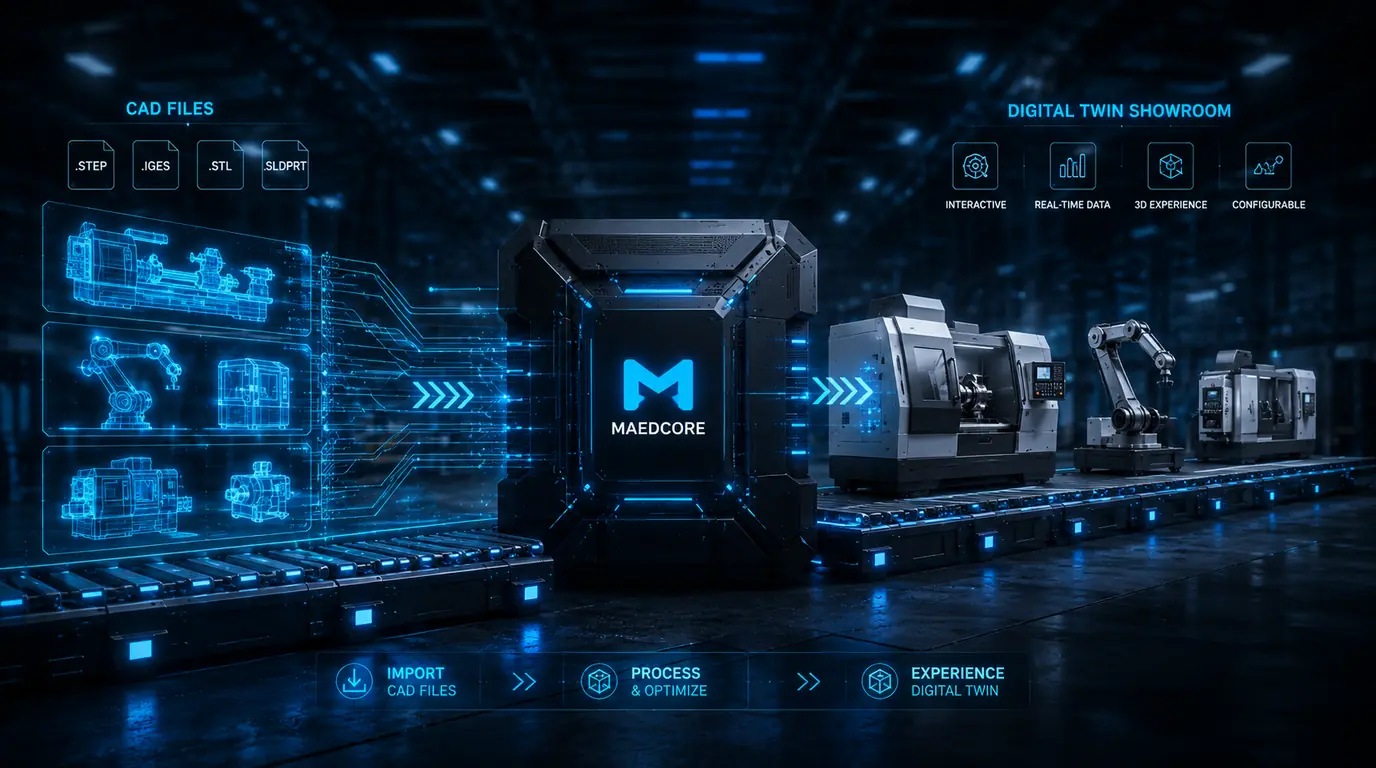
The main technical obstacle sits in CAD file conversion, ahead of hardware. Native formats from CATIA, SolidWorks or NX rarely import cleanly into Unity or Unreal Engine; polygon reduction and material remapping add 20–40% to development time. The fix is straightforward but must be agreed at project kick-off: define a STEP or FBX export pipeline from day one. In a 3D industrial animation project we built for the sale of twin rolling-mill plants, that was precisely the central challenge: converting high-density CAD geometry into a navigable environment that allowed buyers to walk through the facility virtually before committing to the investment (Industrial 3D Animation: Selling Twin Plants with Maedcore).
A layout review based on point-cloud capture and CAD import ranges from €5,000 to €25,000. Implementation takes 3–8 weeks if the point cloud already exists; add 4–6 weeks if scanning needs to be done from scratch.
Use case 3: Remote FAT — $40,000 per visit is the cost nobody budgets for
The average cost of an on-site FAT visit is $40,000 (ProPharma, 2023); a virtual FAT infrastructure costs €2,000–€8,000 as a one-time investment, so payback occurs at the very first event.
The $40,000 figure includes flights, accommodation, subsistence, the time of engineers away from their own plant, and the opportunity cost of having them off-site for days. The Offshore Technology Conference (2022) documented that virtual FATs have become an accepted method with a strong likelihood of becoming the post-pandemic standard, also reducing CO₂ impact (OTC, 2022). Control Engineering highlights another benefit that few companies anticipate: remote FAT increases stakeholder participation because the time commitment shrinks from days to hours (Control Engineering / Applied Manufacturing Technologies, 2025).
There is an important tension that generic content ignores: in regulated industries (pharmaceuticals, medical devices), EU Annex 15 and FDA CFR requirements still mandate physical qualification steps that virtual FAT cannot fully replace. For unregulated industrial machinery, virtual FAT is a practically objection-free solution. The closest published case from Spain is INNOVAE’s Remote Technical Assistance system for Volkswagen dealerships: it digitised technical knowledge through session recordings and auto-generated reports, minimised expert travel and reduced mechanics’ learning curves (INDPULS, 2025).
Use case 4: Technical sales demos — the showroom that never closes
Interactive demos convert at 38%, versus a 25% B2B average, a 52% uplift (Optifai, 2026). In complex machinery sales where the product weighs twelve tonnes or costs a million euros, taking the product to the customer simply stops being an option.
In sectors such as heavy machinery or bespoke capital equipment, a typical sales cycle exceeds twelve months and a physical product demonstration is either logistically impossible or prohibitively expensive. VR changes that equation: instead of the buyer travelling to the factory, the factory travels to the buyer. Siemens uses VR for industrial equipment demos, allowing customers to see how machines operate in a virtual environment before committing to a purchase (Treeview Studio, 2026).
The Optifai benchmark (38%, N=939 companies) covers all interactive demo formats, not VR specifically. No published study with a named methodology isolates the conversion uplift of VR demos for industrial capital equipment. This is the most significant data gap for anyone seeking to justify investment in sales VR alone: engagement data are solid; VR-specific conversion data for capital equipment have not yet been published with sufficient rigour. What is documented is that XR device shipments for industrial use grew more than 40% year-on-year in 2025 (Treeview Studio, 2026), a signal that industrial sales teams are voting with their budgets.
Decision matrix: which industrial VR use case to pilot first
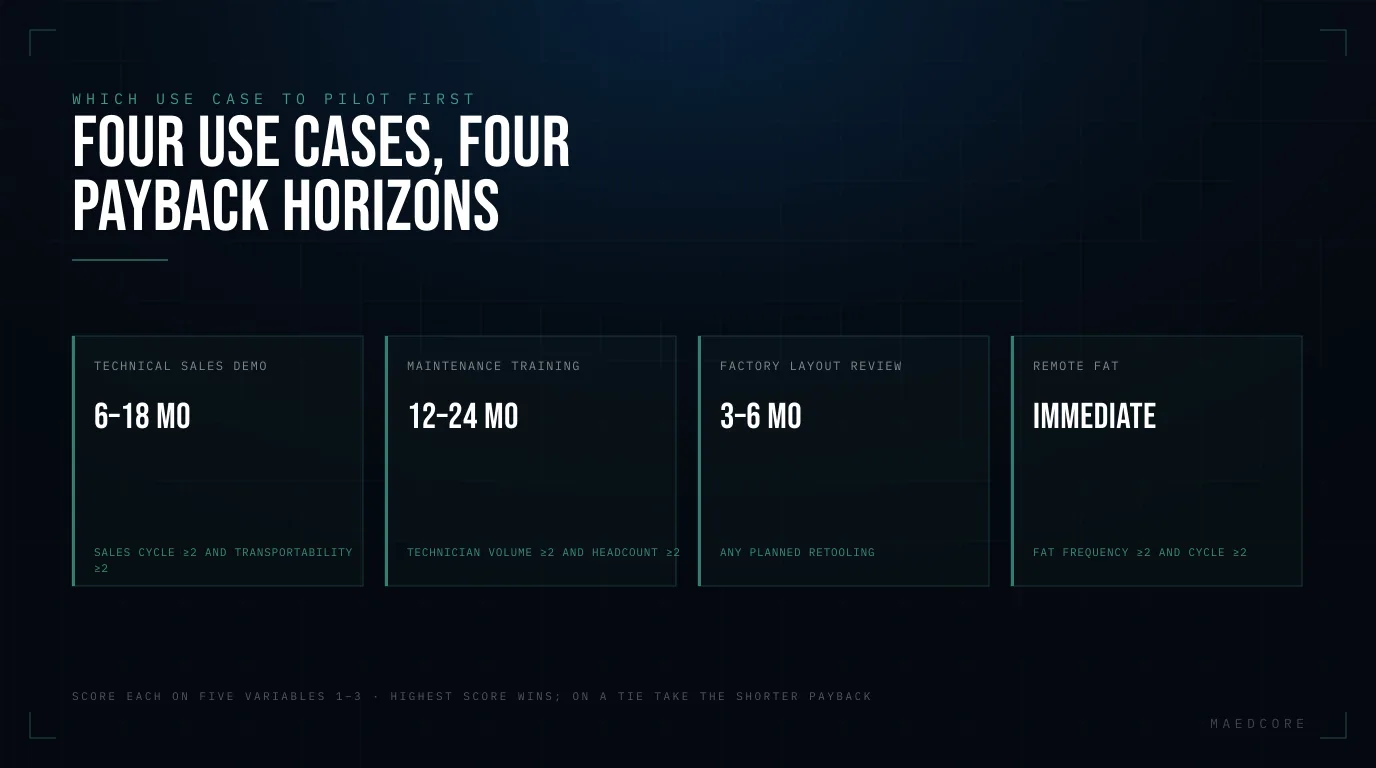
This is the tool that does not exist in any other article on industrial VR: a prioritisation matrix based on five operational variables that any plant manager or commercial director can answer in ten minutes.
The five input variables (scale 1–3)
| Variable | 1 (Low) | 2 (Medium) | 3 (High) |
|---|---|---|---|
| A. Sales cycle length | <3 months | 3–12 months | >12 months |
| B. Annual volume of technicians to train | <50/year | 50–300/year | >300/year |
| C. Product transportability | Easy to transport | Partial | Not transportable |
| D. Frequency of FAT / international buyers | Rare | Occasional | Frequent |
| E. Total headcount | <100 people | 100–500 people | >500 people |
Scoring rules by use case
| Use case | Best-fit signal | Minimum score | Payback horizon |
|---|---|---|---|
| Technical sales demo (VR) | A≥2 + C≥2 | A+C ≥ 4 | 6–18 months |
| Maintenance training VR | B≥2 + E≥2 | B+E ≥ 4 | 12–24 months |
| Factory layout review VR | E≥2, planned retooling | Any planned refurbishment | 3–6 months |
| Virtual remote FAT | D≥2 + A≥2 | D+A ≥ 4 | Immediate (per-event saving) |
Decision rule: Calculate the score for each use case. The highest score is the recommended pilot. If two tie, choose the one with the shorter payback horizon. If your available budget is below €20,000, prioritise remote FAT (lowest development cost) or the sales demo (greatest revenue leverage).
Worked example: hydraulic press OEM, 180 employees
Consider a hydraulic press manufacturer with 180 employees. It sells primarily to German and French buyers with decision cycles exceeding 18 months. Its machines weigh between 8 and 15 tonnes. It trains around 80 of its own technicians per year and conducts four to six international FATs annually.
Scores under the matrix:
- A (sales cycle >12 months) = 3
- B (80 technicians/year) = 2
- C (12-tonne presses, not transportable) = 3
- D (4–6 international FATs/year) = 3
- E (180 employees) = 2
Results:
- Technical sales demo: A+C = 6 ✅
- Remote FAT: D+A = 6 ✅
- Maintenance training: B+E = 4 ✅
- Layout: no planned refurbishment → low priority
Recommendation: Tie between sales demo and remote FAT. Because remote FAT generates immediate, quantifiable savings from the very first event (up to $40,000 per avoided visit according to ProPharma, 2023), it is recommended as the first pilot. The technical sales demo is the second project: higher development complexity, but direct impact on a long-cycle pipeline. Maintenance training is the third project: at 80 technicians per year, break-even will be reached in 2–3 years depending on module cost.
Explicit assumptions of the framework
This framework is engineering judgement, not a validated econometric model. Payback horizons assume that VR modules are developed custom (not off-the-shelf), that CAD files exist in an exportable format, and that the organisation has internal or external capacity to manage the technology change. The cut-off scores (≥4) are conservative: if your score falls below the minimum for every use case, VR is not the obstacle. Your operation simply does not yet have the volume or complexity that justifies the investment over simpler alternatives.
Frequently Asked Questions
How much does an industrial VR project actually cost?
Can industrial SMEs justify investment in VR?
Does virtual FAT meet regulatory requirements in pharmaceuticals or medical devices?
What are the most common reasons industrial VR projects fail?
Related reading
- Industrial Product Configurator: taking the pre-sales engineer off the critical path of every quote.
- VR Training vs. Traditional Training: the training-specific ROI comparison against classroom instruction.
- Virtual Reality in Industry: the overview: use cases, benefits and the technologies underneath.
- VR Showroom for Industrial Machinery Sales: the sales-side application: showing the machine without shipping it.
- Industrial 3D Animation: Selling Twin Rolling-Mill Plants: Maedcore project case study
- Maedcore (Immersive Experiences): what we build in this area.
Sources
- Solving for Skills Training with Virtual Reality — PwC, 2020
- AR/VR/MR/XR Spatial Computing Industry Statistics Report 2026 — Treeview Studio, 2026
- VR Examples: 50+ Real-World Virtual Reality Use Cases (2026) — Treeview Studio, 2026
- Real Benefits of Virtual Simulation — Boeing Sheffield / AMRC — University of Sheffield AMRC
- Applications of VR in Maintenance During the Industrial Product Lifecycle: A Systematic Review — ResearchGate / peer-reviewed, 2020
- Development of Virtual Reality Support to Factory Layout Planning — Gong et al., International Journal on Interactive Design and Manufacturing, Springer, 2019
- Virtual Remote Factory Acceptance Test — OTC Offshore Technology Conference, 2022
- Benefits of Virtual Factory Acceptance Test Systems — Control Engineering / Applied Manufacturing Technologies, 2025
- Should You Undergo Virtual Factory Acceptance Testing? — ProPharma Group, 2023
- Estadística Estructural de Empresas: Sector Industrial. Año 2024 — INE, 2026
- Advanced Manufacturing Revolution in the Madrid Region — Invest in Madrid, 2025
- VIII Smart Industry 4.0 Report — Industry 4.0 in Spain — LYL Ingeniería / Smart Industry, 2025
- Virtual and Augmented Reality in Industry 4.0 — INDPULS, 2025
- Demo-to-Close Conversion Rate Benchmark — Optifai Sales Ops Benchmark (N=939 companies), 2026
About the Author
Robotics Engineer
For over a decade, I have been driven by a single mission: leveraging AI and robotics to build a world of automated production. I believe that by creating self-sufficient systems, we can empower people to refocus on what truly matters—their families and their passions. My expertise spans from winning prestigious European startup competitions to architecting complex, integrated hardware and software projects. I specialize in bridging the gap between today's industrial challenges and tomorrow's autonomous solutions.
Ready to transform your company?
Book a free 30-minute meeting with an engineer.