Immersive Technologies for Industrial Manufacturers: Honest ROI, Real Trade-offs
Where VR/AR delivers measurable ROI in manufacturing, and where it doesn't. Real metrics, failure modes, and a go/no-go decision framework for plant and

Written by Eduardo Fuentevilla Blanco
Robotics Engineer at Maedcore · Robotics Engineer LinkedIn ↗
Key Takeaways
- ► VR training reaches cost parity with classroom instruction only at 375 learners per year. Below that threshold, e-learning is cheaper for most non-safety-critical procedures.
- ► A peer-reviewed study across 13 Austrian manufacturing AR/VR use cases found average process time reductions of 23.61% and cycle time reductions of 25% (Zigart et al., Production and Manufacturing Research, 2023).
- ► For high-volume, repetitive defect detection, AI vision inspection (95–99% accuracy, 10,000+ parts/hour) outperforms AR-guided human inspection, since the two tools solve different problems.
- ► The most common failure mode in industrial VR is use-case selection: pilots designed to impress a boardroom rather than move a measurable operational metric consistently fail to show ROI.
- ► Spanish industrial VR adoption grew 5.4× between 2019 and 2024 based on 793 real projects (Fyware, 2026). The EU deployment track record is stronger than English-language content typically acknowledges.
- ► A single avoided capital equipment shipment to a trade show can pay for an entire immersive sales demo rig; instrument your sales cycle baseline before launch so you have something to compare against.
Industrial VR pilots fail at a remarkable rate, mostly because they were designed to impress a boardroom rather than solve a measurable operational problem. The global AR and VR in manufacturing market reached USD 12.74 billion in 2024 and is projected to hit USD 100 billion by 2034, yet the single most important number to carry into any immersive technology decision is this: VR training only reaches cost parity with classroom instruction at 375 learners per year, a threshold most industrial pilots never approach. Get the use-case selection right first; everything else is implementation detail.
Most Immersive Technology Pilots Fail — Here Is Why
The majority of industrial VR pilots stall because the problem they were built to solve was never clearly defined in operational terms. A pilot conceived to demonstrate innovation to a steering committee, rather than to reduce a measurable cost or compress a documented cycle time, will almost always be shelved when the executive champion moves on or the quarterly review cycle ends before ROI can be demonstrated.
Most VR training pilots fail because organisations pick the wrong use case, whatever the cost or the technology. A technology that delivers 23.61% process time reduction across 13 peer-reviewed industrial use cases is mature enough. It is simply being applied to the wrong problems.
Market-size figures are worth treating with caution. Precedence Research puts the 2024 AR/VR-in-manufacturing market at $12.74 billion; other analysts put the total cross-sector AR/VR market at $59.76 billion for the same year. These numbers use different scope definitions, geographies, and methodologies, and stacking them as if they tell a coherent story is one of the most common errors in this space. What they agree on: the direction is strongly upward, and the applications gaining traction are industrial, not consumer.
What the Evidence Actually Shows About Immersive Technologies and Industrial ROI
For specific, high-stakes industrial use cases (complex B2B sales demos, AR-guided inspection, and safety-critical operator training), documented ROI is real. For general-purpose enterprise adoption, friction still dominates.
The most directly applicable evidence comes from a peer-reviewed study published in Production and Manufacturing Research (Zigart et al., December 2023), which evaluated 13 AR/VR use cases across Austrian manufacturing companies over two years. Average process time reduction: 23.61%. Average cycle time reduction: 25%. This is controlled industrial measurement, not a vendor case study.
The widely cited PwC figures (VR trainees learn up to four times faster than classroom and are 275% more confident to act on their training) deserve a caveat that almost no industrial content provides: PwC measured enterprise soft-skills training, not shop-floor industrial procedures. The Austrian peer-reviewed data is the right benchmark for industrial contexts.
Here is where two credible sources genuinely disagree. PTC’s 2025 State of Industrial AR report (via KGT Solutions) claims 72% of manufacturers who deployed AR reported positive ROI within the first year. The PwC cost-parity analysis says VR only beats classroom training financially at 375 learners per year. Both can be true simultaneously: ROI is fast when the use case is high-frequency and high-stakes; it is slow or negative for low-volume, low-consequence applications. The 375-learner threshold is the number that most industrial VR content never surfaces, and it is the most important one for a plant manager to know before signing a purchase order.
Forrester Research estimates 219% ROI over three years from a 10,000-employee VR training deployment. That is directionally useful, but a scale that most manufacturers will not reach in a single deployment cycle.
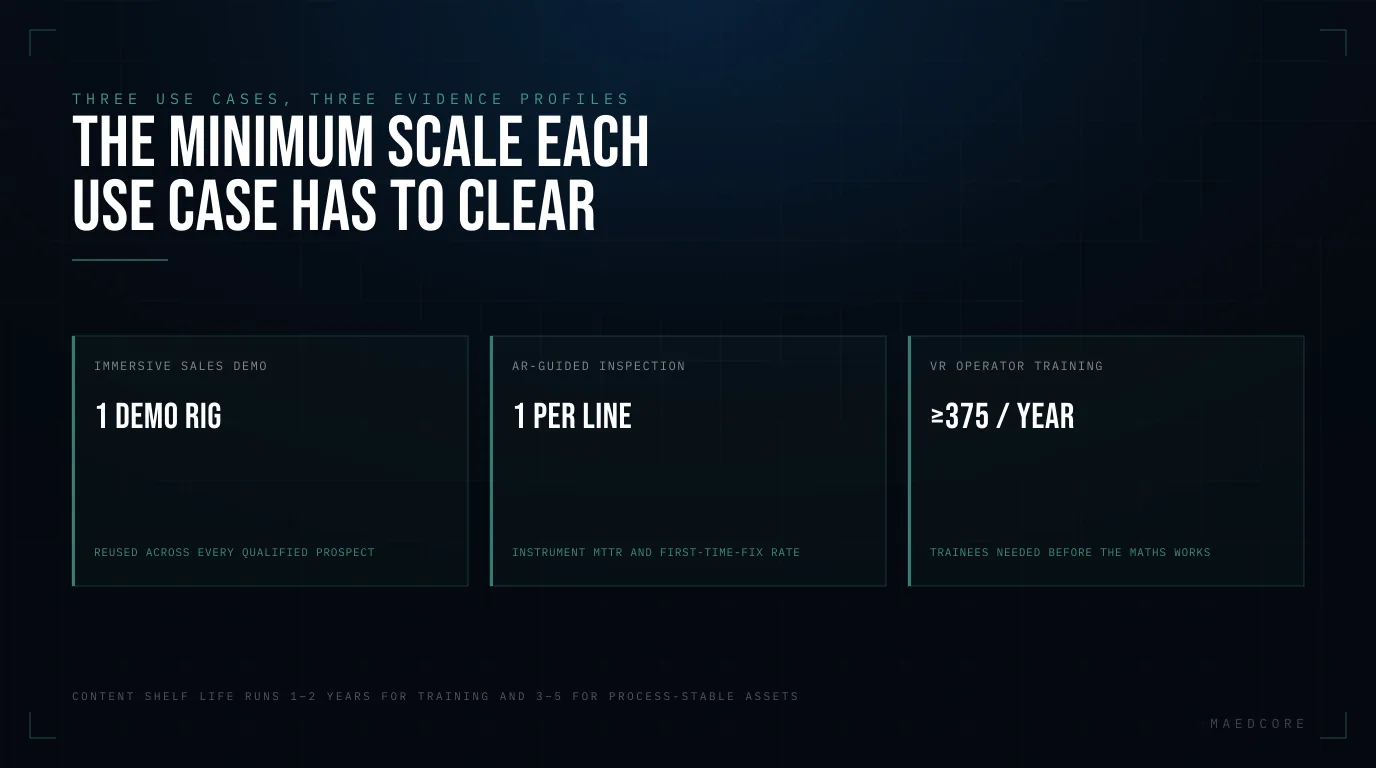
Three Use Cases, Three Evidence Profiles
| Use Case | Evidence Quality | Typical ROI Timeline | Minimum Viable Scale |
|---|---|---|---|
| Immersive Sales Demo | Industry-reported (directional) | 1–3 deals recovered | 1 demo rig, reused across all prospects |
| AR-Guided Inspection | Peer-reviewed + case study | 3–12 months | 1 deployment per inspection line |
| VR Operator Training | Peer-reviewed (Zigart 2023; PwC 2020) | 12–24 months | ≥375 trainees/year for cost parity |
Use Case 1: Immersive Sales Demos for Complex Capital Equipment
When a product is too large, too complex, or too expensive to ship to a client site, an immersive sales demo is often the only way to give a multi-stakeholder buying team a shared, technically accurate experience before purchase.
Large, complex products cost hundreds of thousands of dollars to ship to and from sales meetings and trade shows. A single avoided shipment of capital equipment can pay for a VR demo rig outright, before any sales-cycle effect is counted. One documented industrial VR sales programme shortened the average B2B sales cycle by 27% and increased technical specification comprehension by 78% compared to traditional presentations. This figure is industry-reported rather than peer-reviewed, and should be treated as directional, but the mechanism is credible: an immersive demo allows all decision-makers to experience the product simultaneously, eliminating the “I need to see it again” cycle that accounts for a disproportionate share of sales-cycle length. 48% of manufacturers are now investing in 3D visualisation tools as part of their B2B sales stack.
Content development costs (engineering judgment based on industry benchmarks): a semi-custom industrial product demo runs $30K–$80K per module; a fully custom experience with a real-time configurator costs $150K–$500K or more. Hardware (a Meta Quest 3 at roughly $500 per unit) is not the budget constraint. Content is. Implementation timeframe for a single-SKU pilot: 8–16 weeks.
In a project built for a rolling-mill manufacturer, where two physically identical factories needed to be sold to buyers who could not visit either site, immersive 3D visualisation compressed what would have been a months-long site-visit cycle into a single shared experience. The binding constraint turned out to be production-accurate 3D assets that could be updated when engineering made changes.
That last point is the most common failure mode: content built around the current product version becomes obsolete when engineering releases a revision. Build modular, parametric 3D assets from the start, with a defined update protocol tied to engineering change orders. The second failure mode is scope mismatch: a demo designed for a trade-show booth (passive, three minutes, high spectacle) fails in a 45-minute technical sales meeting where buyers want to interrogate the product. The third failure mode is connectivity: a laggy VR demo actively reinforces the narrative that the technology is not ready. Always pre-test at the client site.
Use Case 2: AR-Guided Inspection and Spatial Data Visualisation
Human visual inspection misses 20–30% of defects under real production conditions, but AI vision is not always the answer. For spatially complex, variable, or safety-critical assets, AR-guided human inspection is the right tool.
The baseline problem is more serious than most quality managers acknowledge. Human inspection accuracy degrades 15–25% after just two hours of continuous observation, and inter-inspector agreement on defect severity sits at only 55–70%.
A distinction that almost no industrial content draws clearly: AI vision inspection and AR-guided human inspection solve different problems. AI vision inspection systems now achieve 95–99% detection accuracy at 10,000+ parts per hour. For high-volume, repetitive defect detection (surface finish on stamped parts, dimensional checks on machined components), AI vision is the right tool. AR-guided human inspection is the right tool for spatially complex or safety-critical inspection where human judgment remains essential and defect types cannot be fully enumerated in advance.
Digital twin-based AR for maintenance workflows can reduce troubleshooting time by 54%, with direct financial impact on MTTR and first-time fix rate. One documented composite structures supplier cut average inspection time per component from 45 minutes to under 90 seconds, increasing throughput by 35% without adding headcount.
The three failure modes to plan for: the 3D model of the asset is “as-designed” rather than “as-built”, so establish a model update protocol tied to engineering change orders from day one. Battery life on industrial AR headsets rarely exceeds three hours of intensive use, so for full-shift inspection tasks, plan for device rotation or tethered solutions. And inspectors will revert to paper if the AR system requires too many taps: UX must be designed for gloved hands and noisy environments.
When NOT to Use Immersive Technologies
The clearest signal that an immersive technology vendor is worth working with is their willingness to tell you when not to buy.
Fewer than 300–400 trainees per year, non-safety-critical procedure. Below the 375-learner cost-parity threshold, e-learning is cheaper, faster to update, and easier to deploy. The exception: any procedure where a single error costs more than the entire VR programme.
High-volume, repetitive defect detection. If the defect type is enumerable and production volume is high, AI vision inspection delivers 95–99% accuracy at speeds no AR-assisted workflow can match.
Rapidly changing products or procedures. Custom VR content for a 20-minute module takes 2,000–4,000 hours to produce (engineering judgment). If the underlying process changes every six months, the content investment is destroyed before it pays back. Rule of thumb: if the product or procedure has a shelf life shorter than 18 months, fully custom VR content rarely makes economic sense.
“We want to show the board we’re innovative.” If the brief cannot be translated into a measurable operational metric (sales cycle length, MTTR, time-to-competency, defect escape rate), the ROI will be zero regardless of how impressive the headset looks in the boardroom.
Cybersickness-sensitive populations. Negative transfer of learning, cybersickness, and failure to adopt are documented challenges, and they show up often. Pilot with a representative sample of the actual user population before committing to full rollout.
The Immersive ROI Readiness Framework: A Go/No-Go Decision Matrix
This is the structured tool that does not exist elsewhere in this space: a use-case-specific go/no-go decision matrix that tells an operations director or technical sales leader, before committing budget, whether their specific problem is a good fit for immersive technology, and which flavour.
The framework works on a simple rule: if a use case scores green on Problem Type, Frequency of Use, and Baseline Cost Being Replaced, proceed to a scoped pilot. If it scores red on any of the three, stop and re-scope the problem before touching technology.
Explicit Assumptions
- Content development costs are based on industry benchmarks and engineering judgment: $30K–$80K for semi-custom, $150K–$500K+ for fully custom with configurator.
- Hardware TCO over three years: $1,024/headset (Pico 4 Enterprise) to $5,996 (Apple Vision Pro), per RAUM enterprise VR benchmarks.
- Cost-parity thresholds are drawn from PwC 2020 via Cornerstone: 375 learners/year to beat classroom; 1,950 to beat e-learning.
- “Content shelf life” estimates are engineering judgment based on typical industrial product and procedure change cycles.
- ROI signals listed are leading indicators to instrument before launch, not metrics to report after.
The Matrix
| Criterion | Immersive Sales Demo | AR-Guided Inspection | VR Operator Training | Skip Immersive Tech |
|---|---|---|---|---|
| Problem type | Product too large/complex/expensive to demo physically | Spatially distributed inspection data; human judgment required | High-stakes, low-frequency procedure with high error cost | Simple compliance tick-box; text-based procedure |
| Frequency of use | Every qualified prospect interaction | Every inspection cycle | Every new hire or recertification | One-off or very rare event |
| Baseline cost replaced | Travel + logistics + lost sales time | Inspector labour + rework + downtime | Instructor time + line downtime | Low-cost e-learning already works |
| Minimum viable scale | 1 demo rig, reused across all prospects | 1 deployment per inspection line | ≥375 trainees/year | N/A |
| Content shelf life | 2–3 years (product lifecycle) | 3–5 years (process-stable assets) | 1–2 years (procedure changes) | N/A |
| Integration requirement | CRM / sales enablement platform | MES / ERP / CMMS | LMS | N/A |
| ROI signal to instrument | Sales cycle length, win rate, travel cost saved | MTTR, first-time fix rate, defect escape rate | Time-to-competency, error rate, retraining cost | N/A |
| Red flag — stop here | Product changes faster than content can be updated | Defects are high-volume, repetitive → use AI vision | Fewer than ~300 trainees/year, non-safety-critical | ”We want to show the board we’re innovative” |
How to Use This in Practice
Start by writing down the operational metric you are trying to move: a number, with a current baseline and a target. If you cannot do that in one sentence, the use case is not ready for immersive technology. Then map your problem to one of the three columns. If it lands in the “Skip” column on any of the three core criteria, the honest answer is to re-scope.
The most common mistake in our experience is skipping the baseline measurement step entirely: launching a pilot without instrumenting the current state, then being unable to demonstrate ROI because there is nothing to compare against. Instrument first. Pilot second.
For VR operator training specifically, the research accounts for an additional 10 minutes needed to onboard new users to a VR headset for the first time. Factor this into time-to-competency calculations or the first cohort’s numbers will look worse than they are. And hardware fragmentation remains a real constraint: content built for one headset generation may be obsolete in 18–24 months. Standardise on one headset family before commissioning custom content.
The Spain and EU Context: Adoption Data That English-Language Content Ignores
Spanish and broader EU adoption data is almost entirely absent from English-language industrial VR content, which matters for any international buyer evaluating European suppliers or partners.
Inmersiva XR’s Industria XR en España 2024 report, aggregating data from 36 Spanish XR companies, found that 89% of Spanish XR companies expected to grow revenue in 2024, with revenue distributed across VR (28%), AR (23%), and audiovisual technologies (19%). Spanish industrial VR provider Fyware reports, based on 793 projects across 133 clients in 16 countries, that adoption of industrial VR grew 5.4× between 2019 and 2024. This comes from actual project data rather than market-research projections, a more reliable signal of real industrial uptake than any analyst forecast.
For international buyers evaluating European manufacturing partners or suppliers along Spain’s industrial corridor, the technology base, engineering talent, and deployment track record are present. Immersive technology does work in European industrial environments, with documented results. The open question is whether the specific use case justifies the investment.
Frequently Asked Questions
What is the minimum number of trainees needed for VR training to be cost-effective?
When should a manufacturer use AI vision inspection instead of AR-guided inspection?
What are the most common reasons industrial VR pilots fail?
Does the PwC '4x faster learning' statistic apply to industrial manufacturing training?
How much does it cost to develop an immersive sales demo for industrial capital equipment?
How long does it take to see ROI from an immersive sales demo programme?
Related reading
- Industrial VR in Practice: four use cases with the metrics companies actually recorded.
- Industry 4.0 and Virtual Reality: the three use cases that clear the ROI bar, and the ones that don’t.
- 3D Animation vs. Interactive VR: which format fits which sales moment, with the cost difference laid out.
- Industrial Product Configurator: taking the pre-sales engineer off the critical path of every quote.
- VR Training vs. Traditional Training: the training-specific ROI comparison against classroom instruction.
- Virtual Reality in Industry: the overview of use cases, benefits and the technologies underneath.
- VR Showroom for Industrial Machinery Sales: the sales-side application, showing the machine without shipping it.
- Industrial 3D Animation: Selling Twin Factories with Maedcore (Maedcore, 2024).
- Maedcore: Immersive Experiences, what we build in this area.
Sources
- Precedence Research — AR and VR in Manufacturing Market — Precedence Research, January 2025.
- PwC “Understanding the Effectiveness of VR Soft Skills Training in the Enterprise” — via Immersive Learning News — PwC / Immersive Learning News, 2020.
- Cornerstone — VR Soft Skills Training Study — Cornerstone on Demand, 2025 (citing PwC 2020 primary).
- Zigart et al., “From lab to industry: lessons learned from the evaluation of AR/VR use cases in Austrian manufacturing” — Production and Manufacturing Research, December 2023. (Peer-reviewed)
- Inmersiva XR — Industria XR en España 2024 — Inmersiva XR, 2024.
- Fyware — Reporte Realidad Virtual Industrial 2026 — Fyware, July 2026.
- RAUM — Enterprise VR in 2026: Headsets, Use Cases, Costs & How to Deploy at Scale — RAUM, June 2026.
- VirtualVerse Studio — Immersive Experience ROI Benchmarks: 2026 Enterprise Data — VirtualVerse Studio, June 2026. (Cites Forrester; secondary)
- KGT Solutions — AR in Manufacturing: 5 Use Cases with Proven ROI (2026) — KGT Solutions, June 2026.
- IT Pro — Why 2024 Won’t Be the Year of AR, VR or Any Kind of Immersive Tech — IT Pro / Rolf Illenberger (VRdirect), 2023.
- iFactory — AI Vision Inspection for Manufacturing: Automated Defect Detection Guide 2026 — iFactory, July 2026.
- Ludusglobal — When VR Safety Training Works (and When It Doesn’t) — Ludusglobal, August 2026.
About the Author
Robotics Engineer
For over a decade, I have been driven by a single mission: leveraging AI and robotics to build a world of automated production. I believe that by creating self-sufficient systems, we can empower people to refocus on what truly matters—their families and their passions. My expertise spans from winning prestigious European startup competitions to architecting complex, integrated hardware and software projects. I specialize in bridging the gap between today's industrial challenges and tomorrow's autonomous solutions.
Ready to transform your company?
Book a free 30-minute meeting with an engineer.