3D Animation vs. Interactive VR for Industrial Sales: When to Use Each
3D animation or interactive VR to present industrial machinery? Real costs, timelines, common failures, and a decision framework with a worked example.

Written by Eduardo Fuentevilla Blanco
Robotics Engineer at Maedcore · Robotics Engineer LinkedIn ↗
Key Takeaways
- ► 3D animations are optimal for fixed-configuration products and mass audiences; interactive VR is justified when the product is configurable, the cycle exceeds 6 months, and the committee asks live technical questions.
- ► B2B buyers spend only 17% of their purchasing time in supplier meetings (Gartner), making the inability to answer off-script questions a real commercial risk.
- ► 3D animation carries near-zero annual maintenance but every new variant is new production; VR carries real maintenance costs (15–25% of initial cost per year) but adding variants costs a fraction of a full re-render.
- ► The five-variable decision framework (configurability, cycle length, audience size, update frequency, budget) produces a score: 5–8 → 3D animation; 9–11 → hybrid; 12–15 → interactive VR.
- ► 3D animation assets can be reused in a subsequent VR build, reducing total cost by 20–35%, but only if source file ownership is negotiated before signing the animation contract.
- ► The most-cited VR effectiveness data (PwC, Airbus, Boeing) relates to employee training, not customer sales demos; applying those figures to sales contexts without that caveat is a common attribution error.
3D animations and interactive VR serve different moments in the industrial sales cycle, so they rarely compete. Choosing the wrong format can mean €8,000 to €80,000 in production spend that never earns its keep. B2B buyers spend only 17% of their purchasing time in meetings with suppliers, which means every visual presentation has to work twice as hard. For manufacturers selling complex or configurable equipment internationally, getting the visual format right is a genuine competitive window.
The real problem: it’s not which format is better, but when to use each one
The right question isn’t “3D animation or VR?” but “what does my visual tool need to answer when the buying committee asks something that wasn’t in the script?”
The industry routinely conflates two use cases with completely different ROI logic: VR for employee training and VR for customer sales demos. Most of the effectiveness data in circulation (PwC, Boeing, Airbus) comes from internal training contexts, not from presentations to procurement committees.
Gartner identifies a relevant tension here: 67% of B2B buyers prefer a rep-free experience and 70% prefer a fully digital, self-serve process; yet that self-serve trend is beginning to reverse, with more buyers demanding human interaction for complex transactions. This isn’t a contradiction: digital self-service works in the discovery phase; human validation remains essential when closing a bespoke machinery purchase.
What a 3D industrial animation can (and cannot) do
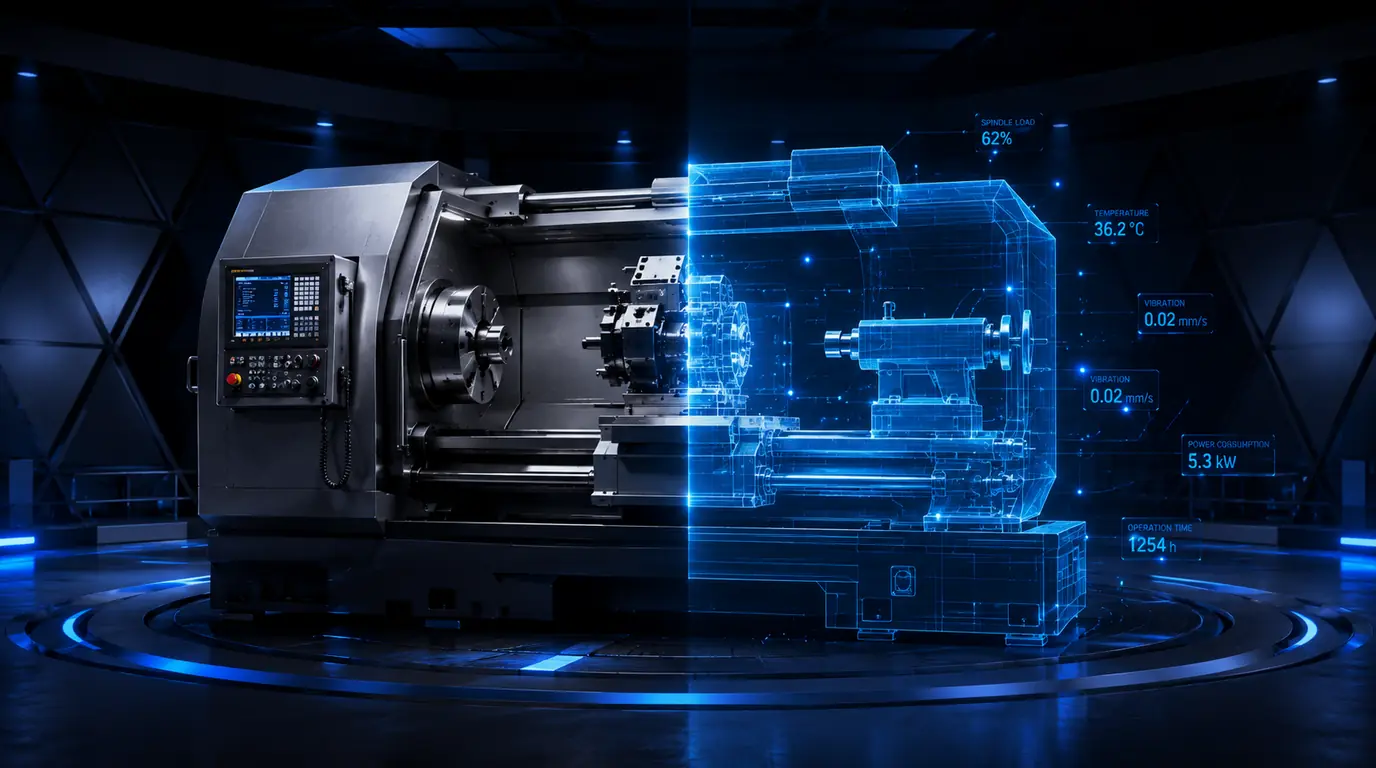
A rendered 3D animation is the most efficient tool for communicating a fixed product to a broad audience. It is also the most fragile when the product changes or the customer asks an off-script question.
Real costs in the current market (2025–2026)
3D animator rates in Spain range between €20 and €45 per hour, but the true cost of an industrial project is dominated by render time: each second of photorealistic animation requires between 30 and 90 minutes of rendering per frame at 24–30 fps. Realistic ranges for the European market are:
- Simple explainer (60–90 s, single configuration): €3,000–€8,000
- Mid-level industrial animation (2–3 min, internal mechanism cuts, photorealism): €10,000–€25,000
- Full process animation (4–6 min, plant-level): €25,000–€60,000
Common failures nobody budgets for
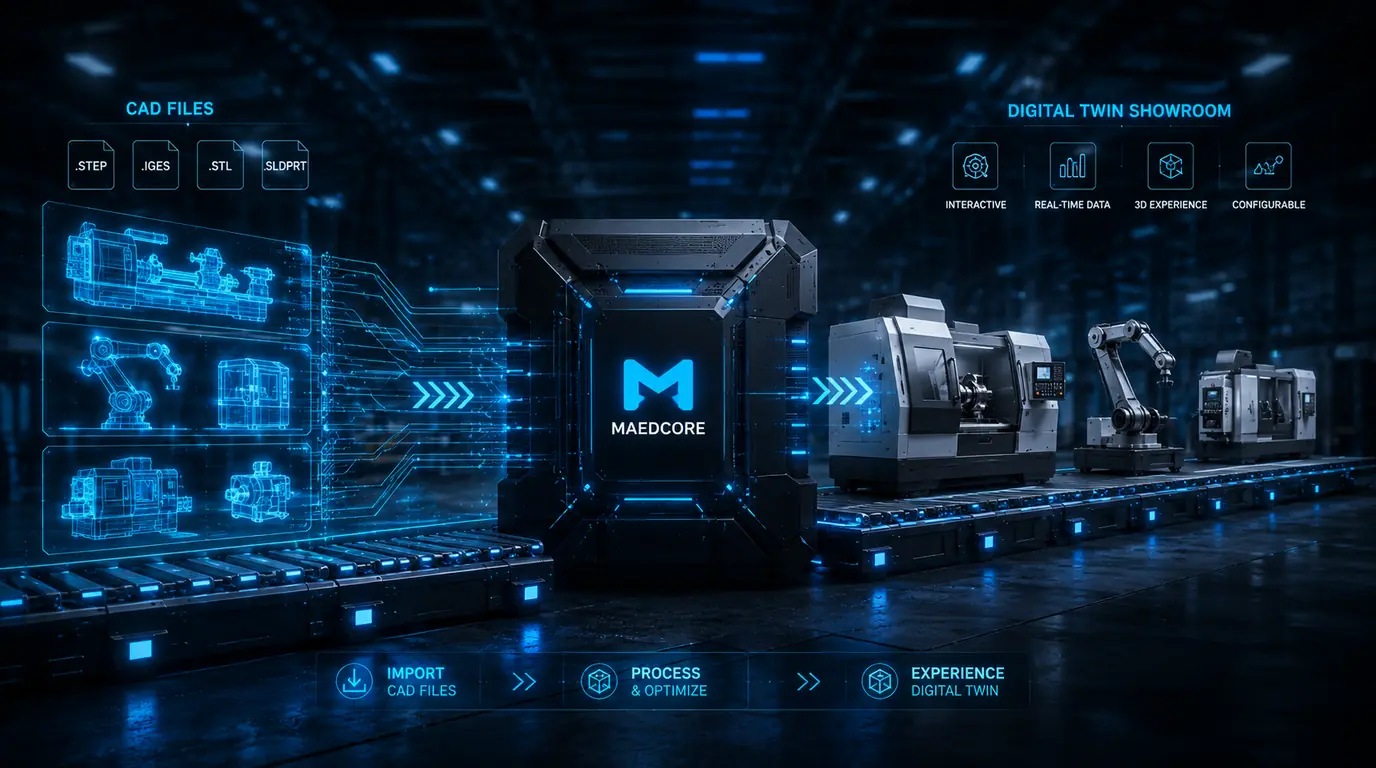
1. CAD file handover friction. Many manufacturers have legacy STEP/IGES files with missing components or proprietary assemblies. Budget 2–4 weeks just for file preparation before a single frame is rendered.
2. Revision spirals. Without a locked brief and a single named approver from day one, revision rounds multiply. Each additional round typically adds 10–20% to the budget.
3. The “one more configuration” problem. Re-rendering a photorealistic sequence costs 30–60% of the original cost of those frames. Asset reuse across projects is possible, but it requires negotiating file ownership before the contract is signed, not after.
4. Obsolescence from product updates. A rendered animation is a snapshot in time. For products with annual model revisions, this creates a recurring production cost that is rarely budgeted from the outset.
In a 3D animation project we built for a manufacturer in the rolling mill sector (documented in the twin-factory sales case study), animation was the right choice because the product was a fixed-configuration installation that needed to be presented to multiple buyers across different countries. The 3D assets were later reused for marketing materials, amortising the initial cost across several channels.
What an interactive VR environment can (and cannot) do
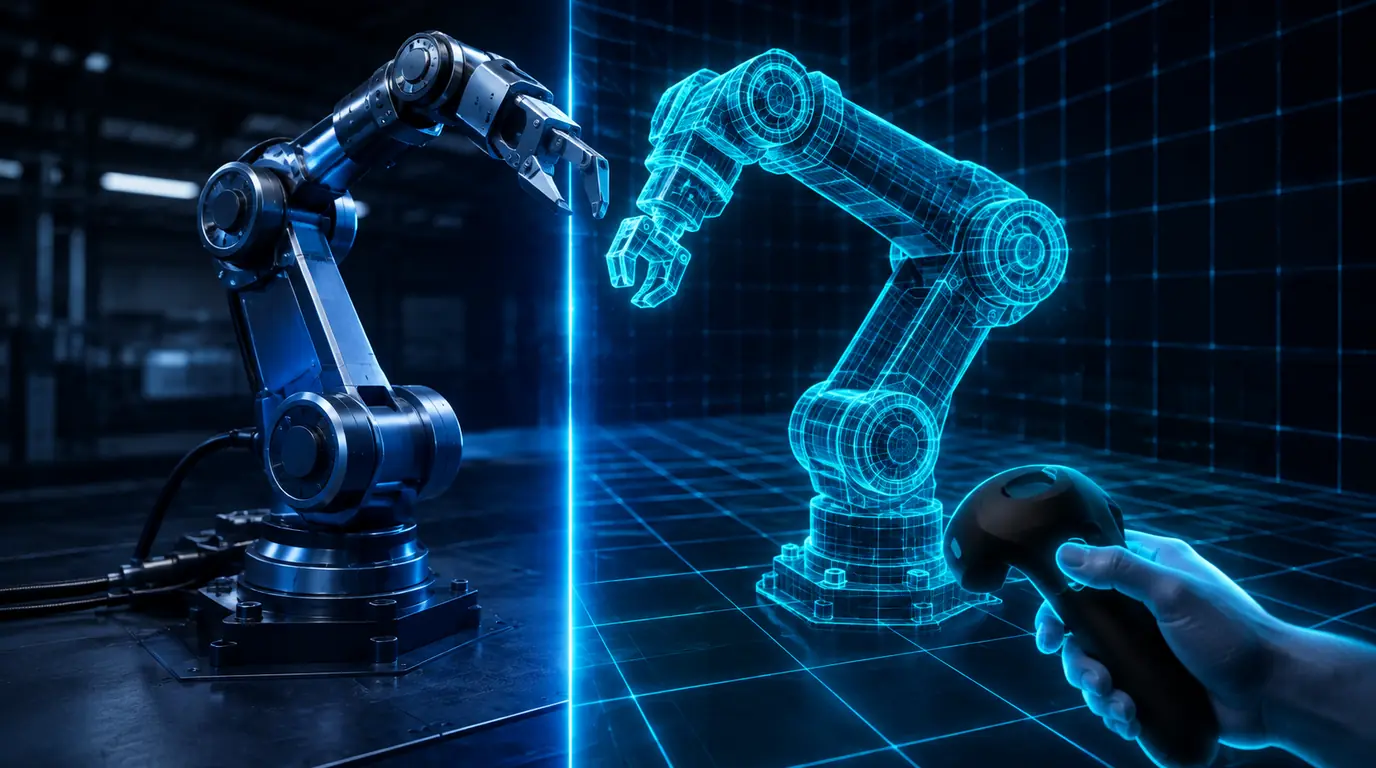
An interactive VR environment turns a sales presentation into a real-time technical conversation. Its cost is only justified when the product is configurable and the sales cycle is long.
When a committee member asks “can you show us the tool-change sequence on the 400 mm cell with the Type B enclosure option?”, an interactive VR environment answers on the spot. A rendered video cannot. Bosch uses augmented reality tools to show industrial customers how its equipment integrates into real environments, and the result has been fewer required in-person meetings and an accelerated sales cycle.
Real costs and timelines
Enterprise VR solutions for industrial use typically range from $40,000 to $155,000. For a focused sales configurator (not a full training simulation), the €35,000–€70,000 range is realistic for 3–5 configurable product variants. Timeline ranges from 6–8 weeks for simple applications to a full year for advanced experiences; for a well-scoped industrial configurator, 10–20 weeks is the realistic range. Annual maintenance can add 15–25% of the initial development cost.
One important caveat: the PwC study documents that VR-trained employees completed training 4× faster and felt 3.75× more emotionally connected to the content, but that study was conducted on leadership skills training, not industrial machinery operation. These figures are directionally useful, not directly transferable to technical sales demos.
Common failures nobody budgets for
1. Scope creep from “while we’re at it” thinking. Each new interaction module adds €5,000–€20,000. Lock the scope to the sales use case first; training modules are a Phase 2.
2. Underestimated LOD optimisation. Full-resolution CAD models cannot run in real-time VR. Expect 20–40% of development time to go on asset optimisation.
3. Motion sickness in the boardroom. Cybersickness affects 20–40% of first-time users. Mitigation: seated experience with a controller and a stable horizon; a “large-screen” no-headset mode as a fallback for executives who won’t put on hardware.
4. IT friction at the customer’s site. Some clients block external USB devices or require IT approval for any software installation. A WebXR-based deployment removes this barrier but reduces graphical fidelity.
5. No analytics without instrumentation. For sales demos, the critical data is: which configurations did the committee explore? Which features held attention longest? This data only exists if analytics are built in from the start.
Real costs head to head: the comparison table
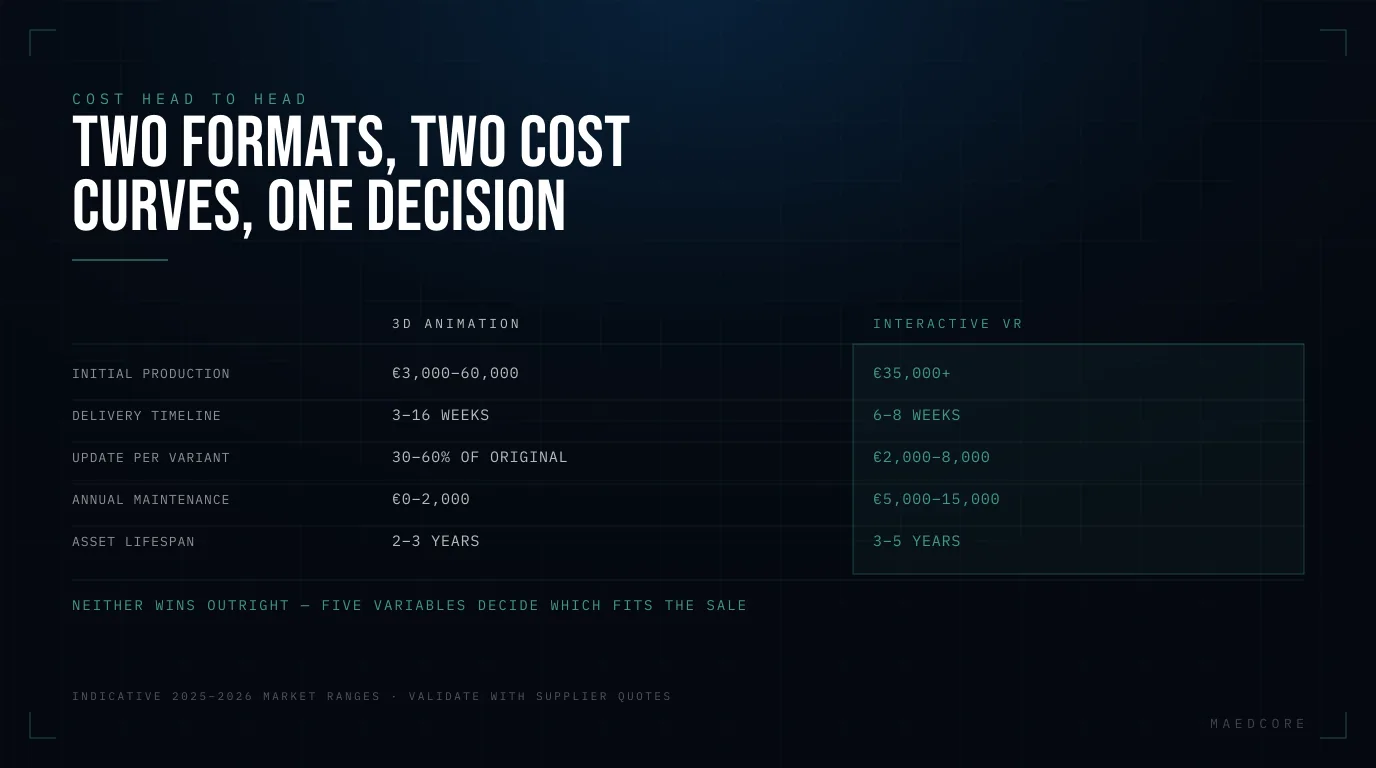
Compared across the same five operational dimensions, the two formats have almost opposite cost profiles.
| Dimension | 3D Animation (low range) | 3D Animation (high range) | Interactive VR (low range) | Interactive VR (high range) |
|---|---|---|---|---|
| Initial production cost | €3,000 | €60,000 | €35,000 | €155,000+ |
| Delivery timeline | 3–5 weeks | 10–16 weeks | 6–8 weeks | 9–12 months |
| Update cost per variant | 30–60% of original cost | 30–60% of original cost | €2,000–€8,000 per variant | €5,000–€20,000 per module |
| Annual maintenance | €0 (static asset) | €500–€2,000 | €5,000–€15,000 | €20,000–€40,000 |
| Estimated asset lifespan | 2–3 years | 2–3 years | 3–5 years (with updates) | 4–6 years |
Ranges synthesised from Theatlyx, DesignRush, Rendemy and Yeeply. VR ranges reflect sales/configurator projects, not full training simulations.
The figure that surprises most people is the update cost. A 3D animation has near-zero annual maintenance, but every new variant is new production. An interactive VR environment carries a real maintenance cost, but adding a product variant is a fraction of the cost of re-rendering a full sequence. For products with more than 3–4 active variants in the sales cycle, the economics flip.
The decision framework: five variables that determine the right format
This scoring system lets you make the format decision before committing budget.
| Decision variable | Score 1 → 3D Animation | Score 2 → Evaluate both | Score 3 → Interactive VR |
|---|---|---|---|
| Product configurability | Single SKU, no variants | 2–5 standard configurations | Highly configurable / bespoke per customer |
| Sales cycle length | <30 days, transactional | 1–6 months | >6 months, multi-stakeholder committee |
| Audience size per demo | Mass (trade show, web, >100 viewers) | Small group, known individuals | Committee of 3–15 people, live questions expected |
| Content update frequency | Stable product >2 years | Annual model revision | Frequent specification changes |
| Available budget and timeline | <€5,000 / <3 weeks | €5,000–€25,000 / 4–8 weeks | €25,000–€150,000 / 3–6 months acceptable |
Scoring logic:
- Total 5–8 → 3D animation is the right tool.
- Total 9–11 → Hybrid: commission an animation and a lightweight interactive layer.
- Total 12–15 → Interactive VR earns its investment.
Worked example: robotic welding cell in front of a procurement committee
Scenario: A welding automation manufacturer presents a bespoke robotic cell to a 10-person committee at a Tier-1 automotive supplier. The system has 4 torch configurations, 3 cell sizes and 2 safety enclosure options. The sales cycle is 9 months. The committee expects live technical questions about the torch-change mechanism.
| Variable | Score | Reasoning |
|---|---|---|
| Product configurability | 3 | 4 × 3 × 2 = 24 possible combinations |
| Sales cycle length | 3 | 9 months, multiple stakeholder reviews |
| Audience size per demo | 3 | 10-person committee, live questions |
| Content update frequency | 2 | Annual model revision anticipated |
| Budget and timeline | 2 | €25,000–€80,000 range acceptable |
| Total | 13 | → Interactive VR |
Why animation fails here: When the procurement engineer asks “show me the torch-change sequence on the 400 mm cell with the Type B enclosure”, the rendered video cannot respond. The sales rep has two options: “we’ll send you a render” (delay, lost momentum) or improvise verbally (risk of technical error). Neither is acceptable in a €500,000 sale.
Why VR earns its investment here: The €40,000–€80,000 development cost is amortised across every demo of every configuration combination throughout the 9-month cycle, and in future cycles, where updates cost a fraction of a full re-production.
Explicit assumptions: the development range assumes a sales configurator with 3–5 variants, no training module, and basic session analytics. The 10–20 week timeline assumes CAD files available in a parametric format and a single technical approval point.
The hybrid path: often the right answer
The most efficient approach is frequently: a 90-second animation for top-of-funnel use (website, LinkedIn, trade shows) and an interactive VR configurator for the final 2–3 committee presentations. The 3D assets produced for the animation can be reused in the VR build, reducing total cost by 20–35% compared with building both from scratch (engineering judgment). This reuse requires negotiating 3D file ownership with the studio before signing, not after.
Frequently Asked Questions
How much does an industrial 3D animation cost?
When does interactive VR justify its cost over a 3D animation for presenting industrial machinery?
Can 3D model assets from an animation be reused in a later VR project?
What ROI data exists for VR in industrial sales, as opposed to training?
Do I need VR headsets for a demo in front of an industrial procurement committee?
How long does it take to develop a VR configurator for industrial sales?
Related reading
- Immersive Technologies for Industrial Manufacturers: the honest ROI picture, including the 375-learner cost-parity threshold.
- Industrial VR in Practice: four use cases with the metrics companies actually recorded.
- Industry 4.0 and Virtual Reality: the three use cases that clear the ROI bar, and the ones that don’t.
- Industrial Product Configurator: taking the pre-sales engineer off the critical path of every quote.
- VR Training vs. Traditional Training: the training-specific ROI comparison against classroom instruction.
- Virtual Reality in Industry: the overview of use cases, benefits and the technologies underneath.
- VR Showroom for Industrial Machinery Sales: the sales-side application, showing the machine without shipping it.
- 3D Industrial Animation: Twin-Factory Sales Case Study — Maedcore
- Maedcore — Immersive Experiences — what we build in this area.
Sources
- Gartner — “Gartner Sales Survey Finds 67% of B2B Buyers Prefer a Rep-Free Experience” — Gartner, March 2026
- Gartner — “Gartner Says By 2030 that 75% of B2B Buyers Will Prefer Sales Experiences that Prioritize Human Interaction Over AI” — Gartner, August 2025
- Gartner — “The B2B Buying Journey” — Gartner, 2026
- Maedcore — “VR Showroom para Maquinaria Industrial en España” — Maedcore, July 2026
- Maedcore — “Animación 3D Industrial: Venta de Fábricas Gemelas con Maedcore” — Maedcore
- PwC UK — “The Effectiveness of VR Soft Skills Training in the Enterprise” — PwC UK, 2020
- Theatlyx — “VR Development Cost in 2026” — Theatlyx, February 2026
- DesignRush — “VR Development Cost in 2026” — DesignRush, 2026
- Rendemy — “Cuánto cuesta una animación 3D de producto en 2026” — Rendemy, May 2026
- Yeeply — “¿Cuánto cobra un animador 3D en España?” — Yeeply, September 2025
- CustomerTimes — “Enterprise VR Training & Industrial Metaverse: 2025 Innovation Matrix” — CustomerTimes, June 2025
- Inprofit — “Las 9 tendencias en ventas digitales B2B para 2025” — Inprofit, November 2024
- Yord Studio — “VR Training in 2025: Benefits, Best Practices & Industry Use Cases” — Yord Studio, September 2025
- Appello Software — “The True Cost of Building a VR App” — Appello, March 2025
About the Author
Robotics Engineer
For over a decade, I have been driven by a single mission: leveraging AI and robotics to build a world of automated production. I believe that by creating self-sufficient systems, we can empower people to refocus on what truly matters—their families and their passions. My expertise spans from winning prestigious European startup competitions to architecting complex, integrated hardware and software projects. I specialize in bridging the gap between today's industrial challenges and tomorrow's autonomous solutions.
Ready to transform your company?
Book a free 30-minute meeting with an engineer.