Industry 4.0 and Virtual Reality: The Three Industrial Use Cases That Actually Deliver ROI
Most industrial VR pilots fail because they pick the wrong problem. Learn which three use cases deliver measurable ROI and how to apply a 15-minute

Written by Eduardo Fuentevilla Blanco
Robotics Engineer at Maedcore · Robotics Engineer LinkedIn ↗
Key Takeaways
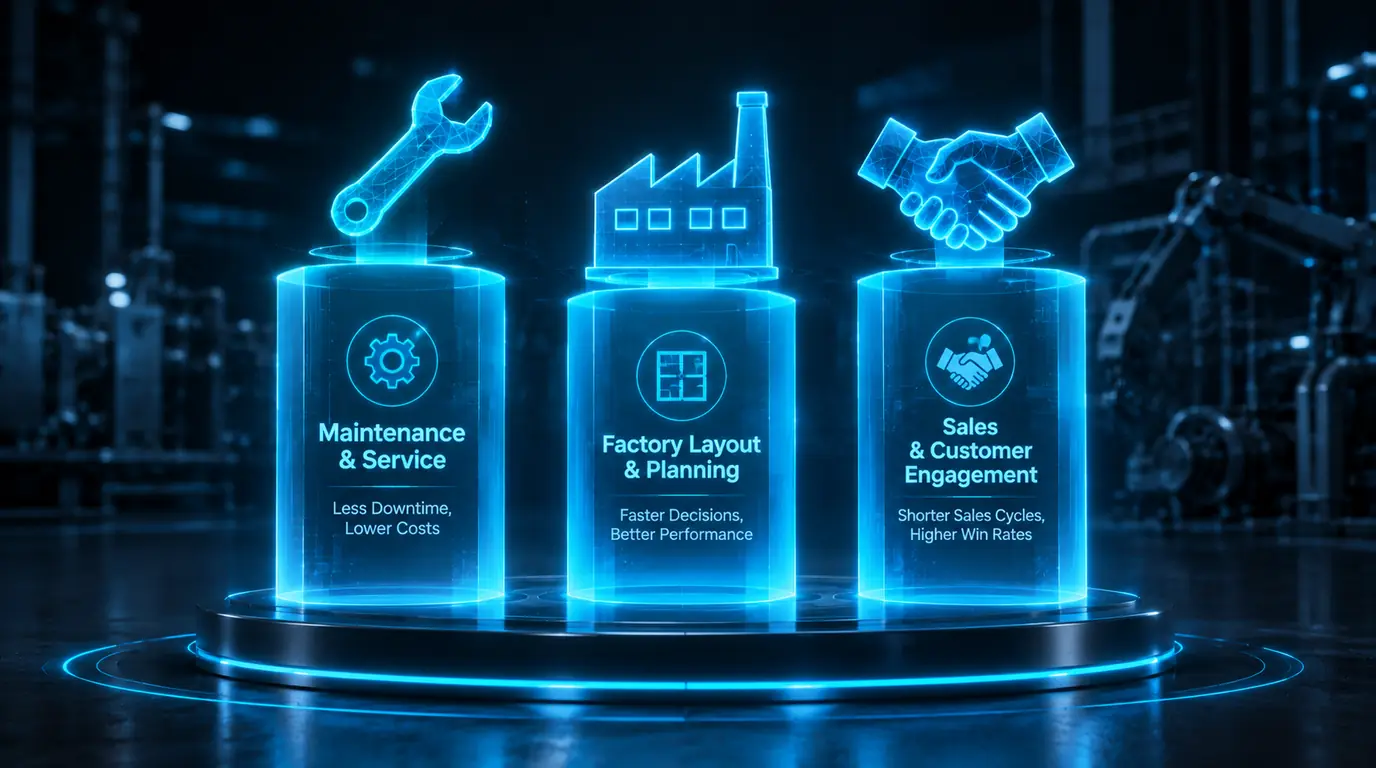
- ► VR ROI in industry concentrates in three use cases: spatial sales configuration, high-risk procedural training, and remote 3D asset review. Outside these three, the cost is rarely justified.
- ► VR training reaches cost parity with in-person methods at 375 trainees (PwC); at 80 operators in a single plant payback is ~3 years, but drops to under 12 months with 250 trainees across multiple facilities.
- ► A Cross-Reality system with AI defect detection reduced inspection error rate from 20.19% to 2.88% in a controlled peer-reviewed trial (Taylor & Francis, 2025), the strongest available evidence for this use case.
- ► The realistic planning range for VR training error reduction is 30–50%; the 71% figure (MDPI, 2026) is specific to high-precision cobot assembly and should not be applied to other manufacturing contexts.
- ► The most common pilot failure has little to do with technology: it is the absence of a measurable baseline metric before deployment, making ROI impossible to demonstrate within the first quarterly review cycle.
Virtual reality delivers measurable ROI in industrial settings, but only within three specific problem families: spatial sales configuration, high-risk procedural training, and remote 3D asset review. Outside those three, it is an innovation expense without a return. The global VR market is projected to reach USD 38 billion by 2029, but market volume says nothing about whether your plant should invest. This article dissects all three use cases with real metrics, their conditions of applicability, and a decision framework you can apply in 15 minutes.
Most Industrial VR Pilots Fail — and Technology Is Not the Reason
Most companies simply choose the wrong problem for their first pilot.
RAUM Enterprise VR documents three recurring failure vectors in corporate deployments as of 2026: the executive champion changes role, IT blocks the rollout over security requirements, or the project cannot demonstrate ROI within a quarterly review cycle and loses funding. The pattern is structurally identical to GenAI projects: more than 50% are abandoned after the proof-of-concept stage, according to Gartner 2026.
According to the DESI 2024 data analysed in a peer-reviewed study on Spanish manufacturing, Spanish SMEs exceed the European average on basic digital intensity. Yet the same study and Springer research on Industry 4.0 transformation in Spanish manufacturing firms agree that Spain sits near the bottom of the rankings for advanced technology adoption (robotics, simulation, and immersive technologies), well behind Germany and the Nordic countries. That gap is precisely the space where VR makes sense as a next step.
Three Use Cases, Not Ten: Why Selection Matters More Than Technology
VR’s ROI in industrial B2B environments concentrates in three problem families. Everything else is a marginal case or is better solved with other tools.
The filter question is straightforward: does the problem require three-dimensional spatial understanding or procedural muscle memory under risk? If yes, VR can be justified. If the problem is information transfer, a well-produced video or an e-learning module solves it at a tenth of the cost.
A distinction almost no article makes explicit: a web-based 3D configurator is not the same as a headset VR experience. The business case, cost structure, and buyer journey are different. The three use cases below are the only ones where quantitative evidence is strong enough to build a business case in front of a leadership committee.
Use Case 1: The VR Configurator as a B2B Sales Tool
3D and VR configurators compress B2B sales cycles and reduce specification errors, but only when integrated with the actual sales workflow rather than built for the demo.
67% of B2B buyers prefer a purchasing experience without a sales rep involved, according to the Gartner 2025 sales survey, and 39% are willing to close deals above $500,000 through self-service channels. Nucleus Research estimates a 20–30% reduction in quoting errors with CPQ platforms that include 3D visualisation. DataIntelo reports sales cycle compression of 48–65% in B2B environments using visual configurators. This figure comes from a secondary research aggregator and should be treated as directional rather than definitive.
A web-based 3D configurator handles the majority of cases. The jump to headset VR is only justified when the product has a spatial component that cannot be communicated on a flat screen: a production line that must fit within the customer’s existing plant layout, a multi-million-euro capital asset that the buyer needs to “walk through”, or an installation where operational ergonomics matters in the purchase decision. In an industrial showroom project built with Omni Viewer, the sales team moved from sending static PDFs to guiding customers through live configurations in real time from any location.
Common failure modes: the configurator built for the demo without CPQ/ERP integration is the most frequent, since quotes still get re-entered manually and the efficiency gain disappears. The second is content maintenance: 3D models go out of date, and a buyer who spots a discrepancy loses confidence in the entire process.
Indicative costs: custom development between €25,000 and €150,000; SaaS platforms between €200 and €10,000 per month. Most teams start seeing measurable impact within 3–6 months.
Key metrics: sales cycle days; quote error rate (%); sales engineering hours per proposal.
Use Case 2: Operator Training in High-Risk Environments
VR training consistently reduces errors and time-to-competency in high-risk procedural tasks, but the economic break-even depends on trainee volume, not on technological sophistication.
The most rigorous study available is a peer-reviewed trial published in Applied Sciences (MDPI) in April 2026, evaluating the impact of VR training on collaborative cobot assembly. Participants trained with VR retained a mean 71% reduction in error rate after one month. The study itself notes that the between-group comparison did not reach statistical significance, which means this result should be treated as promising but not conclusive in isolation.
The realistic planning range is 30–50% reduction in time-to-competency, according to VR Vision Group citing research from GTI Energy and Oberon Technologies. The 75% figure that circulates in some articles corresponds to best-case scenarios in highly repetitive tasks, and it is not a mean applicable to a generic manufacturing environment. Shell reported a 30% reduction in safety training costs after implementing VR programmes. That figure is cited secondarily without access to the primary report, so treat it as an illustrative reference.
Common failure modes: training deployed without measuring baseline error rates or time-to-competency beforehand (without a baseline, ROI is unprovable); content not updated after process changes; network issues, since VR platforms require stable connections with latency below 50ms, and corporate VPNs can interfere with real-time spatial data streams.
Key metrics: weeks to full competency; error rate in the first 30 days; incident rate per 100,000 hours worked; training cost per person (€).
Use Case 3: Remote Inspection Review with 3D Support
Remote 3D asset review reduces inspection errors and eliminates expert travel. The choice between VR and AR is critical here, and most articles ignore it entirely.
The most robust study for this use case is a controlled peer-reviewed evaluation published in Human–Computer Interaction (Taylor & Francis, 2025), with 26 participants inspecting industrial products. A Cross-Reality system with AI-assisted defect detection reduced the error rate from 20.19% to 2.88%, a relative reduction of more than 85 percentage points. 88.5% of remote experts preferred the XR solution.
For this use case, the choice between VR (full occlusion of the real environment) and AR (direct vision with digital overlay) determines the outcome. A local inspector who cannot see the actual part while wearing a VR headset is less effective, not more. The most mature remote assistance platforms (TeamViewer Frontline, PTC Vuforia Chalk, Scope AR WorkLink) use AR for the on-site worker and allow the remote expert to review a 3D replica in parallel. The Taylor & Francis study itself documents current limitations: XR solutions are predominantly single-user oriented and lack effective integration between AI and human expertise.
Regulatory consideration: in regulated sectors (aerospace, pharmaceuticals), remote XR inspection may not be accepted as a substitute for physical presence. Verify with the relevant authority before deploying.
Key metrics: defect escape rate; inspection cycle time (hours); travel cost per inspection event (€).
Decision Framework: Three Filters to Know Whether Your Problem Needs VR
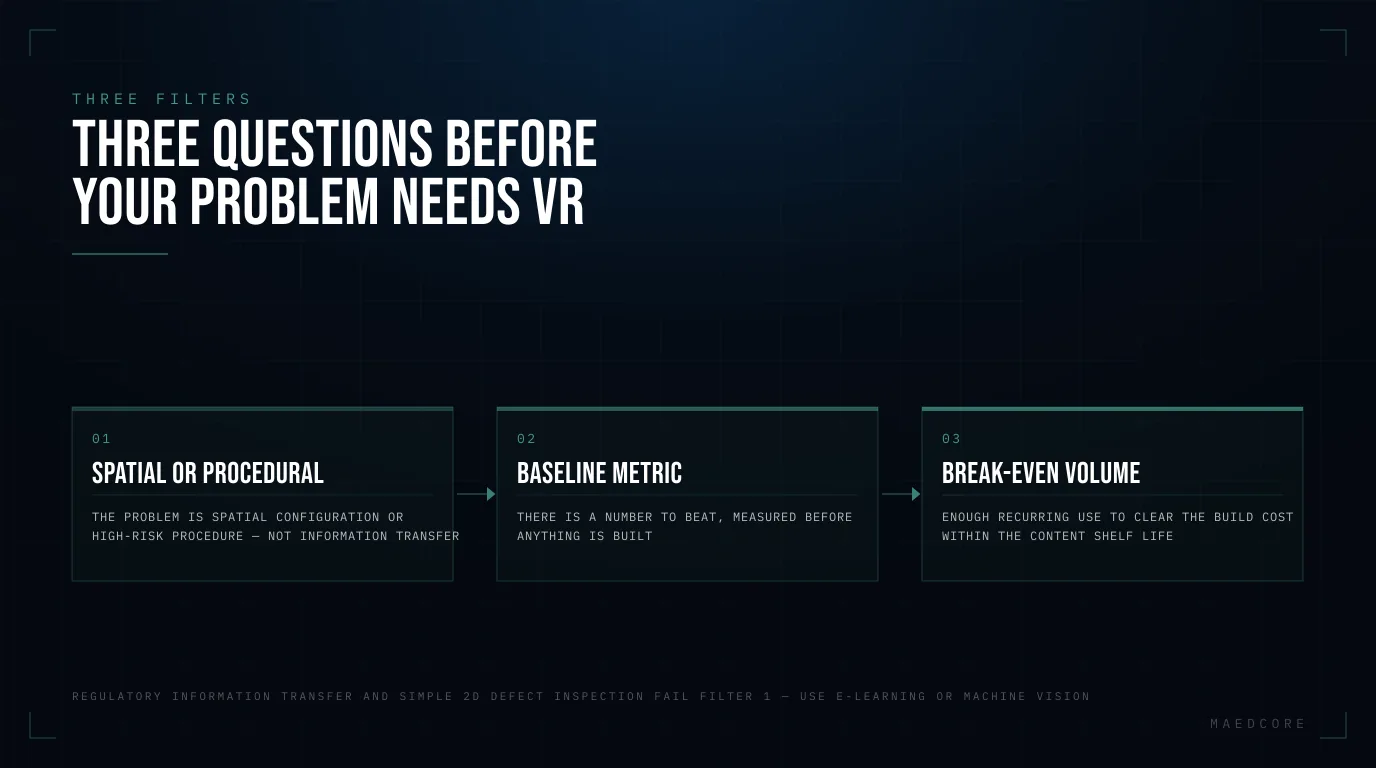
This is the tool no existing article provides: a three-step filter that starts from the problem rather than the technology, and that a plant manager can apply in 15 minutes.
Filter 1 — Is the Problem Spatial or Procedural?
| Problem type | VR justified? | More efficient alternative |
|---|---|---|
| Spatial configuration / plant layout | ✅ Yes | — |
| High-risk procedural training | ✅ Yes | — |
| Remote 3D asset review | ✅ Yes | — |
| Information transfer / regulatory compliance | ❌ No | E-learning, video |
| Soft skills / communication | ⚠️ Marginal | Role-play, video |
| Simple 2D defect inspection | ❌ No | Machine vision system |
Filter 2 — Do You Have a Baseline Metric to Beat?
If you cannot express the current cost of the problem in concrete numbers, VR cannot be justified in front of a leadership committee.
Sales configurator: quote cycle days; proposal error rate (%); average deal value (€); sales engineering hours per proposal.
Operator training: weeks to full competency; error rate in first 30 days; incident rate; training cost per person (€).
Inspection review: travel cost per inspection (€); defect escape rate (%); inspection cycle time (hours).
Filter 3 — Can You Reach the Break-Even Volume?
PwC research, aggregated by Takeaway Reality, establishes that VR training reaches cost parity with in-person methods at 375 trainees and is 52% more cost-effective at 3,000 trainees.
Translated into a realistic plant scenario:
Explicit assumptions: 80 operators, one plant, 15% annual turnover (12 new hires per year). VR content development cost: €35,000 (medium-complexity module, engineering estimate). Hardware: 5 × Meta Quest 3 Enterprise headsets × €800 = €4,000. Annual platform licence: €8,000. Total Year 1 cost: ~€47,000.
Current training cost per person: €800 (trainer travel + instructor time + estimated production loss). VR cost per person at 80 trainees: €47,000 / 80 = €587/person in Year 1; in Year 2 (licence + minor updates only, ~€12,000): €150/person.
Payback at 80 trainees: ~3 years. If the plant also trains operators across two additional facilities (250 total trainees in Year 1): VR cost per person drops to €188; saving per person vs. traditional method: €612. Payback: under 12 months.
This is why programme size matters more than technology choice. A company with 40 operators at a single plant probably should not prioritise VR for training. A company with multiple plants and significant turnover has a solid business case from year one. The same logic applies to the sales configurator: 20 proposals per year for €50,000 projects will rarely justify custom development; 200 proposals for €500,000 projects changes the calculation entirely.
Where the Sources Disagree — and What It Means for Your Decision
Training time reduction: 40% or 75%? The 40% (Gitnux, 2026) is a cross-industry, cross-task average. The 75% represents best-case scenarios in highly repetitive tasks. The plannable range is 30–50%. Use that interval in your business case and you will be both more conservative and more credible.
Error reduction: 40% or 71%? The 40% is a heterogeneous cross-sector average; the 71% from the MDPI study is specific to high-precision cobot assembly. Applying 71% to a packaging line is a methodological error.
ROI in 12–18 months vs. “300% in year one”: the 12–18 months refers to sales configurators (IGIVU, 2026). The 300% first-year ROI for training has no traceable primary source, so do not use it in an internal presentation.
Frequently Asked Questions
How much does an industrial VR project actually cost?
How many trainees do I need for VR training to be cost-effective?
What is the difference between a web-based 3D configurator and a headset VR experience for B2B sales?
Is VR regulatorily accepted for inspection in sectors like aerospace or pharmaceuticals?
How do I stop my VR pilot from stalling and never reaching production?
Related reading
- Immersive Technologies for Industrial Manufacturers: the honest ROI picture, including the 375-learner cost-parity threshold.
- Industrial VR in Practice: four use cases with the metrics companies actually recorded.
- 3D Animation vs. Interactive VR: which format fits which sales moment, with the cost difference laid out.
- Industrial Product Configurator: taking the pre-sales engineer off the critical path of every quote.
- VR Training vs. Traditional Training: the training-specific ROI comparison against classroom instruction.
- Virtual Reality in Industry: the overview of use cases, benefits and the technologies underneath.
- VR Showroom for Industrial Machinery Sales: the sales-side application, showing the machine without shipping it.
- Maedcore: Immersive Experiences, what we build in this area.
Sources
- MarketsandMarkets — Virtual Reality Market Report 2024–2029 — MarketsandMarkets, 2024.
- Applied Sciences (MDPI) — Evaluating the Impact of VR Training Strategies on HRI Cooperative Assembly Performance — MDPI / Applied Sciences, peer-reviewed, April 2026.
- Taylor & Francis — Augmented Remote Assistance for Quality Inspection: A Cross-Reality Collaborative System With Virtual Replicas — Human–Computer Interaction, peer-reviewed, 2025.
- Springer / Journal of the Knowledge Economy — Technological Collaboration and the Industry 4.0 Transformation: Evidence for Spanish Manufacturing Firms — Springer Nature, peer-reviewed, 2025.
- MDPI Sustainability — Exploring Industry 4.0 Technologies Implementation to Enhance Circularity in Spanish Manufacturing Enterprises — MDPI / Sustainability, peer-reviewed, 2025.
- RAUM — Enterprise VR in 2026: Headsets, Use Cases, Costs & How to Deploy at Scale — RAUM, 2026.
- IGIVU — 3D Product Configurator Guide: Web-Based vs. VR Experiences — IGIVU, 2026.
- SBFS — The Business Case for 3D Product Configurators — SBFS, 2026.
- DataIntelo — 3D Visual Product Configurator Software Market Research Report 2034 — DataIntelo, 2026.
- VR Vision Group — Measuring VR Training ROI for Energy & Utility Workforces — VR Vision Group, 2026.
- Takeaway Reality — VR Training and VR Education Statistics 2026 — Takeaway Reality, 2026.
About the Author
Robotics Engineer
For over a decade, I have been driven by a single mission: leveraging AI and robotics to build a world of automated production. I believe that by creating self-sufficient systems, we can empower people to refocus on what truly matters—their families and their passions. My expertise spans from winning prestigious European startup competitions to architecting complex, integrated hardware and software projects. I specialize in bridging the gap between today's industrial challenges and tomorrow's autonomous solutions.
Ready to transform your company?
Book a free 30-minute meeting with an engineer.